Author: writegill

Lecturer in English, Toulouse University II, IUT Figeac, France. Ph.D received suma cum laude: dissertation on William Faulkner. Served with distinction in the French Foreign Legion. Commissioned officer in the Punjab Regiment, active service in Kashmir Publications:two novels, three non-fiction books, doctoral dissertation. Active member, International Association of Thriller Writers. Contributing Editor for The Big Thrill, official webzine of The International Association of Thriller Writers. Interview in the December 16-31, 2008 issue of The Caravan, India. Five-page featured interview in the November 2010 issue of Media Vision, India: “correctly analysed … world trends ...” http://www.mediavoicemag.com/frontpage/3821.html. Writing Credits. Published Fiction. Both novels published by Bewrite Books listed in The Writers and Artists’ Yearbook. 1. Blood Money. GILL, Azam, Bewrite Books, UK, pbk., 316 pages, , 2002. ISBN-10: 1904224911. Len Deighton : “a first-class thriller with authentic backgrounds that take the action around the world”. http://original.antiwar.com/bock/2006/07/08/reality-based-recommendations/ Alan Bock — columnist and the senior writer for the editorial page of the Orange County Register — : “ … impart(s) an authentic flavor to the spy thriller genre. This is the kind of fiction that evokes a stronger sense of how the world really works than any number of the kind of history and foreign policy analysis books that are more often on my nightstand. Fun and informative.” http://www.absolutewrite.com/novels/blood_money.htm Deepa Kandaswamy freelance journalist and interviewer: “… fascinating book … Gill weaves a web of intrigue, mystery and suspense which surprises with its honesty, insider knowledge …, and the astonishing simplicity of operations … a true page turner … fantastic book, fact and fiction are so finely mixed.” 2. Flight to Pakistan. GILL, Azam, Bewrite Books, UK, pbk., 356 pages, 2002. ISBN-13: 978-1904492269. http://deepakandaswamy.blogspot.com/2007_09_16_archive.html#7163630436102176359 Deepa Kandaswamy freelance journalist and interviewer: “… a multilayered, multidimensional story of intrigue, first love, murder, caste, and honor that spans continents, race, and families. It is not often you get to read Asian fiction that does not use the Western stereotypes or the colonial setting of the East … irrespective of where you grew up, the story will move you. Extremely visual in style, I hope it would be made into a movie soon”. Published Non Fiction. 1. The Effect of Editing on ‘Flags in the Dust’ by William Faulkner. GILL Azam, doctoral dissertation received suma cum laude from Stendhal University, France. Published by University of Michigan Press, Ann Arbor, Michigan, USA, 1988. 2. Winds of Change: Geopolitics and the World Order. GILL, Azam, Writer’s Club Press, USA, pbk. 352 pages, 2001. 3. Jail Reforms. GILL, Azam, Peoples Publishing House, Lahore, Pakistan, pbk., 50 pages, 1978. Library of Congress Catalogue Card N° 78-930627. Nawa-e-Waqt, Pakistan’s leading Urdu Daily, 17 August 1978: “…the scholarly author not only enlightens his readers (by) solid and productive suggestions … that could produce far better results … the author’s resourcefulness, scholarship, clarity of thought … (for the) common reader … the writing is a reflection of the enlightened author’s love for humanity and his eloquent, colloquial writing style.” The Pakistan Times 03 March 1978: “…a sincere,, well meaning endeavour in a cruelly, disastrously mismanaged sector of social concern. … reforms …deserve serious consideration... well meaning endeavour….” 4. Army Reforms. GILL, Azam, Peoples Publishing House, Lahore, Pakistan, hardbound, 97 pages, 1979. Library of Congress Catalogue Card N° 79-930870.

The Kalash— Pakistan’s Dionysiac White Tribe.

Part I of II

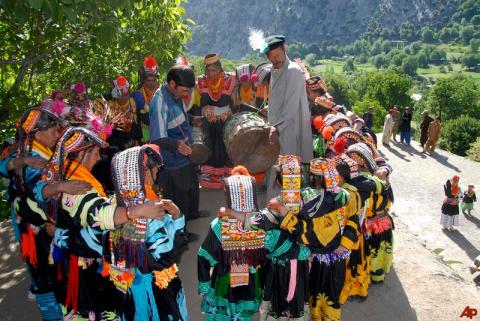
https://writegill.com/wp-content/uploads/2014/12/17a23-pakistan-kalash-festival-2010-5-19-7-18-55.jpg

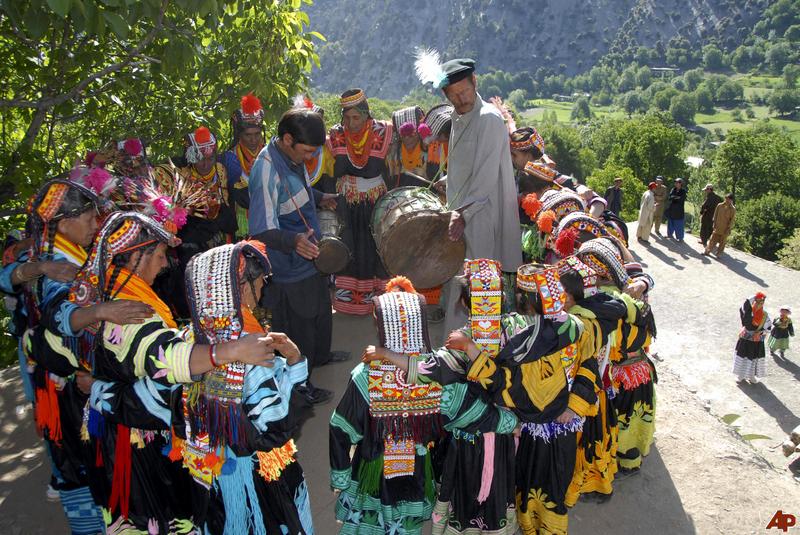
The Kalash are a fair skinned, often fair-haired and light eyed people nestled in three valleys in the heart of the soaring peaks of Pakistan’s Karakorams. They are considered unique by virtue of their belief system — a theological oddity in an Islamic fastness. In the 4th century when Alexander attempted to invade India, these Dardic people stretched from Jalalabad in Afghanistan to the Indus, an area roughly 68,000 kilometres. They are now confined to about a dozen villages in three valleys, with a total population of fewer than four thousand. By the 14th century, most of the Kalash had chosen Islam over polytheism, wine-making and other pagan traditions.

So the Kalash are not a ‘lost’ tribe but just the remnants of a people who chose Islam over their ancestral religion. Kalash, means those who wear the black robe. Their ancestry is embroiled in intersecting theories that boost fanciful personal agenda.

http://www.kingofmacedon.net/images/elephant.gif

The version that seems to have fixated the world’s fancy is that deserters from Alexander the Great’s army settled in the valleys and the Kalash are their progeny — or perhaps even Alexander’s himself,  although that would make them swarthy Macedonians, a tad disappointing. Rudyarad Kipling’s The Man Who Would be King further fed this childlike desire to solve a puzzle or find a treasure exclusive to the finder. For further reading you may consult Dan Brown’s bank account!

More on this in Part II, but whatever their ancestry, the Kalash are certainly an endangered minority.

http://www2.pictures.gi.zimbio.com/Kalash+Tribe+Celebrates+Spring+Remote+Mountain+5qeGsluBDGYl.jpg

As polytheists, their culture is distinguished by a pantheon of deities appeased through animal sacrifices. They grow and make their own wine which they consider sacred. Seasonal festivities are celebrated with wine, music and dancing. Free-striding, bare-faced Kalash women in their headdresses intricately woven with cowrie and crowned with multi-hued feathers are believed to be part-fairy. They choose their husbands if they so wish.

Shepherds and subsistence farmers by tradition, tourism and trade are nudging the Kalash into a cash-based economy. And they don’t really mind. Roads, cell phones, clinics and schools are bringing them out of their isolation. Yet, Kalash who have managed to integrate themselves into the Pakistani system without giving up their belief system are a rarity.

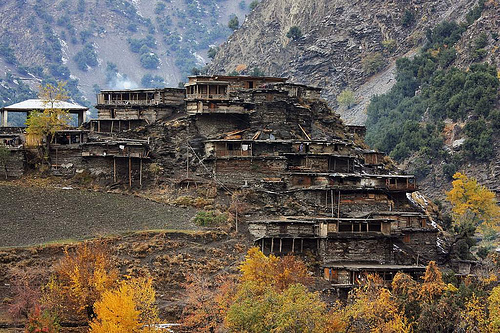
They are not, after all, a species to be preserved in a zoo. Breaking the vicious circle of poverty and ignorance through education and socio-economic mobility is probably a better guarantee against cultural encroachment than half-hearted legislation that is high on spin and low on application.

The Kalash’s descent from Alexander the Great is a romantic story that reels in tourists. Even though a DNA test failed to establish  a connection, the Greek Foreign Ministry’s Hellenic Association has been aiding the Kalash for quite some time on the basis that charity begins at home. The effort is laudable even if they got the wrong address like American commandos did in Yemen on November 25th.

But then, us homo sapiens are prone to believe what they choose.

Thinking of the Kalash as lost Greeks is an enjoyable thought that feeds upon itself.

Video – The Kalash People: https://www.youtube.com/watch?v=3_-1hXs8-3Q

 Wait for Part II: the origins of the Kalash

The American Dream and the Living Nightmare

writegill's avatarAzam Gill

According to the US State Department’s 2012 International Religious Freedom Report, “Christians were a leading target of societal discrimination, abuse, and violence in some parts of the world.” As an instrument of diplomacy, the State Department’s  choice of “some” over ‘many’ or ‘most’ is hardly surprising. And rightly so. Were it not for diplomacy, the world would be an even more violent demonic playground.

As such, from the downgraded semantics employed by professional diplomats and their staff, it is possible to gauge the real extent and intensity of persecution suffered by Christian minorities outside of Western democracies and some Latin American countries. The oppression of Christian minorities barely flits on the periphery of media interest.

Mainly, there is a general belief that all minority Christians are rice bowl converts — the residue of 19th century western colonialism. For the United States to use its power and influence for good…

View original post 628 more words

British Curry at the Crossroads— David Cameron at risk!

The Britsh Curry Oscar

http://britishcurryaward.co.uk/wp-content/uploads/2014/07/British-Curry-Award-2012-Jennie-Dipna-Enam-with-Minister-.jpg

The British have gone into a tailspin over the future of their curry quality which is now hovering over the United Kingdom’s immigration policy.

On December 1, 2014, David Cameron, whose government has further tightened visa restrictions on curry chefs from South Asia, addressed the gathering at the British Curry Awards, known as the Oscars of British Curry, by video: “I’m sorry I can’t be with you tonight,” Cameron said. “Not just because I’m missing out on the chicken tikka masala I hear you’ve got on the menu … .” He was, of course, referring to Britain’s national dish that superseded fish and chips several years ago.

He might actually — and most of his cabinet — be shortly complaining of a quality shortfall in British curry.

http://www.spicelounge.biz/wp-content/uploads/2012/07/Chicken-Tikka-Masala.jpg

A dearth of curry cooks has put curry houses at risk. Chefs have participated in ministerial level talks to ease the 2006 visa restrictions on curry chefs from outside the European Economic Area. The present government has suggested that British chefs be trained to cook curries.

If it were that simple!

Which doesn’t mean a curry is that complicated.

It means that most learners would have no background of eating artisanal curries, which is one way of describing home cooking. They’ll have to start from scratch while the South Asian learners will show a lead of fifteen to twenty years — of discernment, matured taste-buds, instinctive quality assessment, goal-setting and not technique.

So when a British born student starts cooking lessons in an institution, we’re looking at a trainee who was brought up on spotted dick, toad in the hole, roasts, pasties and pies. This solemn individual might not know how to cook, but has well-developed taste-buds screeching good and bad signals to the brain — except for the unfortunates brought up on twinkies.

The curry taste-buds of this earnest seeker of culinary oriental mysteries in a curry institute are a blank canvas waiting for curry powder, curry pastes and other shortcuts to be validated as the modernization of South Asian cuisine. The bewhiskered colonial majors who concocted and flogged their curry powders to a docile public would be delightedly chuckling in their well-kept graves in South Asia.

So take heed, Mr. Cameron. You are treading on thin ice (or curry?) here — one slip and you’ll be up to your ears in spicy mediocrity, your Richard James suit from Savile Row ruined forever.

https://encrypted-tbn2.gstatic.com/images?q=tbn:ANd9GcSTNNe4Chlx81ADhLJx5XGl-FSVtuFS5tfY0w87xDDNdRgr0yR6

You might be content with your bangers and mash, but what about your poor voters? Are they really going to be content with a pint of lager and chicken tikka masala that sucks? Somewhere down the line you owe yourself a re-election, and not playing cricket is unhealthy for the swing vote at the cost of temporary appeasement, the Munich of curry.

Columbus serendipitously reached America, following his Indian Dream of dominating the spice trade. That happened, and turmeric and cardamoms changed the world balance of power.

But the dream was hijacked by the George Washington gang’s dangle of the pursuit of happiness in front of migrant hopefuls to create the American Dream. The British seized the opportunity, acquired India, the Biggest Jewel in their Crown and owned the Indian Dream. Through curry houses, they still do.

And if you reduce their Indian Dream to mediocrity, they will have their say. So book a table at Veeraswamy’s on Regent Street. Savor your chicken tikka masala in opulence and have a think.

Bon appétit, Monsieur le Premier Ministre!

http://www.veeraswamy.com/media/778bc1d6-bac6-4437-a61e-e7acc9a14e4b/HomeSlideshow/home1_veeraswamy_jpg

Friedman Taking the Strategic Intelligence Model to Moscow

General Alexander Meigs Haig, Jr, US Cavalry, Distinguished Service Cross, Silver Star with oak leaf cluster and the Purple Heart, served as President Ronald Reagan’s  Secretary of State and Presidents Richard Nixon and Gerald Ford’s Chief of Staff. Reportedly, he disdained CIA briefs for being of less value than The New York Times. The chief merit of these intelligence briefs, he is said to have believed, was that they emanated from secret sources.

It is thus intelligent to excuse intelligence personnel  from being intelligentAzam Gill.

Taking the Strategic Intelligence Model to Moscow

“There are causes for conflict other than ideology. The United States has an interest in preventing the emergence of a new European hegemon. The Russians must maintain the buffers that sapped the strength of Napoleon and Hitler. Neither interest is frivolous, and it is difficult to imagine how both can be satisfied.

Strategic forecasting is that class of intelligence that is most alien to intelligence services: events that cannot be understood through sources … a form of intelligence best practiced outside of government and state intelligence services.

Excessive sophistication and excessive love of the secret will hide the strategic processes underway.”— George Friedman

Read the full Stratfor article by George Friedman: “<a href=”http://www.stratfor.com/weekly/taking-strategic-intelligence-model-moscow”>Taking the Strategic Intelligence Model to Moscow</a> is republished with permission of Stratfor.”

Something to Share: our enduring love story, by Peggy & Al Schlorholtz

” …  enduring, gripping, enriching …”

http://something-to-share.com/images/Something-to-Share-Cover5a.jpg

Something to Share by Peggy & Al Schlorholtz reveals a delightfully harmonious intersection of literary genres— love saga, autobiography, travelogue, adventure, multiculturalism — within a lifetime of loving service. Multilayered perceptions challenge stereotypes of meaning and raise the reader’s self-awareness.

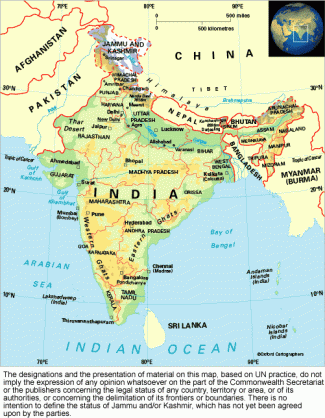
The love story started with a tenth grade Iowa beauty flinging an orange at Al Schlorholtz to grab his attention in the Study Hall. And grab it she did, till the ends of the earth, starting from rural Iowa to Princeton to Pakistan, India, Afghanistan and Nepal.

https://writegill.com/wp-content/uploads/2014/12/0ab52-e8038334-76d1-4572-8564-56078b79fad5_india2.gif

A love story of epic dimensions that goes beyond romance to include the exotic peoples of faraway lands.

http://umairghani.files.wordpress.com/2008/05/w6.jpg?w=450

The Schlorholtzes were clearly multicultural well before the advent of the term as it is generally understood these days. The sub-text of this remarkable work is in the mise en abyme tradition retrieved from heraldry by André Gide for the purposes of critical analysis. It leaves no doubt that despite himself, the author’s crystalline insight into a pivotal geostrategic environment is piercingly unique.

http://binaryapi.ap.org/91acac52b0444639b87b546fba9a9568/460x.jpg

For its penetrating understanding of South Asia, Something to Share should be compulsory reading for the blow-dried inductees into the US State Departmant’s Bureau of South and Central Asian Affairs, just as Mumtaz Shahnawaz’s The Heart Divided was avidly read by missionaries of the Schlorholtzes’ caliber. Perhaps that, but certainly the clarity of their Christian faith made it hard to believe that they were actually missionaries, as with love and without any fuss they served others.

http://c586412.r12.cf2.rackcdn.com/ByLoveServeOneAnother.jpg

For the discerning reader, the fact that a one-star general’s phone call was required to clear the Schlorholtzes household furniture going from Pakistan to India speaks volumes. That Pakistan had a Christian general is startling. The authors do not state the obvious, offering adventure after adventure to be retrieved by the reader in quest of the truth.

http://media-cache-ak0.pinimg.com/736x/27/71/5f/27715f1e39d35d1f1be8438b540a29de.jpg

That the authors state the facts and withhold their opinion is an example for the kind of contemporary journalism that appears to excel in opinion over fact!

And that is the skill with which the intersecting molecules of this remarkable narrative sustain each other.

The missionary professor and his wife’s life story is laudably free of religious clichés or evangelical rhetoric, while carrying veins of mineable secular abundance. The Christian message is implicit in acts of selfless devotion.


https://artenabler.files.wordpress.com/2010/07/fm_mak.jpeg;http://www.larousse.fr/encyclopedie/data/images/1004719-Zulfikar_Ali_Bhutto.jpg;http://www.thestar.com/content/dam/thestar/news/world/2013/08/26/zia_ulhaqs_legacy_in_pakistan_enduring_and_toxic/zia_ulhaq.jpg

The Schlorholtzes lived through Ayub Khan and Zia-ul-Haq’s dictatorships, survived two wars that included getting bombed and watching aerial dog-fights over their landscaped campus home known for its gracious hospitality. They survived Zulfikar Ali Bhutto’s socialism while their daughters studied at Radcliff with Benazir Bhutto whom they remember as ‘Pinky’!

Something to Share revives the forgotten tradition of the likes of Reverends James Gardner and John Williams,  Margaret Prentice, Adomain Judson, William Carey and John and Ida Scudder, who continued enriching lives by penning their unique experiences during retirement.

https://encrypted-tbn3.gstatic.com/images?q=tbn:ANd9GcRk5E2Ib0y7RCTwp_uW7XaNlZAX-X71o8keq3A-rI0DjavTIiku

La difference Schlorholtz is that the professor’s legendary wit pervades the manuscript in Balzacian brush-strokes.

http://cache1.asset-cache.net/xt/129953331.jpg?v=1&g=fs1%7C0%7CPDI%7C53%7C331&s=1

So do settle down with your tipple of choice in your favourite armchair and let Al & Peggy Schlorholtz work their magic on a cold winter’s day.

Lady Di’s Death Revealed Unchanged Passions: Part 6— The Unchanged Reality

https://encrypted-tbn1.gstatic.com/images?q=tbn:ANd9GcTmVabWaPHuqK9Lk3BPVjwFSV5s5IZ-nnzuTU_2_xRfygfiAtSY;

It is safe to state that among the British, there have always been two approaches to dealing with emotions. One is by stiffening the upper lip; the other is by letting the quavering of the heart affect it, and allowing the tears to roll down. The nature of an event, and how people relate to it, often decide the manner of expression at a particular time. That manner, within its time frame, does not imply the destruction and disappearance of the other way.

For the Falklands War, the British showed themselves a resolute, warlike people who could stiffen their upper lips. Even if they had to sail their troops on resurrected ocean liners, they would fight for what they believed in, a reaction very similar to their attitude during the Battle of Britain.

When Lady Diana died, they were mourning a celebrity they had adopted as one of their own. Granted, it was a period when self-examination and self-images were mutating, and Mr Blair’s reforms rode that tide.

Yet, although expressing grief freely meant that a new touchy-feely Britain was there to stay, it did not mean that selfishness, a fundamental trait of human nature, had been definitively replaced.

Pursuit or abandonment of self-interest does not influence the manner of grieving, but the degree of personal loss. It is possible to be selfless, but express no personal grief in public.

Hywel Williams is disappointed that the touchy feely change stopped at the expression of grief. Mr Williams may have hoped that it would mean a new era of welfare reform in Britain, instituted by pressure from a more sympathetic public. Yet, it is possible to be completely unsympathetic and selfish, but to mourn a personal loss. However, had Mr Blair taken the opportunity of initiating electoral reforms and entering the euro system in 1997, the touchy-feely Britain revealed in the mourning of Lady Diana’s death could have been credited with having created a real welfare state.

Awaiting that development, the open expression and acceptance  of quavering hearts firmly and finally places the imperatives of British working class culture over those of the governing class. Even Her Majesty’s accent, according to MacQuarie University, Australia’s researchers, has steadily been bending away from the constraints of Upper Received Pronunciation (URP) toward mainstream Received Pronunciation (RP) — with a whiff of Estuary since the research was published!

The End

Lady Di’s Death Revealed Unchanged Passions: Part 5— Sexual Repression & Satire

http://images.tcj.com/2011/06/Freud0001.jpg

Although the stiff upper lip was a response to adversity, it has been confused with the strait-laced sexual attitudes of. In itself, the stiff upper lip has also been a subject of rich satire. Sexual repression British society inspired John Cleese’s Monty Python and Fawlty Towers, and to some extent, Hanif Kureish’s Buddha of Suburbia.

P.G.Wodehouse, the master of prose so admired by writers as far apart as Kipling, Waugh and Rushdie, devastatingly satirised the British upper classes; one of his novels was even titled Stiff Upper Lip.

All the same, as social mobility in Britain made headway, the model for social comportment remained the aristocracy, and the stiff upper lip confused with sexual repression is a derivative of the original trait.

As such, the British are commonly described as reserved and conservative, an opinion belied by overcrowded pubs bursting with conversation. As another indication of touching and feeling, even television programmes such as Strictly Come Dancing have been analysed by The Guardian as a national obsession with a people not known for “visual and physical literacy”.

http://cdn.c.photoshelter.com/img-get/I0000M5aOw09nZAc/s/900/720/Sex-Sexism-Relationships-Cartoons-Punch-1989-12-08-27-2.jpg

It is significant that in the eighties and nineties Punch magazine, a British institution in restrained, understated humour and satire had to remain closed due to insufficient circulation. It was ironically revived by Mr Fayed, an Egyptian deemed unfit to buy Harrod’s and whose son Dodi, Lady Diana’s companion, died with her. The years in which Punch lay dormant, its rival, Private Eye, known for Benny Hill style humour, flourished!

The decline of Punch and the rise of Private Eye mirrors the weakening influence of upper class standards and a celebration of working class tastes.

Lady Di’s Death Revealed Unchanged Passions: Part 4— Tony, Champagne Charlie, Elton John, hugs & tears

ttp://www.google.fr/imgres?imgurl=http%3A%2F%2Ffc05.deviantart.net%2Ffs70%2Fi%2F2014%2F144%2Fb%2Ff%2Fgroup_hug_by_tiitra_tear_heart-d7jitlh.jpg&imgrefurl=http%3A%2F%2Ftiitra-tear-heart.deviantart.com%2Fart%2FGroup-Hug-

Mr Blair was able to successfully walk the space between word and act due to the clear signals emanating from the people’s expression of grief at Lady Diana’s untimely demise. The funeral was practically stage-managed by the government, and the hillocks of flowers in front of Buckingham palace combined with the hints dropped in Mr Blair’s speeches pressured the Queen into coming from Balmoral to Buckingham for the funeral. She was not even allowed to passively disapprove of Lady Diana’s manner of living and dying. There were open tears and passionate speeches during the funeral ceremonies, uniting the high and mighty with the lowly and humble. Complete strangers just hugged and wept, and Lady Diana’s brother, also known as “champagne Charlie” made an impassioned speech the contents of which clearly criticised the royal family.


http://www.curatedobject.us/.a/6a00e54f9f8f8c883401630359614b970d-pi;  https://writegill.com/wp-content/uploads/2014/11/badfb-elton_john_365905.jpg; http://blogs.law.harvard.edu/houghton/files/2012/06/ms-thr-858_000001.jpg; http://ghostneuquino.files.wordpress.com/2010/11/att00026.jpg

Elton John composed and sang Lady Diana’s eulogy, Candle in the Wind, (putting Marilyn Monroe at par with a Royal) the translation of which was carried on the front page of the prestigious French daily, Le Monde, while not a whisper of reserve escaped from the Royal household to question the appropriateness of Elton John’s sexual preference. There was disappointment from the public about the Royal Family’s dry-eyed stiff upper lip reaction to the tragedy, and the courtiers gave no press statements on the subject. When the public espied Camilla Parker Bowles, she was liberally assaulted with bread-rolls. All these were signs that the Britain of that day was no longer the Britain of preceding years.

http://www.victorianweb.org/images/medals.gif;

However, before Victoria became Queen-Empress of the British Empire, the British might not have been described as touchy-feely, but they certainly were not Victorian in the sense of the term we now use. Victorianism is not a fundamental cultural or genetic trait of the Anglo-Saxon peoples. The words bawdy and raunchy had never lost their relevance since the Shakespeare. The Elizabethan age was the times of Shakespeare and Marlowe, when what is sexual innuendo today was explicitly expressed on the stage, and moreover, appreciated. We may go further back to the times of the legendary Robin Hood and his Merry Men, when, despite the religious fervour inspired by the Crusades, merriment was a sought after virtue. The British were a rambunctious, hard-drinking lot of tavern brawlers who became successful pirates before being legitimised as corsairs. The tradition of merriment continued to be appreciated through low-brow soap operas and street artists, and has now been democratised in an increasingly heterogeneous society in television sit-coms such as Benny Hill, Fawlty Towers, Yes Prime Minister, The New Statesman, East Enders, Coronation Street and Goodness Gracious Me.

Lady Di’s Death Revealed Unchanged Passions: Part 3— Fear for Britain

Part 3— Fear for Britain.

http://www.google.fr/imgres?imgurl=http%3A%2F%2Fimage.guardian.co.uk

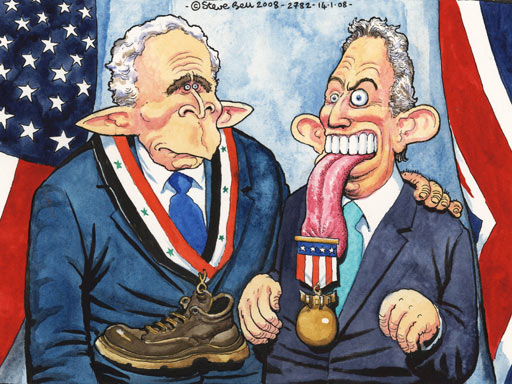
The death of functional conservatism within the British Tories led Dame Thatcher to give her blessings to Mr Blair, and shortly thereafter, Mr Blair made every effort to ensure that Dame Thatcher would not regret her decision. He shored up the special relationship with Washington, much to the United States’ advantage, as time has shown. Abandoning the traditional socialist approach, he merged the Self-Regulatory Organizations into the Security and Investments Board, lending it a structure similar to the United States Security and Exchanges Commission, and setting it up as a counter-weight to the Bank of England.

With the economic interdependence of the United States and Britain ensured, Dame Thatcher declared that “there was no fear for Britain under Blair”.

Taking a cue from the Chinese Prime Minister Deng Xiaoping, Mr Blair felt encouraged to launch his “four modernizations”, promising a flexible economy, a modern welfare state, constitutional reform and a role for Britain in the world. It was a tacit admission that Britain’s economy was rigid, its welfare state outdated, its unwritten constitution an anachronism, and that its grip on Uncle Sam’s coat tails was slipping.

http://static.guim.co.uk/sys-images/Guardian/Pix/pictures/2009/1/14/1231896919311/14.01.09-Steve-Bell-award-001.jpg

Mr Blair then put act to speech, and Britain certainly changed. There was less unemployment, and seen as a whole, the British economy was doing well, with corporations thriving. Britain took firm steps to shift from an industrial to a service economy, and the housing market was booming. The effect on the middle and upper classes has been positive, but on the lower middle class and the poor, devastating. There was no job security, and the closing down, or relocation of traditional industries left people dependent on temporary employment agencies. For many job seekers, service industry translated as outsourcing with further job losses.

The results of the modern welfare state are overcrowded hospitals, poor schooling, and overworked police faced with a choice of chasing armed juvenile delinquents or hardened, home-grown terrorists. Constitutional reform stopped short of actually producing a written constitution compatible with the charters of European Union member states, and had to content itself with devolution of legislative power to Wales and Scotland. Since the bombing campaign of Serbia in 1999, the daily telephone call between the U.S. president and the British Prime Minister was ritualised, if that may be considered a foreign policy achievement.

Lady Di’s Death Revealed Unchanged Passions: Part 2— Multi-cultural Britain

Part 2— Multi-cultural Britain

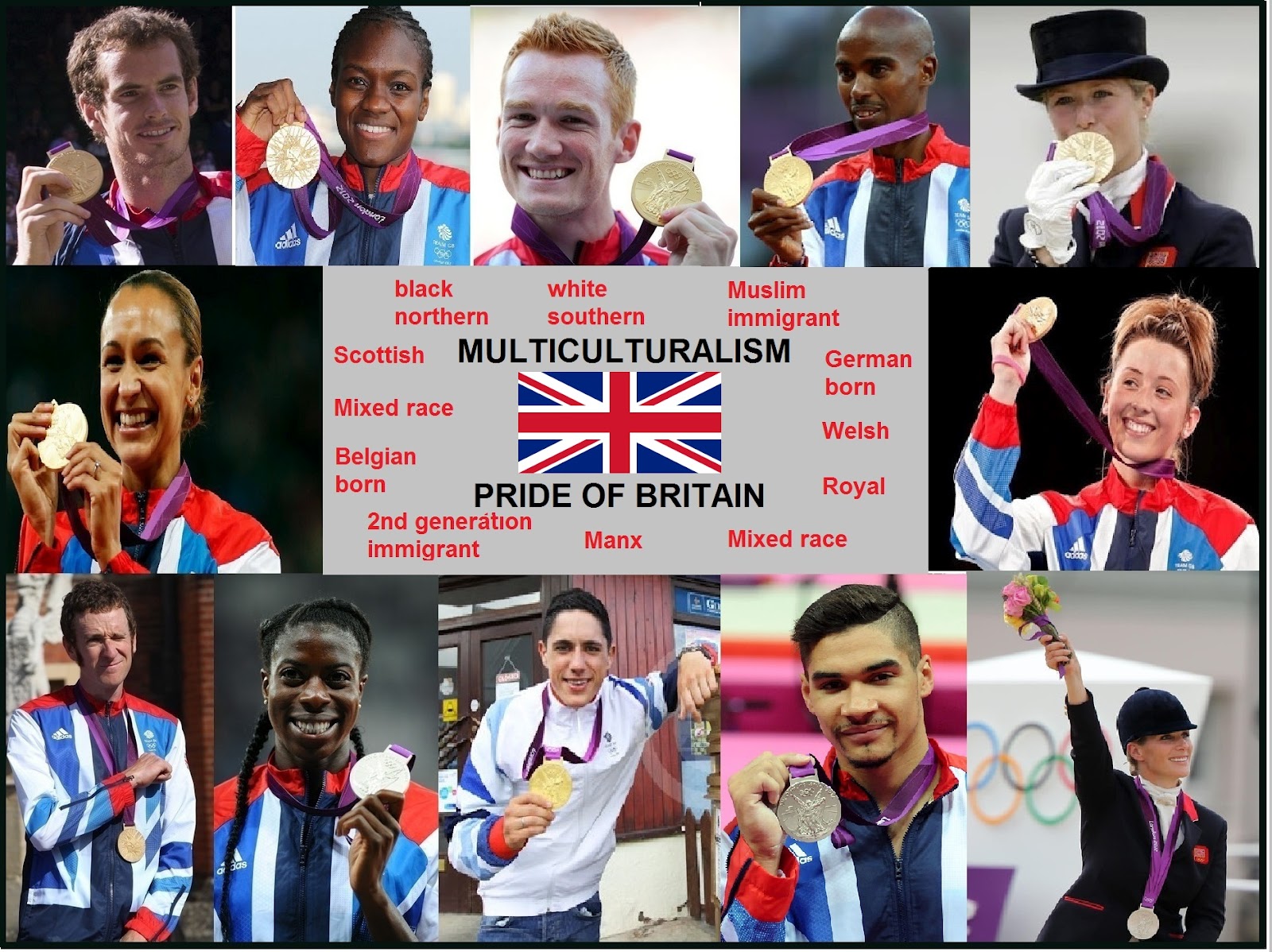
 http://blog.kevinmaxwell.co.uk/wp-content/uploads/2013/05/Olympic-multiculturalism-2.jpg

The attitude of the stiff upper lip came under unconscious revision during the hey-days of Lady Diana Spencer’s rule over the hearts, expectations and imaginations of the British public. The reaction to her tragic and untimely death in 1997 by the same public caused this change to be openly acknowledged by sociologists and the media.

Shortly before her death, Tony Blair, the Prime Minister of Britain, had led his Labour Party to a resounding victory and been nominated Prime Minister. Mr Blair’s campaign team had recognised the change in the British public, and revamped the labour Party as New Labour to respond efficiently to the expectations of a changed, socially mobile, heterogeneous and ethnically diverse Britain in which fish and chips as the national dish had been, in effect, replaced by Chicken Tikka Masala, a side effect of post-war immigration from South Asia.

The “quavering intuitions of the heart” were based on feeling and touching, and the British were said to have evolved into a touchy-feely people, a term that is now a standard way of describing this trait as opposed to the stiff upper lip.

Therefore no study of this change, and the degree to it which has endured, can succeed without taking into account the way the British public expressed their grief at Diana’s death, and what Tony Blair promised them.