Christian Warriors of Pakistan
Azam Mairaj’s three finely penned English articles and Urdu book Dharti Jaey Kyun Paraey (links below) are a timeless gift that position him as a selfless historian of Pakistan’s Christian community. Without provoking or whinging, Azam Mairaj brings into focus the input of Christian warriors to the Islamic Republic of Pakistan. He does this at a time when Christian minorities within Muslim lands are undergoing discrimination and persecution as a misconstrued extension of the West.
There are mindsets that presume a Christian counterpart to the transnational political Ummah, supposed to be a faith community, which has now assumed political dimensions that put Muslim minorities in a conflict of interest. The absence of a Christian Ummah and a fundamental belief in the separation of church and state, ensures the integrity of the national loyalties of Christian minorities.
Azam Mairaj’s writings on Christian contributions to the defense of Pakistan performs this unparalleled service of bridging a credibility gap between his community and the rest of the nation without making any but the most positive of waves. In the light to his creativeness and consequent experience, it is now time for him to start a foundation to finance a collective of writers to continue the remaining stages of his initiative.
The artist Zulfikar Bhutto might want to set aside his apparently Marxist-Leninist analyses of society, appreciate that communities in Pakistan are identified by their belief systems and come on board such a project. He and other mainstream intellectuals have this opportunity to go down in history as Ralph McGill, Virginia Foster Durr or Joel Elias Spingarn did for the American civil Rights Movement.
There are enough well-filled Pakistani pocket books to compete with the patronage extended by the White majority of the United States to its minority communities. The moral high ground on which Pakistan stands should be at the same altitude as that of the United States of America to freely brandish anti-American rhetoric!
Mahatama Gandhi said: “Freedom is not worth having if it does not include the freedom to make mistakes.” Accordingly, before quantitatively expanding the subject of minority participation in Pakistan’s defense and development, two dust devils need to be vacuumed.
The first one is about the inversely disproportionate number of Christian officers to Christian Other Ranks (OR s), Non Commissioned Officers (NCOs) and Junior Commissioned Officers (JCOs). The second dust devil is the swearing-in of Christian officers whereas Muslim officers only ‘solemnly affirm’.
Unless things have changed in the last three decades, the Pakistan Army had no provision for Christian applicants as combatant ORs. Their state of scholastic, medical and physical fitness notwithstanding, they were only employed as sanitary workers. Most of them were strapping lads from Christian villages representing martial castes deridingly amalgamated within the C-word reserved for the Christians of Pakistan. So, every regiment had its contingent of ‘Masihs’ as they were known and, occasionally, the odd Christian officer. But no combatant ORs, NCOs or JCOs, which is perhaps why only two of them are mentioned by Mr. Mairaj. And it is telling that the author has not been able to unearth any information about Lance Naik Yaqoob Masih from 21 Punjab. This is a subject of study worth a research grant.
Now to the second dust devil.
The stirring ritual of the Pakistan Military Academy Kakul’s Passing-Out Parade, commissioning officers of the Pakistan Army, is solemnized within the framework of military precision and pomp. Muslim Gentlemen Cadets (GCs) ‘… solemnly affirm …” their loyalty to their profession and nation to become commissioned officers.
Then the Adjutant raises his sword and orders Christian GCs to take one step forward, triggering a moving display of Silent Drill.
The GCs step out.
A splendid looking Havildar Major in full regalia including a curling moustache and crimson sash marches across the parade ground carrying a silver bound Holy Bible on a solid silver tray.
The exact second that he slams to attention in front of the GCs, their palms go over their Holy book and they start reciting the lines of the oath pronounced by the Adjutant, ‘I … swear by Almighty God …’.
The ceremony leaves no spectator or participant unmoved.
Yet, the Muslim GC only needs to affirm his fealty but the Christian has to swear by Almighty God.
The consequences of this difference were brutally brought to my attention by the Head Clerk of my Punjab Regiment battalion.
Prime Minister Bhutto had instituted a new oath in which we all had to promise not to take part in politics. So, I once again had to swear by Almighty God. Then I had to affirm my men, as Company commander and Adjutant. The men were lined up and waiting when a deeply embarrassed Head Clerk, who is also the unit’s legal advisor, hurried up. With great embarrassment and, unable to look me in the eye or actually say anything, he handed me the open section of the Manual of Pakistan Military Law (MPML) to read. It unequivocally stated that only an affirmed officer (and not a sworn officer) could administer the affirmation to junior ranks.
I was stunned.
I could lead my men to hell and back but not affirm them?
Another officer had to replace me.
The men looked sulky.
I was a popular and respected officer. The embarrassment of my troops’ and most of my brother officers took a while to settle down.
This, too, is a subject of study worthy of academic scrutiny.
The unifying consequences of Azam Mairaj’s initiative on inter-communal harmony cannot be underestimated in this time of communal alienation and strife.
Mahatama Gandhi’s contemporary, John Dewey, philosopher, psychologist, and educational reformer offers food for thought: “Failure is instructive. The person who really thinks learns quite as much from his failures as from his successes.”
http://nation.com.pk/national/06-Sep-2012/the-story-of-christian-martyrs
http://tribune.com.pk/story/483378/daniel-utarid-son-of-the-soil/
http://tribune.com.pk/story/462717/defender-of-pakistan/
Dacoit’s Honor: Noori Natt and Paul Jatt
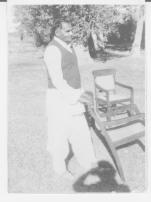
A. P. Gill
Noori Natt’s eyes crinkled as he stroked his flaring moustache. The floor to ceiling bars of his cell only seemed to enhance his legendary dash. He was enjoying the scene without feeling any discomfort at his situation.
On the manicured lawn of the Lahore, Qila Gujjar Singh police station, the little boy squealed with delight as his older brother picked him up and whirled him around while the girl clapped her hands and their young mother sat on a chair, smiling and knitting.
The old Police Stations in the Punjab are built around a hollow square entered through a gate protected by an armed sentry. Officers on duty sit in that block. The management offices face the entrance and the blocks on both sides connecting the entrance and offices are remand custody cells of which the inner wall looking out onto a lawn consists of steel bars. There is no interrogation room — buttock beating on the well-cut lawn surrounded by flower-beds serves that purpose.
Beret set languidly back on his head, constable Hector Lal Din strolled indolently along the verandah running in front of the cell bars. Bloody hawalatis, he thought as he sporadically stroked the bars with his six-foot long stave, while scratching his itchy crotch with the other. As he neared Noori’s cell, he smartened up. Noori, a man with a name on both sides of the India Pakistan border, was not be trifled with and could also be the source of a fat tip.
“Ohé Hectorah!” Noori’s said quietly.
Hector went up to the cell bars. “Jee Noori Jee?” he inquired respectively, ensconcing the renowned bandit’s name in respectful prefix and suffix.
“Who’re these kids?”
“A. P. Gill’s!”
“The magistrate who remanded me?”
Hector nodded.
“What’re they doing here?”
“Safe place for them to play!”
The little boy suddenly started running in the direction of the cell, his brother behind him.
He came up the steps to the verandah and then stopped, staring at Noori.
“Are you a dakoo?”
“Yes, a good one!”
“Daddy says it’s ok to talk to the good ones.”
“Hey, you little brat —” snarled the older boy, then stopped as Noori raised an authoritative hand.
“Don’t — your mother’s just behind you.”
The boy stopped.
The young mum in a shalwar kameez came up.
“Salam aleikum, Begum Sahib,” Noori respectfully greeted her.
“Wa aleikum as salam, Noor Sahib.”
He was taken aback by the woman’s courtesy.
“Do you know who I am, Begum Sahib?”
She nodded. “Yes, another human being with a family waiting for him. But you look well.”
“Begum Sahib, he’s very well looked after,” Hector added.
“I’m due to appear for my first hearing in Gill Sahib’s court tomorrow. I’m locked up on his responsibility,” he added, eyes twinkling.
“You know about my husband. He’s never been accused of an unjust decision, or favouritism. And he doesn’t take rishwat bribes.”
“That’s the worry, Bibi Jee!” he remarked with a twinkle in his eyes.
“Put it in God’s hands. Pray and I’ll pray for you.”
He noticed the cross around her neck and bowed his head. “May your Yesu Masih, our Hazrat Issa, bless us all, and Allah protect your beautiful children.”
Susan Gill walked away with her children and Noori’s mind went back fifteen years, just at the outbreak of the Second World War.
During the monsoon, in a dramatic dawn raid on a jeweller’s haveli mansion to the east of the river Chenab, Noori had decamped with five kilos of gold strapped to the saddle of his milk white steed. A police party led by Superintendent Nicky Nicholson and Sub Inspector Sant Singh Caleb Gill were hot on his heels. Pouring rain in a gale-force wind neither deterred them nor their horses, nostrils flared, snorting and foaming with effort and excitement. After half an hour’s unchecked gallop the police were unable to shorten the distance between themselves and Noori’s steed. The waves in the mighty Chenab seemed to reach up and touch the black sky drenching them to the bone. Without checking his steed, Noori plunged straight into the jaws of the mighty Chenab in spate.

Sant Singh Caleb Gill
Superintendent Nicky Nicholson, pulled in the reins of his galloping mount. The horse raised its forelegs and neighed in the classic stance of a checked gallop and so did the rest of the party. An expert, left-handed shot, Nicky drew his revolver and sighted on the back of the receding Noori. Sub-Inspector Gill, riding to his right, pulled the left rein of his stallion and dug his left heel in its side, careening into his superior officer’s mount, and spoiling his aim. The shot went wide and Gill prepared to resume chase. Before he could fully disengage from his last maneouvre, Nicky had seized the reins of his subordinate’s stallion.
Both men glared at each other.
“Let me get him, Sahib!”
“No. I won’t lose my best officer to the bloody Chenab for a dacoit.”
“But you’d shoot him in the back, Sahib? He’s a man among men and deserves as much!”
A millisecond’s face-off, then teeth shone through brown and white-tanned skin. Both officers exchanged nods, they wheeled their horses in an about-turn and dug their heels into their sides. The elite Punjab Police patrol galloped behind them amid the screams of their ancestral war cries.
The news of Sub Inspector Gill saving Noori’s life spread across the length and breadth of the Punjab. Shortly, Gill was tragically killed in the line of duty, but Noori was unable to pay his respects at his funeral. Noori’s arrest warrant, however, was submerged by the blood-letting madness of the 1947 Partition riots between Hindu / Sikhs and Muslims. Noori excelled himself by leading mounted parties to protect Muslim refugees fleeing Indian territory. And on the way in, he redeemed himself by taking Hindu / Sikh refugees into India. But he was unable to pay his respects at Gill’s funeral, and by the time Paartition settled it was too late and Gill’s younger brother was busy entrenching his magisterial reputation to replace his brother’s. It weighed heavily on Noori’s shoulders.
Noori shook his head. Hector had broken his reverie.
“There’s a message for you that was phoned into the office.”
The sudden lack of expression on Noor’s face told Hector how important the innocuous message was.
“All is well at home and elsewhere.”
“Thank you, Hector. You’ll be looked after.”
Hector bowed his head and strolled away.
Noori’s heart soared. At dawn, he would quietly walk out of his unlocked cell door and past the sentry, from where a Chevrolet Impala would take him to a private aircraft at Walton airport outside Lahore. He would be provided with two genuine passports in different names, foreign currency and a weapon. In a few hours he would be in Dubai. Then another thought hit his gut.
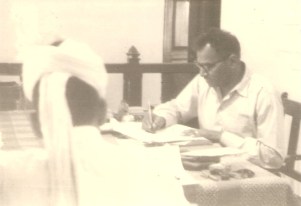
A. P. Gill holding court: the turbaned head is that of the court reader
Arthur Paul (A. P) Gill, section 30 magistrate, Lahore, was sub inspector Sant Singh Caleb Gill’s kid brother. Known in his family as Nikka’a, or kiddo, he had always wanted to be a magistrate and was fast-tracking his way to become a legend. Every morning he got in half an hour early to look over the day’s case files and today was no exception. Little did he realize, sitting on the dais, flipping the pages of Noori’s case file, that this day would be another personal and professional landmark. The fan whirred overhead and the morning was still fresh at that time.
“As Salaam aleikum, sahib bahadur!” a deep voice quietly greeted.
Nikka’a grunted without raising his head.
Footsteps neared the dais. Nikka’a finished the page, looked up and the world stood still. A. P. Gill suddenly felt being stared at, and looked up from The Pakistan Times. His blood ran cold, he silently started reciting the 23rd Psalm but maintained his composure. He looked straight into the eyes of the smiling, handsome face.
“Oi, Noori’a’a, what the hell are you doing here, without handcuffs, or a police escort!” he demanded, then smiled wryly. “You’re early!”
“So are you, Gill Sahib,” Noori replied, adjusting the two-horse chinese boskey silk kurta over his shalwar with one hand. The other hand held a smart leather briefcase. “But if I’m here, it’s not to hurt you, but to offer you a gift.”
“You insolent dog, I could take you apart with my bare hands,” Gill said flatly.
Noori inclined his head. “We who live apart from your society know you’re a hard man, Sahib-ji. Give me five minutes, then take me apart or call your police.”
Gill looked deep into Noori’s dark brown eyes, made a decision, glanced at his watch, and nodded.
Noori stepped forward, and put the briefcase on top of the railing that separated a magistrate’s dais from the public, clicked it open, then spun it around so Gill could see the contents.
Gill scowled at the contents.
“Check the revolver, Sahib-ji, and both passports.”
Gill removed the .38 Smith and Wesson revolver between two passports lying over packets of neatly stacked foreign currency, opened the cylinder, saw the shining brass of the cartridges, closed it, and offered it to Noori butt forward.
“Well?” Gill inquired, eyes glinting.
Noori pressed a lever, let the cartridges roll onto his other palm and put the revolver on the railing.
Gill grunted, and flicked open the passports, one British, the other Turkish. The picture in both documents was Noori’s, but not the names.
“Now please ring Walton Private Airport to confirm that a plane is waiting for Sheikh Azhar Zahoor’s private flight to Dubai.”
Nikka’ah put the phone back on its cradle and looked down at Noor.
“All right. What’s this tamasha all about?”
“Your brother spared my life. In return, I can’t steal your career — and it’s a brilliant one, Sahib jee! Had I said that I could escape at will in court later today, what would you have done?”
“Had you buttocks beaten to shreds!” Nikka’ah said with a grin. “So what are you hoping for?”
“Justice and mitigation.”
Gill nodded. “It will be done. Now fuck back to police custody before I change my mind and shoot you dead on the spot!”
Noori obeyed and Nikka’a kept his word.
Indo-Pakistan LOC Tikka Party
Source: Indo-Pakistan LOC Tikka Party
Indo-Pakistan LOC Tikka Party
Preamble. LOC Kashmir will offer autobiographical short fiction in one of the world’s most dangerous flashpoints, the 740 kilometer Line of Control dividing the Pakistani and Indian parts of Kashmir. Approximately 500,000 Indian and 300,000 Pakistani armed and battle-hardened troops face each other across their gun-sights. Both sides indulge in infiltration and aggressive patrolling. Exchanges of fire occur with regular frequency. This is where and how I spent my late teens, as a young officer in the wake of the 1971 Indo-Pakistan War, before having to enlist in the French Foreign Legion. I wish to see peace in beautiful Kashmir during my lifetime, even though I am not very hopeful.

http://www.google.fr/imgresimgurl=http%3A%2F%2Fabuabdulsamadz.co
Jawan (private) Mansha, Punjab Regiment, Pakistan Army, sighted down the barrel of his MG 1A3 machine gun. Index finger outside the trigger guard: breathe in, breathe out, wait for Naik Sain’s order, then take up the slack of the first pull-off, block respiration and lemon-squeeze on the second pull-off to release 7.62mm rounds with a muzzle velocity of 2700 feet per second at 1300 cyclic rounds per minute.
He was in his forward earthen bunker in Chamb Sector, on the Kashmir Line of Control, 170 km southeast of Islamabad, ensuring the tenuous possession of the sylvan enclave divided by a sparkling tributary of the River Tawi. His battalion was deployed on a thousand metre frontage, two rifle companies up. The Indian Army was deployed opposite, at about two hundred meters.
Hereditary professional warriors facing each other, living rough, fingers on trigger guards, mindsets focused on killing and dying.
The bunker was cool in the April heat, especially due to the thick branches of the lop-sided ta’ali hardwood tree with roots and trunk in Pakistan but branches in India. Shelves cut from the earthen walls held mess tins, enamel mugs and webbing, all neatly laid out by size. Just like on parade. There was no running water, only a field toilet a hundred meters to the rear and certainly no personal phones. Mail once a week for those who could read.
“Ustad jee,” Mansha whispered calmly, using the customary form of address of ‘teacher’ for a Naik. “Five green uniforms entering my killing zone.”
Naik Sain put his tea mug on the ground, confirmed through his binoculars and wound the lever of the field telephone.
The battalion Adjutant, Captain Eric Peter, was enjoying his midmorning tea and samosas in one of the bombed-out rooms of Chamb Police Sation that served as the battalion headquarters. He was going over the morning’s SITREPS — situation reports submitted by spotters in observation towers along the LOC.
The field telephone rattled.
“Peter!” he barked into the mouthpiece, then listened attentively. Known for quick, bold decisions, he took one now.
“Well done, Ustad Sain. If they start trying to cut the branches, give them a verbal warning. If they ignore it or insult you, fire a five-round warning burst over their heads. I’ll put the battalion on stand-to and inform the Colonel Sahib and Brigade Headquarters … yes, if they return fire, waste them!”
Very quietly and without any fuss, the Pakistani Punjab Regiment battalion went through its stand-to drills. Every man and his weapon double checked, locked and loaded, ammunition belts in the feeding trays of MG 1A3s, razor sharp bayonets ready, last prayers.
Before sending out the wood-cutting party, Captain Diljeet Hooda, a Haryanvi Jat, Adjutant of the Indian Punjab Regiment battalion had put his unit on stand-to.
Now both sides waited in the nerve-jangling silence only experienced by active warriors.
The five soldiers of the Indian Punjab Regiment fanned out at the last line of trees, standing loosely, barrels of their 7.62mm SLRs pointed obliquely skywards in the high port. Two of them had axes in their belts. Sarfaraz Ali, their three-striper Havildar, , held his Sterling 9mm Sten gun in his left hand. His right, palm downward, extended in the Pakistani Punjab Regiment’s direction.
As one man, the Indian Punjabis fluidly went into the lying-loading position, each behind a pre-selected boulder.
On the opposite side, Sain gave an appreciative nod.
The glade had become deadly.
Even the birds and crickets seemed to know that it was time to hold their peace, and the water in the stream seemed to have surreally stilled.
At Sarfaraz Ali’s quietly whispered command, Jawan Mela Ram and one-striper Lance Naik Joginder Singh got up, slung their SLR rifles on their shoulders, removed the axes from their belts and started walking towards the ta’ali tree branches whose trunk and roots were in Pakistan.
Mansha coolly lined them up in his sights and queried in a low voice, “Ustad Jee?”
“Not yet. Peter Sahib’s order — warning first, then five round brust over their heads. If they fire back, waste them.”
“And if we get wasted, Ustad Jee?”
“Then we go straight to paradise!”
“And if they’re Muslims too?”
“Then we all meet up there! Now shut up and concentrate.”
The string running out through the back of the bunker tautened and shook the empty tin can. Twice. Once to attract attention, the second time to tell them that Lance Naik Siddique, the third squad member and a crack shot, had spotted his Indian counterpart from his perch. Which meant that he, too, had been spotted.
Jawan Mela Ram and Lance Naik Joginder Singh were now right under the overhanging branches. They were at a range of 50metres from Mansha’s MG 1A3.
The glade was deathly quiet.
The Indian Punjabis drew the axes from their belts.
At that second the graveyard silence was ruptured by Sain’s commanding voice.
“That’s a Pakistani tree. Don’t touch it or we’ll open fire!”
The Indians stood stock still.
“The branches are Indian!” Havildar Sarfaraz Ali’s battle hardened voice countered. “We need them for firewood. Cut them!”
Mela Ram and Joginder Singh raised their axes.
“Five round brust FIRE!” Sain roared.
Mansha had already taken the first pull-off on the trigger. He now blocked his respiration and very gently lemon squeezed the sherni — lioness — as the MG 1A3 was known by its operators.
DTrrrrr!
Five rounds in a perfectly controlled burst ripped through the branches above the Indians.
Neither target showed naked fear, but it was there, controlled and present.
The marksmen in the trees didn’t open fire.
Then there was a single shot from the Indian side, and a thud behind the bunker, but no cry from Lance Naik Siddique.
“Fire!” almost simultaneously from Havildars Sain and Sarfaraz Ali.
Both parties opened up.
The fragile integrity of the sylvan glade disintegrated under the onslaught of 7.62mm rounds. Muzzle flashes, dust spirals, shouted curses in Pothohari Punjabi and Haryanvi. The sulphorous odor of cordite started creeping onto the glade’s freshness.
The first burst sliced through Jawans Mela Ram and Joginder Singh. Rounds went right through them and they fell, their gushing blood spilling on the arid earth. The remaining Indians were steadily firing back from behind their boulders, their 7.62 rounds thudding into the roof of the earthen bunker. One came straight through the shooting slit, and went cleanly through Mansha’s left shoulder. He grunted but held his aim, sweeping the barrel gently to cover the remaining three Indians. Out-gunned, the Indians withdrew in disciplined leapfrogging fire and move drills.
“Cease-fire!” and then Sain wound the field telephone again. Only after his report did he take the medical kit, bind Mansha’s flesh wound and go outside to check on Lance Naik Siddique, but it was too late.
Puffing his rosy cheeks with an explosive release of air, Brigadier General Shireen Yousafzai, Pakistan Army, put down the red phone of the hot-line with his Indian counterpart. His immediate staff of Brigade Major (BM) and General Staff Officer Grade III( GSO-III) looked expectant.
“Well, gentlemen, this is what’s going to happen.
“The Indians will come for their bodies and as always, we’ll return them under an honor guard — as they do too — wrapped in new blankets drenched in perfume. The bodies on both sides will be classed as border accidents ….”
“So that’s done,” Brigadier General Musarrat Hussein of the Indian Army was concluding to his BM and GSO-III.
“At 11H00, after we recover our bodies, the woodcutting parties of each side will move forward. They will work as one to cut the tree down, chop it up and burn it to the last twig. Lamb and chicken tikkas will be grilled on the embers, and we’ll all have lunch.”
The staff officers nodded their approval.
“Day after tomorrow is our our Diwali festival of lights, and two weeks later, the Muslim Eid festival. We’ll exchange sweets as we have been doing.”
Conflict Resolution in Pakistan
Interfaith dialogue has rarely, if ever, brightened up a neighborhood — it causes confusion instead of forging the requisite affiliations for conflict resolution. The representatives of each religion believe that their faith has a copyright on truth. To reinterpret and syncretize being heresy, interfaith dialogues flounder on this reef of exclusivity, surviving on toothless announcements of mutual admiration.
So these dialogues are neither about faith and nor among equals. One faith being temporally stronger than the others, it’s about concessions and handouts which means condescension and consequent resentment. Religious leaders play politicians pretending to resolve conflict while bargaining concessions and preparing tidy little press statements.
Since interfaith dialogues have done little to resolve inter-communal clashes, then maybe the existence of different faiths is not, in itself, a cause of conflict. Somewhere down the line pragmatic religious leaders hope that inter-faith dialogues grant them inter-communal leadership.
The logical alternative to pre-determined failure is an inter-communal dialogue. That too, is fraught with danger, especially in countries like Pakistan where communities are identified by their faith and not by their geographical location or ethnicity.
So communal identity needs to be tackled and faith left to its own dynamics. As such, leaders of different faith communities should just meet and commune regularly over gourmet meals of which all clergies are known to be connoisseurs. At these communions, religious discussions should be taboo, engendering secular relations which may then blossom into inter-communal friendships.
And since Pakistanis are no longer Mughal or British subjects, but citizens in their own right, they should not wait for the state to organize and finance the mughlai dishes, halvas and venues of such meetings. Local businesses, business associations, associations and foundations should organize a national competition of the best inter-communal meals and the best discussion results judged through public-access to the menus and minutes on the Internet.
In times of communal tension, it is these Maulanas, Padres, and Hindu, Parsee and Sikh priests who will be orchestrating peace on their mobile phones instead of gasping, overworked police officers.
Chief Justice Alvin Robert Cornelius was a stellar example of the attitude to inter-communal relations.
Cornelius Sahib was so beloved of devoted jurists that they would affectionately refer to his initials as Allah Rakha since he stood up to President Ayub Khan! His oft-quoted statement “I am a constitutional Muslim” was neither a declaration of faith, nor a desire to convert to Islam. As one of the world’s renowned constitutionalists, he had appreciated that Muslims, claiming Islam to be a culture in itself, had engineered the creation of Pakistan. As such, all Pakistani citizens, regardless of their faith, were constitutional Muslims. One may add that all citizens of Pakistan are also cultural Muslims.
On July 25, 2014, decades after ‘Allah Rakha’ Cornelius’ statement, Goa’s Deputy Chief Minister Francis D’Souza declared that “India is a Hindu country. It is Hindustan. All Indians in Hindustan are Hindus, including I — I am a Christian Hindu”, sparking a merry controversy that let him have his day on the front pages.
It is such acceptance by minority faith communities that allow their goodwill to be reciprocated by their neighbors. Eastern Christians suffer from the reputation of their western co-religionists. Western Christianity still bears the scars of the Crusades, the Inquisition and colonization in which Eastern Christians played no part.
Yet, the residual tarnish has hardened the lives of Christian minorities in the East.
At the end of the day, Christianity is an Eastern religion, the Gospels of which encourage fellowship parallel with internal, spiritual development. Temporally declaring oneself to be a cultural / constitutional Muslim or Hindu is not a cop-out — it only enhances faith.
Thus it is that by and large, across Pakistan, Christians and Muslims cohabit in peace without the assistance of inter-faith cowboys, happily communing at Eid and Christmas. The occasional tension erupts from jealousy and land disputes, although the recent massacres and church bombings are singularly distinct.
Justice A. R. Cornelius and Sri D’Souza’s exemplary attitudes accepting socio-political reality have not been duplicated by Indian or Pakistani communities in the West. They still expect largesse to be doted out by the state, a ryot mentality of subjects. To go and get it while standing tall is the prerogative of integrated citizens.
Mirriam Webster defines a citizen as “one entitled to the rights and privileges of a freeman.”
Freemen do not wait for the state to organize regular dinners for the leaders of faith communities to build relationships to preempt or resolve conflict.
As minorities, they do not wait for state patronization, but incite the state to extend it.
And they savour their neighbours’ reciprocal love through hugs, eidee, cakes, sheer khurmas, biryani, jhalfarezis, and namkeen goshts, adding lustre to their precincts and mohallas.
Ritually celebrating each other’s eids, Christmases, diwalis and baisakhis is a win-win situation.
The Term ‘Islamic’ Terrorism
On November 13, terrorists struck again in the world’s City of Lights. On December 2, it was San Barnardino, in California, USA. Then Yemen. Then London, the Lufthansa flight and where next?
While nations mourn, a well-rehearsed machinery emits enlightened warnings against an uncontrolled backlash, padded by reminders that the situation, being the pre-meditated creation of US-led imperialism, implicitly mitigates terrorist acts. President Obama has made a measured speech against any backlash against American Muslims, unusually broadcast from the Oval Office.
Yet, pictures of the victims with captions such as “While the world media is focused on Paris attack, atrocities continue in Palestine” gloat with impunity to imply that the victims of terrorism have received their just deserts.
And the semantic battle over the use of the signifier Islamic as an attribute renews its vigor.
To grasp the polemics enshrouding the signifier Islamic requires an understanding of the overlapping concepts of Sha’b and Ummah.
Sha’b refers to a nation with a common ancestry or geography, making Chinese, Pakistani or Saudi Muslims distinct entities subject to the constraints, privileges and obligations of their nation-states. No single state can share in the accomplishment or failings of another.
Ummah is a synonym for ummat al-Islamiyah, which means Islamic state as opposed to the nation state, or the transnational collectivity of Islamic peoples. Triumph, failure and tragedy are equally shared by individual and collective components. In practice, the concept of Ummah, enshrines the civilizational accomplishments of Muslim peoples and subordinates that of Sha’b, transiting from Muslim to Islamic.
Islamic being what pertains to Islam, Mirriam-Webster defines it as “the religious faith of Muslims including belief in Allah as the sole deity and in Muhammad as his prophet; the civilization erected upon Islamic faith.”
Thus, if it is commonly accepted that a great civilization inspired by the Islamic religion may be called ‘Islamic’, when it goes into decline, it does not become un-Islamic.
Islam is a noun for a belief system, and its followers are identified by the noun Muslim. When a person is referred to as a Muslim, the degree to which he is one, is irrelevant as it cannot be judged off-hand. The status of Muslim is immeasurable for non-Muslims and if a person declares he is Muslim, can only be challenged by competent Muslim authority. The signifier Islamic lends itself to measurement due to its liberal use by Muslims with reference to their past.
A person is only referred to as Islamic by the ignorant, unless it is “Islamic peoples”.
Islamic usually qualifies an event, situation, object or act. The acts may be flattering or prejudicial to Islam itself. Thus, there are Islamic conferences, Islamic prosperity, Islamic education, Islamic art or Islamic charity.
Among acts, the achievement of one Muslim nation is claimed by all.
Therefore Muslims and non-Muslims have conjointly referred to the Islamic conquest of Spain, as a continuum of Islamic for science, medicine, education, art and charity.
Thus, the Umayyads, who acquired Spanish real estate, hailed from Mecca were ethnic South Arabians and on the jus sanguinis principle, Saudis even though Saudi Arabia did not exist at that time. Going by jus soli, their seat of government being in Syria, it would be more appropriate to call it a Syrian conquest.
Although the term would exclude Muslims from Kabul to Kashgar, it would also secure them against charges of invasion and colonization in a democratic era of apologies. Whatever the case, Muslims themselves, especially during the decline of the power of Muslim states overtaken by the Enlightenment, have been compensating for their sunset by deflecting focus on bygone Islamic art, architecture, literature and medicine.
Muslims have been able to achieve this semantic and soft-power victory in tolerant western democracies evidenced in the Islamic art shows, galleries, centers etc., and volumes of cut and paste jobs by keen academics!
While mainstream, enlightened Muslims struggle to compensate for the failure of the Ottomans to provide Muslims with a renaissance, misguided Muslims, hoping to revive a Caliphate to reverse decline, have been able to recruit enough dispossessed souls living in misery to initiate acts of terrorism financed by decadent petrodollars seeking to trim western sails without dirtying their hands.
Since mindsets had been prepared to accept architecture as being Islamic because it was designed by a motley scattering of Muslims, terrorism by a few Muslims also acquired the signifier “Islamic” to qualify it. Calling it Islamist only makes a difference to the choir, since the root word remains unchanged.
The impressive resources deployed by Muslims in fighting this term and bickering over blame-shifting is an impressive resource waiting to be deployed against terrorism itself. Terrorism is neither the birth child of an Islamophobic conspiracy, nor a mere blowback of inept American policy, although the existence of both are a convenient umbrella for terrorists and their unwitting sympathizers. The term is a child of terrorist acts committed by lethally irresponsible fringe Muslims.
Proclaiming that the victims of terrorism were a direct result of their nation-states’ foreign policies insinuates that they deserved their fate and renders the narratives of comfort and sympathy meaningless. We’re talking here of neighbours and compatriots in mourning, who need comfort and not reminders of their nations’ foreign policy shortcomings.
This pass-the-parcel received wisdom should wait until the mandatory chaleeswan forty-day mourning respected by Muslims is over. Jumping the gun on this issue is poor taste at the best, exulting at the worst, either or both of which may come to drench the gloaters with shame.
Blasphemy: The Incident
Azam Gill’s latest novel
The first English novel written by a Punjabi Christian about the Christians of Pakistan.

Little Muthkar Masih’s life is in mortal danger, caught in Pakistan’s lethal combination of class and communal conflict, inequality, intolerance, fundamentalism and jihad overridden by the blasphemy law. This is the epic saga of lovers trapped in the dangerous world of the fallout from the Afghan Jihad in Pakistan. Louisa Skimmer is a lecturer in English literature. An urban, middle class daughter of a distinguished police officer, she studies at Lahore’s most prestigious ladies’ college. Piaro Masih learns trade craft at his father’s feet. He inherits his rural family’s role as a bandit and smuggler in the Punjab’s heartland. Can their love survive in the conflict between Islam and Christianity, caste and social class, East and West, theocracy and secularism? Testing their limits, considering the condition of women in Pakistani society and the excesses of orthodoxy and fundamentalism, events race to a tragic and blasphemous conclusion. The only witness is a child who must be protected.
Available at 880 bookshops including –
France: http://www.amazon.fr/Blasphemy-The-Incident-Azam-Gill/dp/3659704547
USA: http://www.amazon.com/s/ref=nb_sb_noss?url=search-alias%3Daps&field-keywords=azam+gill+blasphemy
UK: http://www.amazon.com/Blasphemy-Incident-Azam-Gill/dp/3659704547/ref=sr_1_1?s=books&ie=UTF8&qid=1448057701&sr=1-1&keywords=blasphemy+azam+gill
India: http://www.amazon.in/s/ref=nb_sb_noss/278-2970901-4840127?url=search-alias%3Dstripbooks&field-keywords=azam+gill+blasphemy
Canada: http://www.amazon.ca/Blasphemy-Gill-Azam/dp/3659704547/ref=sr_1_1?s=books&ie=UTF8&qid=1448039915&sr=1-1&keywords=blasphemy+azam+gill
Tea and Halwa ‘till the Next Round!
Preamble. LOC Kashmir will offer autobiographical short fiction in one of the world’s most dangerous flashpoints, the 740 kilometer Line of Control dividing the Pakistani and Indian parts of Kashmir. Approximately 500,000 Indian and 300,000 Pakistani armed and battle-hardened troops face each other across their gun-sights. Both sides indulge in infiltration and aggressive patrolling. Exchanges of fire occur with regular frequency. This is where and how I spent my late teens, as a young officer in the wake of the 1971 Indo-Pakistan War, before having to enlist in the French Foreign Legion. I wish to see peace in beautiful Kashmir during my lifetime, even though I am not very hopeful.
http://www.google.fr/imgres?imgurl=http%3A%2F%2Fabuabdulsamadz.com%2Fw
Tea and Halwa ‘till the Next Round!
It was late and only two officers remained at the folding metal mess table. They were humming to the faint sounds of the regimental song Badlu Ram ka jisam zameen ka neecha hai, aur hamko uska ration milta hai, drifting in from the men’s bunkers. The field mess of the Assam Rifles battalion deployed on the Kashmir Line of Control (LOC) facing the Pakistan army was a large underground bunker about eight hundred meters behind the front line.
Major Manjit Singh Chander, holder of the second highest gallantry award, the Maha Vir Chakra, yawned. His Company Officer, Second Lieutenant Albert Bajwa, fresh out of the Indian Military Academy, snorted. “Sick of this shitty meat, sir,” he retorted. “But there’s nothing to be done except survive on scrawny local goats.”
“Don’t ever say that, young man. There’s always something to be done.”
Albert nodded. That attitude had earned his Company Commander a Maha Vir Chakra.
“So what should we do sir? Go on patrol and nick a couple of chickens from a farm?”
Major Manjit Singh stood up and snapped his fingers. “You got it! Fresh meat. There’s plenty around without raiding farms!”
“Oh yes, sir! There’s game but with our 7.62mm SLR assault rifles there won’t be anything left of a partridge!”
“Ohé k’hughoo k’hordhé — hobby horse — I’ve got a shotgun!”
Albert’s eyes glinted.
“So tomorrow, 06H00, after stand-to, in front of my bunker.”
“Shouldn’t we inform the Pakistanis, sir?”
“No problem — they can tell the difference between the sound of a shotgun and an assault rifle!”
“What if we drift into their area?”
“Why the hell should we?”
Both Indian and Pakistani army la’angree cooks served the same breakfast of hot, sweet, milky tea, deep-fried puris and semolina halwa or chick-peas. By the end of the morning stand-to on the LOC, jeeps snarling on high revs rushed breakfast containers to the platoon headquarters where a jawan from each rifle section brought them through the crawl trenches to the bunkers.
That morning the Pakistani puris had been especially delicious, with halwa to match.
Due to the layout of the terrain, two-striper naik Ilam Din, Punjab Regiment, Pakistan Army and his two jawans, Karam Ali and Ghuncha Khan were in a bunker well forward of the line of deployment. It allowed the platoon to cover most of the dead ground in front although the rest of it sloped into Indian territory. After a clear field of fire of fifty metres their combat vision had to contend with man-high reeds on sandy soil. Which meant hard to see and hear. So they had to be alert at all times. It was thus.
“Ohé chughad, you’re writing poetry again?” Naik Ilam Din asked with a playful slap behind Ghuncha Khan’s head.
“No Ustad Jee”, he replied, using the respectful ‘teacher sir’ form of address used for a two-striper. “I’m writing to my uncle. Look!” He ducked a second slap.
Naik Ilam Din couldn’t read.
“So what’re you saying to him?”
Ghuncha Khan grinned wickedly.
“That I’m in the best rifle section of the Punjab Regiment and commanded by its best naik —”
“Ustad-jee!” Karam Ali’s urgent whisper from behind the MG-1A3 7.62 machine gun arrested Naik Ilam Din’s raised hand.
Ilam Din turned his head and Ghuncha Khan put his writing pad down, picked his G-3 7.6mm assault rifle and sighted along the barrel, index finger outside the trigger guard, thumb over the safety catch. Ilam Din cranked the handle of the field telephone and spoke in a rapid whisper.
The partridge were sprightly that morning and Major Manjit Singh a perfectionist. He wanted them from where he could get a decent shot. But they decided to move tantalizingly in short hops — birds do have their little ways. 2/Lt Albert Bajwa walked a little to his left, his 9mm Sterling sub machine gun slung casually over his right shoulder. The worlds of both officers had shrunk to the sight of hopping partridges.
They ignored the gentle rustle in the reeds but stopped dead in their tracks at the harsh command of “Rukk – hath uppar – ta’ali bajao” — halt, hands up, clap your hands. The last to ensure against a clutched grenade, pin out, ready to be thrown.
Both officers stood deathly still, then slowly turned left.
Naik Ilam Din and Ghuncha Khan had sprung up from the reeds, their G-3 rifles rock steady, bayonets fixed, fingers on the triggers, first pull-off, eyes professionally focused.
Albert’s glance went to his superior, ready to unsling his Sterling and blaze away. A casual gesture from Major Manjit Singh stayed his resolve.
“We are officers! We were just hunting.”
“I can see that Sahib! And welcome to Pakistan!” Ilam Din added cheekily.
“Is this how you treat an officer?”
A Junior Warrant Officer suddenly loomed into everybody’s vision, though out of his men’s line of fire.
“No, like this, Sahib!” he declared with a parade-ground smart salute.
Both Indian officers replied in the same manner.
“Naib Subedar Ashiq Bajwa, Punjab Regiment, Pakistan Army!” he said, moustache and voice bristling.
“Major Manjit Singh and 2/Lt Albert Bajwa, Assam Rifles!”
The hard planes of Ashiq Bajwa’s features cracked open into a smile, teeth shining whitely. A low, rumble rose from the bottom of his belly, became a chuckle and exploded as laughter. His men were expressionless, eyes on the intruders, fingers steady. The Indian officers grinned.
“What’s funny, Sahib?” Albert asked. Regardless of rank, Indian and Pakistani officers and troops alike address a warrant officer as Sahib.
“Two Bajwa Jatts, on opposite sides, respecting our contracts. But what’s funnier is —” and he paused for a loud giggle — “that young officers of the Indian army are as foolhardy as our own — good news for the next war!”
This time they all broke into laughter even though Ghuncha and Ilam Din’s gun barrels remained rock steady.
“I reported to our Adjutant Sahib. He says to turn you back!”
“Good decision. Thank you,” Manjit Singh said.
“But I’m not going to. I have a condition.”
Both Indians were suddenly back on their guard.
“You come with me, have our tea and halwa and then go.”
“Otherwise?”
“My men will cut you down.” His eyes were pitiless.
The Indian officers exchanged looks and nodded.
“Well then, halwa and tea win, Sahib! You and your adjutant are gracious.”
The smiles were back.
“God in His majesty, Sahib. Come. Time for tea and halwa. Then go back and prepare for the next round.”
WHAT THE US CAN DO ABOUT PERSECUTION OF CHRISTIANS
As such, from the downgraded semantics employed by professional diplomats and their staff, it is possible to gauge the real extent and intensity of persecution suffered by Christian minorities outside of Western democracies and some Latin American countries. The oppression of Christian minorities barely flits on the periphery of media interest.
Mainly, there is a general belief that all minority Christians are rice bowl converts — the residue of 19th century western colonialism. For the United States to use its power and influence for good on the behalf of an oppressed Christian minority at the risk of compromising its political agenda is not an option. Letting this minority survive as best as it can, is. Just as with the non-Christian Kurds in Iraq during the end days of Saddam Hussein. Thus, the thought that these residual remnants of colonialism are merely the consequence of an economic impulse flagellates western guilt for its redemption, with the hope that mercantile policies can be better pursued from this moral high ground.
Somewhere down the line, this argument has further suffered by being force-fed into the Iraqi and Syrian situations. After all, before the US went into Iraq, and the Arab Spring blossomed for the strategic benefit of militant Islamic fundamentalists, eventually leading to the Syrian civil war, Christians in Iraq and Syria were said to be happy with their lot. As happy as they could be by murky suffrance. Their survival depended on a policy reminiscent of a “don’t see don’t tell” approach: conversions to Christianity were illegal, and to the best of my knowledge, even a capital offence. At the same time, the Syrian Orthodox church colluded with the state to persecute Christian evangelists of other denominations. The US State Department, meanwhile, blithely pursued its diplomacy as the ranks of persecuting-country immigrants in the American Dream swelled, and in proportion to their prosperity, were able to dictate where and when — if at all — Christmas Trees would be lit.
The foreign policy of the United States also appears to have inspired its immigration policy of generously opening its doors to immigrants from countries where Christians undergo direct discrimination. While these immigrants are enabled to hold stock options in the American Dream, their Christian fellow citizens in their homelands only hold shares in a Living Nightmare — of fear and insecurity during their lucky periods when their homes and churches aren’t torched. Such a policy can safely be criticized as being absurdly disproportionate.
The underlying positive discrimination in the United States’ immigration policy leaves Christian minorities to languish in their predicament, since there is not a single country that has passed positive discrimination laws for the protection and uplift of a depressed Christian minority. Their expatriate dual citizens in the United States, however, may prosper under these laws if they care to.
Except in some individual cases, the United States has no policy to accommodate Christian minority applicants to the United States as refugees from persecution. Yet, in furtherance of its policy during the Cold War, escapees from Communist countries received a treatment almost on par with that accorded to economic immigrants from countries where Christian minorities are actively persecuted.
It is regrettable that this policy shows no signs of being revised in order to redress the unfavorable situation of Christian minorities.
The implicit policy of ignoring the plight of Christian minorities and seeking to assuage western guilt for colonialism has reached an impasse. In any case, carrying this burden is an exercise in the absurd. United Fruit’s dubious approach to Latin America and Hearst’s ‘Hully Gee it’s War!’ notwithstanding, the US never was a colonial power, even though it received the ‘white man’s burden’ from Kipling. This policy begs to be revised — nay, excised. As Alexis de Tocqueville said in Democracy in America (1835), “The greatness of America lies not in being more enlightened than any other nation, but rather in her ability to repair her faults … If America ceases to be good, America will cease to be great.”
Recognizing the suffering of Christian minorities without taking active measures to redress it has been a mistake. It can be repaired by extending a policy of positive discrimination or most favored status to Christian immigrants from countries in which they are a minority.
Also see The New York Times Magazine at http://www.nytimes.com/2015/07/26/magazine/is-this-the-end-of-christianity-in-the-middle-east.html?action=click&contentCollection=magazine®ion=rank&module=package&version=highlights&contentPlacement=2&pgtype=sectionfront&_r=0

