Teddyism in South Asia!

O’ Teddy, my  cruel and heartless lover, she sang!

Well before Britain started growing and exporting chilies to India and Pakistan, it cried victory over Teddyism, the youth sub-culture of the 1950s, enthusiastically lapped up by Pakistanis. Its remnants, buried deep in Britain, still flourish in Pakistan.

In the early sixties, boys strutted with their feet in pointies, legs in narrow bottomed, tight trousers, chests in tight shirts and Brylcreamed duck-tail hairstyles — after all, Teddyism and Preslyism overlapped in time. The smell of Old Spice and King’s Men after shave made the girls hide their smiles.


https://encrypted-tbn3.gstatic.com/images?q=tbn:ANd9GcRm2Cjril-ksAZSWRmDX-bFcpQ_OD-Rr19vcDxi8WnHE_PKfL7nLg; https://encrypted-tbn1.gstatic.com/images?q=tbn:ANd9GcQkG8-QPHP2hy4QWetdlPQ7Qj9Dzx4JltDl6JdWJDfUQecC0yhV

Dolly liked it, though she hid her smile as best as she could.

After all, actually being caught smiling was considered ‘forward’ or too ‘modern’ for a Pakistani girl.

Yet, although South Asian women never directly adopted Western styles of clothing, girls themselves were not immune to the influence of this style on their traditional couture.

 http://glamstruck.com/wp-content/uploads/2012/09/Sharmila-Tagore.jpg

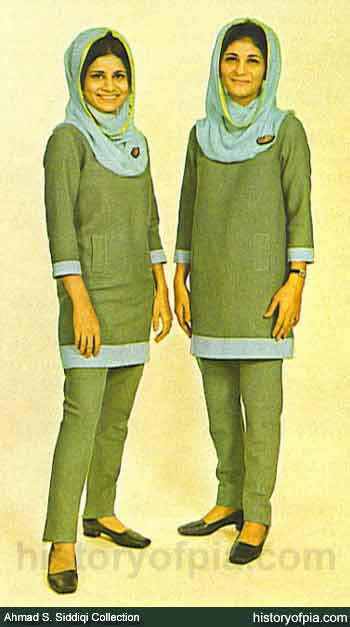
The indirect influence was clearly visible in the Ladies’ Teddy Suit of form-fitting pajama bottoms under mini-kameezes or kurtas inspired by Mary Quant’s mini and micro skirts while diligent back-combing was de rigeur.

We are, of course, referring to the hello jee western-educated urban middle classes.

This look was exemplified by the Pakistan International Airlines flight attendants’ new uniform designed by Monsieur Pierre Cardin in 1966, respectfully called Pir Khair Deen by many.

Anyway, the dopatta long scarf over a teddy suit was draped in different styles reflecting the wearer’s degree of emancipation. Some girls discarded it entirely, shocking people out of their business. But that wasn’t the only outrage about the teddy fashion.

Since their birth, the parental generation had been used to seeing white and brown Englishmen both wearing shape-hiding shorts and trousers that flapped around the legs. They were suddenly confronted with this shape-showing fashion, and in fact were most worried about the possible consequences on their growing children’s feet stuffed into narrow pointed shoes.

But all to no avail.

Teddyism took hold, spurred by Nazir Begum’s song Teddy Balam, hai zalam in the 1963 film Chooriyan, the first Pakistani Adults Only film.  Tufail Farooqi’s lilting composition and Nasira’s gyrations gave the lie to Kipling’s “East is East and West is West and ne’er the twain shall meet.” East and West met with a box office bang in this song:

https://www.youtube.com/watch?v=ameii-4gUNI

:

http://i.ytimg.com/vi/c-HfNZEb5IY/hqdefault.jpg

Mein rang rangeely teddy

Mérà piyar vee har dum ready.

I’m a multi-colored teddy

I pant for my love is ready

To top it all, the melody was interspersed with English words like welcome, fashion, position, aeroplane, my darling kiss my hand to make Pakistanis dream and view themselves differently.

The sharp, short sound of ‘teddy’ had a welcome impact on the Pakistani ear, the word slipped into colloquial language, and is still thriving.

In 1961, Pakistan had adopted the international decimal system, with 100 paisas to a rupee. As the one paisa coins were very small in diameter they were promptly dubbed teddy paisa. The name has stuck.

Someone of short stature, even in a shalwar kameez was called Teddy.  The word even unnaturally united academia and the military. One of the Punjab Regiment’s best drama artists was Lance Corporal Salim a.k.a.Teddy, and one of the best known professors of English Literature at Forman Christian College, Lahore was also Salim a.k.a. Teddy. One was in khaki, the other one zigzagged across the leafy campus in a dark, tight-fitting teddy suit. Neither was aware of each other’s existence, except perhaps to one of Professor Teddy’s former students who just happened to be the Lance Corporal’s Company Commander!

Through both Salim Teddies the army and academe united in an ironic recognition of this little understood British movement.

In the 1950s a section of British youth decided to revive the fashion of King Edward VII’s era from 1901 to 1910 with an influence measured until 1917.

“Originally known as Cosh Boys, the name Teddy Boy was coined when a 1953 Daily Express newspaper headline shortened Edwardian to Teddy.”

The first youth group in England to call themselves teenagers, they helped to create a youth market.  They also distinguished themselves in the 1958 Notting Hill race riots in London by beating up helpless West Indian immigrants before they discovered their manly pride in paki-bashing.

Just as the word Jugni originates from Queen Victoria’s Jubilee it was appropriate for Teddyism to be institutionalized within this Punjabi musical form:

Ik din Teddy gayi darbar

A’ap andar té burka ba’ar

Ohnoon pawé Data’a di ma’ar

Ohé pir méréya Jugni kehndi aé

Té na’am Ali da,

Ali da

Na’am Ali da layndi aé

Teddy went to Saint Data’s shrine

She found herself inside

With her burka covering outside

May she be struck by Saint Data

O’ my saint so Jugni says

As she takes the name of

The name of

Takes the name of Hazrat Ali

But at the end of the day, believe me, Dolly in a teddy suit was worth a million teddy paisas!

Come, Let Us Reconcile …

http://t2.gstatic.com/images?q=tbn:ANd9GcTLQhOPS5HoQFfLCHp_JK6FcJI4PRGghfeS5aofZZyfVx-Vyz59KKyY68-o

Lurking beneath cozy semantics, relations between the West and the Islamic world remain trapped in the past.

Three factors scream their guts out for a seat in related paradigms.

The 13th century Siege of Baghdad by the Mongols under Halaku Khan marks the end of the Islamic Golden Age, and not the Western Industrial Revolution’s need for raw materials and markets that led to colonization. Yet, no bitterness is directed at Mongols or Mongolia, perhaps because their underdeveloped state is unconsciously taken to be nature’s punishment!

Secondly, Islam expanded into Eastern and Western Christendom well before European powers occupied Islamic lands.

Thirdly, while the Islamic world and the former Christendom beat their chests about their superior colonial governance, neither is untarnished by the dark stain of institutionalized discrimination and slave-trading.

They claim the moral high ground and undermine each other in callisthenic one-upmanship!

Halaku Khan the Mongol ground the Abbasids and their fine civilization into dust, danced gleefully around burning libraries and spitefully had salt ploughed into Iraq’s fertile land.

http://www.museumofthecity.org/wp-content/uploads/2013/07/history_timeline_photo_09_1.jpg

Consequently, the Ottoman and Persian empires were unable to spawn an Age of Enlightenment and its golden goose, the Industrial Revolution.

Yet, simmering resentment at the West’s success is close to boiling point.

Preaching from pulpits can stoke, cool or redirect resentment.

Preachers need to be taken on board to tell their congregations why the West took a lead and guide their flocks in the same direction.

The past neither needs to be buried, nor resurrected, but studied as a compass for a common, interlinked and interdependent future.

Over a thousand years of blood-drenched Franco-German rivalry was neutralized after World War II by creating a structure of economic interdependence. Admittedly, both nations had the same level of economic, scientific and social development. That seems to be the one way out of this impasse of alarming Western-Muslim rivalry, further complicated by the many warring worlds the Islamic world.

http://upload.wikimedia.org/wikipedia/commons/thumb/7/7d/Clash_of_Civilizations.png/1280px-Clash_of_Civilizations.png

The much maligned and politically incorrect Clash of Civilizations was the work of Professor Huntington, a staunch American Democrat and life-long liberal. Now George Friedman of Stratfor seems to have excelled himself in a forthright and pointed analysis entitled A War Between Two Worlds, despite a title rich in multi-directional meaning.

Although Friedman is right in saying that much of the Muslim antipathy comes from having been bypassed by the industrial revolution, it is regrettable that he has circumvented the effect of the 13th century Mongol invasion.

Yet, his scholarly article remains a time-worthy read: http://www.stratfor.com/weekly/war-between-two-worlds#axzz3Oyy3waWV.

However, at the end of the day, time-honored models for studying geo-strategic challenges were never expected to be infinite and need to be re-assessed.

Newer models relevant to the imperatives imposed by the raw intelligence material are a compelling need.

The Charlie Hebdo Attack: aftermath?

http://ichef.bbci.co.uk/live-experience/cps/912/mcs/media/images/80171000/jpg/_80171382_80171381.jpg

Tuesday, January 6th , 2015, in remembrance of the Magi who followed a star to visit the new-born Christ child, epiphany was being celebrated in France with the usual tradition of eating an almond and butter stuffed gallette. Whoever bites on the hidden ornamental figure is pronounced king and wears the paper crown. Very few remember the blood drenching of the day following Epiphany. When the Magi failed to report the location of the Christ child to King Herod, he had every new-born baby massacred.

In a macabre display of blood-letting on the day after Epiphany, two French citizens by birth decided to avenge the insult to the Prophet of Islam (PBUH) who had been satirized in cartoons by the French left-wing weekly Charlie Hebdo in 2006.

The magazine had rerun the Danish Juland Post’s cartoons and added a few of its own. Islam having a strong aniconic tradition, a graphic representation of any of the prophets mentioned in the Holy Qura’an is taken as a deadly insult. That includes Hazrat Issa, (Jesus Christ), Hazrat Musa(Moses) Hazrat Daud (David) and of course Prophet Muhammed (PBUH).

The preceding decades have seen strong criticism of movies such as The Last Passion of Christ, King David, The Ten Commandments and others, banned in most Muslim countries. Although there was no lampooning of the prophets, yet their graphic representation was enough to incense the Islamic world. Muslims do not, by and large, feel that a simile might lead to a metaphor and thus become a pardonable offense. Nor do they appreciate the didactic value of image-based teaching.

Not where their holy prophets are concerned.

Eight years after Charlie Hebdo exercised its Voltairian right to use satire in order to draw public attention to situations in need of remedy, the French born brothers Kouachi burst into the offices of Charlie Hebdo, coolly shot dead the editor, ten of his staff, two police officers, and calmly walked out declaring that they had avenged their prophet.

That may be, but the act has received condemnation from Muslim clerics across the spectrum of the Islamic world.

The perpetrators were cornered in business premises and shot dead by France’s elite GIGN counter-terrorism troops. Their associate had taken hostages in a Kosher supermarket, killed four, and also been shot dead.

The final body count between January 7 and 9 was twenty including the three offenders, with twenty-one injured.

https://pbs.twimg.com/media/B65RIiNCAAATLpY.jpg:large

Paris was terrified and France was outraged.

Some mosques were defaced, but in general there has so far been no repressive backlash on France’s five million Muslims unrelated to this misguided act.

Which, its savagery apart, it is.

Somewhere down the line, the perpetrators gave the perceived interests of the Muslim Umma a higher priority than the land of their birth. They elected themselves judge, jury and hangpersons on the behalf of Muslims who, however incensed they might be on the issue, do not believe it justifies cold blooded murder in the name of their prophet.

The Kouachi brothers had obviously rejected their affiliation with their welfare nation state. That association is one of the foundations of the vaunted French public education system, which failed the Kouachi brothers and the French nation when and where most needed. The Kouachi brothers too, failed their system and deliberately betrayed the land of their birth.

Something is rotten somewhere, in and far beyond the state of Denmark.

Attacking Charlie Hebdo for its cartoons eight years after the commission means that the act hopes to generate a backlash on Muslims, widen communal gulfs and destabilize France. And that is strategy beyond the reach of the Kouachi brothers.

Someone somewhere is pulling global strings following an agenda with strategic objectives. A million marchers in Paris led by forty-eight world leaders bursting with high-calorie semantics that make good press will not impress them.

http://news.bbcimg.co.uk/media/images/80197000/jpg/_80197061_6bd6e1bd-2a9e-4bd3-91af-434cf507aff7.jpg

http://www.google.fr/imgres?imgurl=https%3A%2F%2Fheartsongsblog.files.wordpress.com%2F2013%2F02%2Fthe_lords_prayer.gif&imgrefurl=https%3A%2F%2Fheartsongsblog.wordpress.com%2F2013%2F03%2F03%2Fbalancing-the-chakras-with-the-lords-prayer%2F&h=473&w=333&tbnid=_b6rzelPWyLlHM%3A&zoom=1&docid=dJQFZvhKyGtA0M&ei=E56yVKrDGIXnywOE3YDADQ&tbm=isch&iact=rc&uact=3&dur=7107&page=1&start=0&ndsp=12&ved=0CC8QrQMwAg

The Last Lost Kingdom

Lost kingdoms, sequestered civilizations and isolated tribes interconnect fact and fiction, illusion and reality, and imagination and substance. 21st century means of communication, observation, archiving, analyses and publication should ensure the boredom of knowing it all. But hidden gems such as the former Himalayan kingdom of Lo remain untouched.

Nicole Crowder’s photo editing is a stunning exhibition of controlled talent.

A fortress in the sky, the last forbidden kingdom of Tibetan culture.

Nicole Crowder: http://www.washingtonpost.com/news/in-sight/wp/2015/01/05/a-fortress-in-the-sky-the-last-forbidden-kingdom-of-tibetan-culture/

Sheltered by some of the highest mountains in the world — Annapurna and Dhaulagiri — and bordering China on the Tibetan plateau, hides an ancient kingdom called Mustang, or Land of Lo. The kingdom is often confused with the mythical Shangri-La. The capital of the Mustang kingdom, Lo Manthang, is home to the Loba people, and its walled city is considered by some scholars to be the best preserved medieval fortress in the world. It is a candidate to become a UNESCO World Heritage site.

Thanks in part to its ancestral location — and because it has been forbidden to foreigners until as recently as 1992 — Mustang has retained its ancient culture. Though its capital is located in Nepal, it is one of the last strongholds of traditional Tibetan life left in the world. It remains a restricted region that is difficult to access. Foreigners must obtain special permits and pay high rates to visit it.

Photographer David Rengel visited the region recently to document the culture and observe its long-preserved way of life. Part of the project was realized while he began filming a documentary alongside producer and director by Larry Levene called “The Last Lost Kingdom” for the production company Es.Docu.

The lower part of Mustang yields more moist land and is rich in vegetation, while the more arid land in upper Mustang makes agricultural life a bit harder.

For centuries, caravans roamed the Kali Gandaki gorge between regions of Tibet, China and India with salt, yak wool, cereals, dried meat, spices and other goods on the so-called Salt Road. A road is being built along this route that will directly connect Mustang with China. When the road is completed, it will become one of the most accessible corridors of the Himalayas, and Mustang’s inhabitants’ lives may rapidly change with the influx of foreigners. Many of the young Loba people are waiting expectantly and anxiously for the road’s completion, but many older residents are hesitant about what it will mean for their culture and identity.

The Indo-Pakistani Caste System: multi-hued Smarties!

Transcript of Dr. Ramaswamy’s radio interview on Caste in South Asia

http://www.english-online.at/geography/india/caste-system-in-hinduism.gif

Hello, Claire Herringstone for the weekly Asia Today.

Our guest on tonight’s program is Dr. Ramaswamy, social anthropologist from Madras University, whom we’ll be interviewing for our viewers on the subject of untouchables within the South Asian caste system.

“Dr. Ramaswamy, good evening and thank you for joining us.”

“Good evening, and thank you for inviting me.”

Hen-henh. The first question is — how did a country with such fine philosophical roots end up with something like the caste system?”

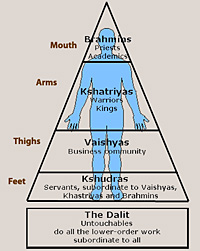
“Caste is an old, established institution, almost as old as history. Gautam Buddha opened temples to all castes, so even before Christ, it was well entrenched in India. It’s hard to say whether the migrant Caucasian tribes brought caste with them, or whether the social structure of the Aryans of the Saraswati was already based on caste. According to the Rg Veda, Purush, the primal man, destroyed himself to create a human society. The Brahmin priests sprang from his head, the warrior Kshatriyas from his hands, the land-tilling Sudras from his thighs, and the untouchables from his feet.”

http://www.justletmelearn.org/images/casteSystemGraph.jpg

“Indeed, but surely there must be something more than history and religious mythology to enforce it?”

“Yes. Manu’s Laws as they are commonly referred to in the West greatly reinforced the caste system.”

“When was that?”

“About two thousand years ago. Even then, Indian craftsmanship was highly valued beyond its borders. India was renowned as an exporter of the highest quality weapons steel at that time.”

“Could you tell our listeners a little more about that?”

“What the West today calls Damascus steel, and is unable to duplicate.  The ingots of this exceptional steel were exported to Persia and the Middle East, where sword-smiths fashioned blades whose cleaving power and flexibility held the Crusaders in awe. Sir Walter Scott’s description of the cutting power of Saladin’s sword in The Talisman is a good illustration. In fact, the pre-Islamic Arab word for sword was Muhannad, meaning from Hind. Thus, at that time, the skills of India’s craftsmen had placed the Indian economy in a unique position in the world. So the Indian leadership was keen to ensure the continuity of these techniques. It was considered that skills were best passed on from father to son. Encouragement soon became edict. A caste-based society further reinforced this institution by adding scriptural and scholarly justification, further empowering the ruling class.”

http://i52.tinypic.com/dxlnxu.jpg

“Most illuminating, Doctor. In India, there’s been this name change. Mahatma Gandhi called untouchables Harijans, and they call themselves Dalits. Why is that?”

“I myself am a Dalit, and we prefer it to Harijan which we consider to have been condescending, and untouchable, or backward, which is an insult.”

“Are Dalits, then, a separate race?”

“Yes and no.”

“How’s that? Sounds like a typically Indian response!”

“I object to that. It’s an anthropologist’s informal way of saying ‘to a certain extent yes’. Indian academics prefer not to speak pompously with laypersons! Anyway, Dr Ambedkar’s research proved genetic similarities between the highest and lowest castes in Maharashtra State.”

“So how do you account for the genetic similarities between the highest and lowest castes?”

“Victors have always raped the subjugated, and India’s states and chiefdoms were forever fighting each other — that’s one reason. Then there were concubines, and love matches. Over the centuries, India’s myriad states of varying sizes saw periods in which they came under a central empire and times when they receded from its grasp. Thrones regularly changed occupants while dynasties waxed and waned. The losers either vanished into mendicant yogi orders, or disappeared into the impure bastis of the untouchables. Thus it is that among the chuhras, lowest on the rung, there are those who talk of royal lineage. The oldest of these are descendants of royal families who escaped conquering blades that sought to eliminate dynastic lines. They are the Chuhra Choudhry leaders of today, and over the centuries, have been inter-marrying with other chuhras.”

“So caste does have something to do with wealth and fortune!”

https://writegill.com/wp-content/uploads/2015/01/283c1-aishwarya-rai.jpg

“Although caste may appear to be almost genetically fixed, it can be won, lost and reinstated by force and fortune. It is also an overlap of geography, race, profession and politico-military power. In Tamil Nadu and Uttar Pradesh, Jatt farmers were considered Sudras. However, the British historian, Colonel Todd attributed Rajput origins to them.  This places them in the Kshatrya warrior caste. Up until the rise of Sikhism in the Punjab, Jatts were lower than Rajputs. With the evolution of Sikhism as a militant force, their status rose. In the eighteenth century, as a result of Banda Bahadur’s revolt against the Mughals, Punjabi Jatts assumed the status of Kshatryas, for the simple reason that they exchanged their ploughshares for swords. Tribes that had jealously claimed loftier origins were content to pass themselves off as Jatts rather than Rajputs. Conversely, at the height of Muslim power in India, tribal bards invented fantastic Arab and Central Asian origins for their chiefs. Muslim Arains claimed to be from Iran, whereas as Hindus, they were Kumbhos and claimed Rajput origin which society in general denied them anyway. If, by some freak accident of history, a region had come under Chuhra rule, these very tribes would have started claiming Chuhra origin. Maybe that is why India has this proverb “the buffalo belongs to him who wields the staff.”

http://goanand.com/blog/wp-content/uploads/DSC07759.jpg

 “But the Sikhs and Muslims have no caste!”

“Their religions don’t recognize it, but their communities practice it. Despite calling itself an Islamic Republic, Pakistan practices caste! So do the Christians, especially the ones in the South.”

“And why’s that, Doctor?”

“Because, it is India’s curse, with which we are all tainted. On the other hand, as Deepa Kandaswamy says, the West suffers from race and class.”

“Indeed. Could you tell our listeners a little more?”

“Chuhras converted to Sikhism are called Mazhabis, full fledged members of the warrior brotherhood that served the British and now serve India in its armed forces. Chuhra converts to Muslims who remained serfs are called Mussalies, and often with a change in fortune, assume the tribal names of their former masters. Those that managed to leave serfdom took the titles Sheikh and Khwaja, which were the titles of the highborn Muslim missionaries from the Middle East or Central Asia who converted them. Chuhras converting to Christianity took the family name of the British missionary who converted them. Thus it is that in India and Pakistan are found Sheiks who would scandalize an Arab, Smiths and Johnsons who would shock an Anglo-Saxon— we are indeed, a multi-hued nation, like a packet of smarties!”

http://socgen.ucla.edu/wp-content/uploads/2013/08/jj.jpg;

Pakistani women and an Indo-Pakistan peace deal can end terrorism

Get the moms on board and then pray …


http://www.independent.co.uk/incoming/article9931016.ece/alternates/w620/babyshoe1.jpg;http://pakteahouse.net/wp-content/uploads/2014/12/peshawar4.jpg

As a quick default response to the massacre of 132 schoolchildren and 13 adults in Peshawar, Pakistan on 16 December 2014, the Pakistan government has lifted the moratorium on convicts awaiting the death penalty. As retribution, it implies that these convicts had been the puppet masters of the atrocity. As dissuasion, it infers that they are in league with militants: by definition, convicted criminals are not enemy combatants and come under the protection of the penal code. The measure will allow the next attack to be prepared while it makes good press, and then dutifully slides under the carpet to resurface in different garb when required. In the meantime, the Pakistan army is steadily conducting its operation in North Waziristan.

Pakistan’s professional army recruits from hereditary Kshatriya warrior clans converted to Islam. The combination results in its high combat performance. But in this case the army is out of its depth. Like the US Navy SEALS who got Bin Laden, the Pakistan Army needs precise addresses and secure transport. It apparently has neither, only a vague geographical sector where it advertised its arrival, like its American step-cousin, losing the element of surprise and allowing targets to move house.

If reports are to be believed, elements within Pakistan’s security establishment have these addresses, but need the occupants as their delivery system for asymmetric mischief with India over a hemorrhaging property dispute.

In the likelihood that the addresses are surrendered and adequate transport is available, the targets will be efficiently dealt with.

But that only postpones the problem.

The mothers, paternal aunts and paternal grandmothers embedded in the joint family system will then swing into action. The targets’ surviving sons will be reared as vengeance machines, and in another few years, regardless of right or wrong, will seek to avenge their fathers. They might repeat their fathers’ acts, or attack senior officers involved in the operation, or assassinate their children.

The generals know this.

So once the Pakistan government is through with this hanging business and mob blood lust abates, they should go after the addresses. The intelligence officers who have them (if they do), are neither former United States’ Cold War mercenaries nor corrupt. They are Pakistan Military Academy graduates imbued with professional integrity. They have been conducting their operations with the conviction that they are best serving their nation’s interest in this way. Be that as may, that is how it stands. So grabbing a few and water boarding them is another dead end.

First, these officers need to be convinced that surrendering addresses is in the highest interest of their nation— an indispensable success cog.

Second, they and their families will need to go into a witness protection program— a tall order for a country renowned for its level of corruption.

Third, and most difficult, is peace with India, which would deprive these officers and their younger protégés of any motive to make and nurture such contacts.

Parallel with this measure is the mobilization of women, crucial to long-term success.

Only other women can suborn the mothers, paternal aunts and paternal grandmothers of the targets from a tradition practiced for thousands of years. They call it badal— exchange, a two-syllable, short word for a process that is propelled by dynamics indefinable in western terms.

So, unless a concentrated action to get these wives, mothers and sisters to condemn their kin, reject this custom and decentralize the joint family system is not launched, finding and punishing the latest perpetrators will only postpone further massacres by a decade or so.

Pakistan’s hello jee fashion parade ladies now need to justify their university education and drawing room hai jee patriotism by organizing women’s study groups on this subject. Their husbands are decision makers. These women need to brainstorm the issue, refine their ideas, play devil’s advocate with each other, and present the distilled results to their husbands with stern ultimata.

Mothers of victims and potential victims can convince other women that their husbands, sons and brothers were in the wrong.

Then it will end.

Badlu Ram could reduce India-Pakistan Tensions

Left to itself, moral uprightness can degenerate into joyless self-righteousness or intolerance of the opinions and behavior of others. It can shrivel into a dead end of blood drenched eloquence. The presence or absence of music and the type of music to which a society responds draws a thin red line between the balance of its degree of righteousness and self-righteousness. Cultural continuity, and the intensity of its practice can be studied in components of society that seek to preserve its status quo even at the risk of life and limb, which is one way to describe an army.


Punjab Regiment L to R :  Pakistan, undivided & India :  http://upload.wikimedia.org/wikipedia/commons/8/8b/33rd_Punjabis_(15_Punjab)_(PMs)_1910.jpg;  http://defence.pk/attachments/8000c3ece83dfbdfb15dd6309b0f74b7-jpg.85154/;  http://media.sacbee.com/static/weblogs/photos/images/2011/jan11/republic_day_sm/republic_day_10.jpg

Let’s take a look at the symptomatic evolution of war marches of India and Pakistan considering that India seems to be heading Pakistan’s way.

Like all warlike cultures, India and Pakistan, whose regiments were divided only sixty-seven years ago, cherish their war songs they don’t sing, since of course they are neither sissies nor mirasi minstrels!

The exception is the Indian Army’s Assam Rifles which owes a debt to Captain Manjit Singh, a Christian officer born in Jammu, graduated from Madras University, an ace hockey player and the guiding genius behind the Badlu Ram ka badan song.

The light-hearted words reflect the dashing merriment expected of young officers close to their troops, enjoying their chota pegs. A rifleman, eyeing up a pretty girl, was put on pack drill for neglecting to clean his rifle.


http://worldonline.media.clients.ellingtoncms.com/img/photos/2002/05/21/3AindiaNEW_t640.jpg?a6ea3ebd4438a44b86d2e9c39ecf7613005fe067; http://3.imimg.com/data3/IS/NM/MY-9325985/41sarj9ocbl-_sl500_aa300_-250×250.jpg

Enter Badlu Ram, who died in the ‘Japan Waar’, but the quartermaster was smart, didn’t declare his death and kept drawing rations in his name! The refrain, acknowledges that while Badlu Ram’s body is under the earth, his rations are still drawn— 100 years Hallelujah— bang on John Brown’s body! And here it is: https://www.youtube.com/watch?v=lIl1nL64KNI

This lilting march says that at least Assamese warriors do not take themselves too seriously, in accordance with General Ingle’s advice in A Soldier’s Prayer for his Son. Even their battle cry is neither religious nor nationalistic— Rhino charge!

A choice uncharacteristic of India and Pakistan whose battlefield losses indiscriminately come under Martyred and not Killed in Action, with both countries seeking to claim the self-righteous high ground.

For example, musically, one cannot disassociate the Pakistan Army from Ae Mard e mujahid Ja’ag zara https://www.youtube.com/watch?v=oFmHxJcG7u4. Although secular India might allow regiments to keep their religious battle cries such as Bol na’ara Haidari, Bolé so Nihal and Jai Ma Kali, their marching songs enshrine cheerless nationalism, such as Qadam Qadam, https://www.youtube.com/watch?v=9sJqJeLwww0, the delightful exception being the Madras Regiment’s Bollywoodian Suhana Safar aur yeh Mausam Rangeen https://www.youtube.com/watch?v=mhto634aZIUJeeyo veer Madrasi!

But it was not always so glum.

http://www.nam.ac.uk/online-collection/images/960/1-999/750.jpg

From Sepoy to Subedar: the memoirs of Subedar Sita Ram Pande (1873), reveal that the Bengal native Infantry, formed of Punjabis, Pathans and Uttar Pradeshis, used to sing Kabhi sukh kabhi dukh, angrez ka naukar— sometimes pleasure, sometimes pain, a servant of the English!

The Karnatic Regiment went even further, singing of Queen Victoria being a “very good man…” http://research.culturalequity.org/get-audio-detailed-recording.do?recordingId=24077

The pre-partition, undivided elite Punjab Regiment marched to the pederastic, Zakhmi Dil, which means Wounded Heart. John Masters in Bugles and a Tiger writes of “one of the most famous of Pathan songs, the ‘Zakhmi Dil’ (‘Wounded Heart’) begins with the words, ‘There’s a boy across the river with a bottom like a peach, but, alas, I cannot swim”.


http://mentalfloss.com/sites/default/files/styles/article_640x430/public/butt_slap.jpg

Alpha males have always flirted with homosexual phrases and conduct to flaunt their heterosexuality like sportsmen patting each other’s bottoms. Soldiers of elite units are no different.

http://upload.wikimedia.org/wikipedia/commons/thumb/b/b0/2june_2007_296.jpg/800px-2june_2007_296.jpg

Take into account Le Boudin, anthem of the French Foreign Legion, in time and space as far apart from India and Pakistan as it could be.

The prelude refers to a round-bottomed bum-boy getting sodomized in the priest’s tent, and closes with Hey round-bottom, drop your trousers, censored in public in the interests of lofty political correctness!

The South Asian constituents of a five thousand year old tradition have been successfully battered by self-righteousness. The obscurantist wind that suffocated fifty centuries of renowned tradition has become a tsunami. It has spawned mass murder in Pakistan and not to be outdone, India’s restless zealots also threaten to lead its secularism astray. .

Badlu Ram is a gust of fresh mountain air to ease the suffocation and touch base with a balanced past. India and Pakistan should be bellowing their lungs out singing Badlu Ram ka Badan.

Thank you, Major Manjit Singh.

Ray of hope for Pakistan

Santa comes to Joseph Colony

Short piece, moving pictures

by Ammar Shareef, from Dawn.com

In March 2013, an angry mob of more than three thousand people stormed Joseph Colony – a Lahore locality with an overwhelmingly Christian population – and set more than 100 homes on fire.

Lahore police stood by as the inflamed crowd torched the humble homes, admittedly avoiding clashes. Despite the outrage the incident sparked, the government took little real action. Twenty-one months later, the ghosts of Joseph Colony still haunt the Christians living in Pakistan.

A number of individuals have since sprung into action to try to make up for the senseless violence, and, in however small measures, undo the tragic wrong.

For the second year in a row, an anonymous donor managed the distribution of Christmas gifts to children of the colony’s Christian community. Distributing cricket bats, badminton rackets and colouring books among children is certainly no compensation for what happened in March last year, but it did manage to spread some smiles on the faces of the kids.

To celebrate your biggest festival in a decidedly hostile environment — no child deserves that. And it should not have been this way. We should have put an end to the madness once and for all. We should have undone every single thing that led to that situation to ensure it didn’t occur again.

But we didn’t. And it did occur, again.

And now it seems that all our children stand terrified in the midst of a menace they had nothing to do with.

Explore: Remembering Peshawar: A sombre Christmas for some

As I captured the endearing smiles of these children, I was overwhelmed with conflicting feelings: pure joy and terrible guilt.

The guilt will stay, but for a few, dear moments, let us get into the Christmas spirit and partake in the simple joys of these children.

Merry Christmas!

Ammar Shareef is a photographer based in Lahore. He can be reached at ammar.shareef@afterhoursgroup.net

http://www.dawn.com/news/1152898/santa-comes-to-joseph-colony

Hidden in Sight Remedy for Christmas excesses

South Asia’s digestive enzyme

Hark yebelching be the act of expelling air from thy stomach through thy mouth: t’will hold thee in good stead for thy Christmas gluttony but forget not the hand ‘fore thy mouth.

http://cache3.asset-cache.net/gc/981715-002-saudi-arabia-nafud-desert-shammar-tribe-gettyimages.jpg;v=1&c=IWSAsset&k=2&d=D7ZucN885lpRxlg1Qqc1lQnf7Ubfja%2FD%2BdvXYEgVog8%3D; http://thelowercasearab.files.wordpress.com/2011/11/arab_food.jpg

Belching and digestion are blood relations estranged since the end of babyhood.

It is generally believed that east of the Suez, belching after a meal appreciates the food’s gourmet credentials. In South Asia, however, belches acknowledge the food’s digestive properties. Respecting the cooking process and selecting spices proportionate to the ingredients triggers the breakdown of food into energy. The unprompted belch signals digestive victory.

http://i.ndtvimg.com/mt/movies/2012-10/weddingbollywood-big.jpg; http://weddingpakistani.com/wp-content/uploads/2012/04/10-best-caterers-for-Pakistani-weddings.jpghttps://writegill.com/wp-content/uploads/2014/12/c0738-suprememehandi.jpg

Hedonistically rich South Asian feasts incorporate digestive dishes and accompaniements: the belch reassures the hosts that the digestive tract is tickety boo.

Since men and women not of the immediate family eat separately at feasts, the volume of the belch was adjusted to reach far and wide.

Even in between meals, expulsion of intestinal gas or air from the mouth or lower down, noisily or in silence, are considered signs of good health, despite allopathic, ayurvedic and yunani medical solutions to the contrary. The belief is even expressed in a rather rude rhyme.

This obsession with digestion was thus among South Asians, and still is.

But then what about their British first cousins, who’d figured out the triangular relation between heart-healthiness, eating beans and farting?

A host will offer second and third helpings of a particular dish with arguments based on its digestive properties.  It is also a polite host’s manner of easing the way for increased consumption under the guise of good digestion rather than greed. My wife managed to wean me off the habit of extolling the digestive merits of each dish when her English compatriots were at our table. However, the habit still tends to rear its head in defiance at the oddest of moments.

Accompanying salads, pickles, chutneys and raitas, doubtlessly stand-alone taste enhancers, are actually supporting elements for the main thrust of meat dishes which are a digestive challenge. So a wedding feast is invariably concluded by spinach and meat, the spinach ensuring against any risk of getting blocked.

The wise guest, hedging bets, will of course have a drink of isabgol da chilka— psylliam husk— before going to bed that evening.

In their Anglo-centric cultural myopia, the British unblinkingly lumped South Asian belching on the Middle Eastern logic. Hardly surprising when Collins & Lapierre’s acclaimed Freedom at Midnight remarks how little the British actually understood the Indian culture beyond what they needed to ensure their rule.

Mazhar Shah, Pakistan’s reigning celluloid villain of the 60s, summed up the relations between digestion and belching in one of his most famous lines: “I could eat up your whole family and not even belch”!

For the interested, listen at: https://www.youtube.com/watch?v=2SQsBWYeriM