India

TWINNING IN Saeed Ibrahim’s “TWIN TALES from KUTCCH”

Vitalizing twinning in this period saga, Saeed Ibrahim deftly overlaps characters, places, and situations within the novel’s hall of tactically placed mirrors in perfect sync. TWIN TALES is a microcosmic, counterfactual gem of the period preceding the 1947 Partition of India and Pakistan — a ray of sanity, overriding divisions and separation, to rebuke the macrocosmic killing fields and trains of death the British left as their legacy. Not to speak of 88% illiteracy, 32 years life expectancy and no health service or public education worth the name, except for fee-paying, lucrative schools for the elite to ensure unequal opportunity.
TWIN TALES OF THE KUTCCH brings love, family and humanity to the fore in subliminal criticism of the brutal independence of India.

Coming soon: full review in https://www.differenttruths.com/

Afghanistan Alexander’s descendants Azam Gill BBC Asian Network Blasphemy Blasphemy Pakistan books British Asians British Raj Caste Cattle rustling CIA DJ Nihal Express Tribune France French Foreign Legion India India-Pakistan tensions Kalash Karakorams Lahore LOC Kashmir militant Islamic fundamentalists Nepal Pakistan Pakistani Christians Pakistani Christmas Persecution of Christian minorities Persecution of Pakistani Christians poetry Punjabi village Christians Punjab Regiment Punjab smugglers rat people Rustling Satire South Asia South Asian Warriors Stiff Upper Lip Terrorism Tony Blair USA US Presidential election World War I Victoria Cross writing

𝐀𝐒𝐊𝐄𝐑𝐓𝐀𝐋𝐈: 𝟏𝟎𝟏 𝐏𝐨𝐞𝐦𝐬 𝐨𝐟 𝐃𝐫. 𝐑𝐨𝐨𝐩𝐚𝐥𝐢 𝐒𝐢𝐫𝐜𝐚𝐫 𝐆𝐚𝐮𝐫

“𝓑𝓻𝓮𝓪𝓴𝓲𝓷𝓰 𝓼𝓽𝓮𝓻𝓮𝓸𝓽𝔂𝓹𝓮𝓼 is the natural outcome of my poetic oeuvre. War, widowhood, myths, rural folk, contemporary social conditions are some of the themes that haunt this volume. The poems in this volume are my spontaneous response to life’s true happenings. You may find the 𝓼𝓪𝓽𝓲𝓻𝓮 and 𝓲𝓻𝓸𝓷𝔂 sometimes difficult to bear. 𝓒𝓸𝓷𝓯𝓵𝓲𝓬𝓽 and 𝓿𝓲𝓸𝓵𝓮𝓷𝓬𝓮 have,…

ZARA’s WITNESS, by SHUBHRANGSHU ROY

Zara will smile in the company of Bach’s Jonathan Livingstone Seagull, St Exupéry’s The Little Prince, Gibran’s The Prophet and Coelho’s The Alchemist. After the ersatz blossoming of Maharesh Yogi and Ravi Shankar nudged by the Beatles’ self- grafting, this is a breath of fresh air blown from India’s multi-millennial civilization

TWIN TALES FROM KUTCCH: a microcosmic, counterfactual gem of the period preceding the 1947 Partition of India and Pakistan — a ray of sanity…

WORLD JATT / JAAT DAY

“Multi sourced information and Extensively researched,” Dr. V. Gill, USA

Saga Indicus traces the origins of the Indian Jatts. Agriculturists, warriors, and now represented in all the professions, they are mainly found in Punjab, Sindh, Rajputana and the western portion of the Gangetic Doab. The origins of Jatts cannot be traced without exploring ancient Indian history which takes the lion’s share of Indo-European studies. The origin of the Jatt people is traceable through the meaning of the word itself, referred to in Panini’s Ashtadyayi, and further back in The Mahabharta itself. The trail of overlapping meanings leads back in time from Panini (450BC)’s Ashtadyayi to The Mahabharta, and forward in time to the present-day Jatts and their constituent Gill clan. Saga Indicus undertakes this study through: The Panini Fulcrum: 400 BC. The Vikramaditya Fulcrum: 375-415 BC. The Prithipal Fulcrum: AD 9. The Bhatinda Fort fulcrum: AD 783. The Gilpal Fulcrum: AD 1113. Saga Indicus is crucial to the understanding of Indo-European cultures.

The Indo-Pakistani Caste System: multi-hued Smarties!

Transcript of Dr. Ramaswamy’s radio interview on Caste in South Asia

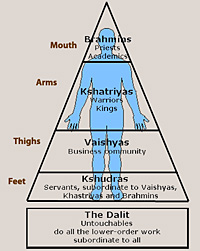
http://www.english-online.at/geography/india/caste-system-in-hinduism.gif

Hello, Claire Herringstone for the weekly Asia Today.

Our guest on tonight’s program is Dr. Ramaswamy, social anthropologist from Madras University, whom we’ll be interviewing for our viewers on the subject of untouchables within the South Asian caste system.

“Dr. Ramaswamy, good evening and thank you for joining us.”

“Good evening, and thank you for inviting me.”

Hen-henh. The first question is — how did a country with such fine philosophical roots end up with something like the caste system?”

“Caste is an old, established institution, almost as old as history. Gautam Buddha opened temples to all castes, so even before Christ, it was well entrenched in India. It’s hard to say whether the migrant Caucasian tribes brought caste with them, or whether the social structure of the Aryans of the Saraswati was already based on caste. According to the Rg Veda, Purush, the primal man, destroyed himself to create a human society. The Brahmin priests sprang from his head, the warrior Kshatriyas from his hands, the land-tilling Sudras from his thighs, and the untouchables from his feet.”

http://www.justletmelearn.org/images/casteSystemGraph.jpg

“Indeed, but surely there must be something more than history and religious mythology to enforce it?”

“Yes. Manu’s Laws as they are commonly referred to in the West greatly reinforced the caste system.”

“When was that?”

“About two thousand years ago. Even then, Indian craftsmanship was highly valued beyond its borders. India was renowned as an exporter of the highest quality weapons steel at that time.”

“Could you tell our listeners a little more about that?”

“What the West today calls Damascus steel, and is unable to duplicate.  The ingots of this exceptional steel were exported to Persia and the Middle East, where sword-smiths fashioned blades whose cleaving power and flexibility held the Crusaders in awe. Sir Walter Scott’s description of the cutting power of Saladin’s sword in The Talisman is a good illustration. In fact, the pre-Islamic Arab word for sword was Muhannad, meaning from Hind. Thus, at that time, the skills of India’s craftsmen had placed the Indian economy in a unique position in the world. So the Indian leadership was keen to ensure the continuity of these techniques. It was considered that skills were best passed on from father to son. Encouragement soon became edict. A caste-based society further reinforced this institution by adding scriptural and scholarly justification, further empowering the ruling class.”

http://i52.tinypic.com/dxlnxu.jpg

“Most illuminating, Doctor. In India, there’s been this name change. Mahatma Gandhi called untouchables Harijans, and they call themselves Dalits. Why is that?”

“I myself am a Dalit, and we prefer it to Harijan which we consider to have been condescending, and untouchable, or backward, which is an insult.”

“Are Dalits, then, a separate race?”

“Yes and no.”

“How’s that? Sounds like a typically Indian response!”

“I object to that. It’s an anthropologist’s informal way of saying ‘to a certain extent yes’. Indian academics prefer not to speak pompously with laypersons! Anyway, Dr Ambedkar’s research proved genetic similarities between the highest and lowest castes in Maharashtra State.”

“So how do you account for the genetic similarities between the highest and lowest castes?”

“Victors have always raped the subjugated, and India’s states and chiefdoms were forever fighting each other — that’s one reason. Then there were concubines, and love matches. Over the centuries, India’s myriad states of varying sizes saw periods in which they came under a central empire and times when they receded from its grasp. Thrones regularly changed occupants while dynasties waxed and waned. The losers either vanished into mendicant yogi orders, or disappeared into the impure bastis of the untouchables. Thus it is that among the chuhras, lowest on the rung, there are those who talk of royal lineage. The oldest of these are descendants of royal families who escaped conquering blades that sought to eliminate dynastic lines. They are the Chuhra Choudhry leaders of today, and over the centuries, have been inter-marrying with other chuhras.”

“So caste does have something to do with wealth and fortune!”

https://writegill.com/wp-content/uploads/2015/01/283c1-aishwarya-rai.jpg

“Although caste may appear to be almost genetically fixed, it can be won, lost and reinstated by force and fortune. It is also an overlap of geography, race, profession and politico-military power. In Tamil Nadu and Uttar Pradesh, Jatt farmers were considered Sudras. However, the British historian, Colonel Todd attributed Rajput origins to them.  This places them in the Kshatrya warrior caste. Up until the rise of Sikhism in the Punjab, Jatts were lower than Rajputs. With the evolution of Sikhism as a militant force, their status rose. In the eighteenth century, as a result of Banda Bahadur’s revolt against the Mughals, Punjabi Jatts assumed the status of Kshatryas, for the simple reason that they exchanged their ploughshares for swords. Tribes that had jealously claimed loftier origins were content to pass themselves off as Jatts rather than Rajputs. Conversely, at the height of Muslim power in India, tribal bards invented fantastic Arab and Central Asian origins for their chiefs. Muslim Arains claimed to be from Iran, whereas as Hindus, they were Kumbhos and claimed Rajput origin which society in general denied them anyway. If, by some freak accident of history, a region had come under Chuhra rule, these very tribes would have started claiming Chuhra origin. Maybe that is why India has this proverb “the buffalo belongs to him who wields the staff.”

http://goanand.com/blog/wp-content/uploads/DSC07759.jpg

 “But the Sikhs and Muslims have no caste!”

“Their religions don’t recognize it, but their communities practice it. Despite calling itself an Islamic Republic, Pakistan practices caste! So do the Christians, especially the ones in the South.”

“And why’s that, Doctor?”

“Because, it is India’s curse, with which we are all tainted. On the other hand, as Deepa Kandaswamy says, the West suffers from race and class.”

“Indeed. Could you tell our listeners a little more?”

“Chuhras converted to Sikhism are called Mazhabis, full fledged members of the warrior brotherhood that served the British and now serve India in its armed forces. Chuhra converts to Muslims who remained serfs are called Mussalies, and often with a change in fortune, assume the tribal names of their former masters. Those that managed to leave serfdom took the titles Sheikh and Khwaja, which were the titles of the highborn Muslim missionaries from the Middle East or Central Asia who converted them. Chuhras converting to Christianity took the family name of the British missionary who converted them. Thus it is that in India and Pakistan are found Sheiks who would scandalize an Arab, Smiths and Johnsons who would shock an Anglo-Saxon— we are indeed, a multi-hued nation, like a packet of smarties!”

http://socgen.ucla.edu/wp-content/uploads/2013/08/jj.jpg;

Something to Share: our enduring love story, by Peggy & Al Schlorholtz

” …  enduring, gripping, enriching …”

http://something-to-share.com/images/Something-to-Share-Cover5a.jpg

Something to Share by Peggy & Al Schlorholtz reveals a delightfully harmonious intersection of literary genres— love saga, autobiography, travelogue, adventure, multiculturalism — within a lifetime of loving service. Multilayered perceptions challenge stereotypes of meaning and raise the reader’s self-awareness.

The love story started with a tenth grade Iowa beauty flinging an orange at Al Schlorholtz to grab his attention in the Study Hall. And grab it she did, till the ends of the earth, starting from rural Iowa to Princeton to Pakistan, India, Afghanistan and Nepal.

https://writegill.com/wp-content/uploads/2014/12/0ab52-e8038334-76d1-4572-8564-56078b79fad5_india2.gif

A love story of epic dimensions that goes beyond romance to include the exotic peoples of faraway lands.

http://umairghani.files.wordpress.com/2008/05/w6.jpg?w=450

The Schlorholtzes were clearly multicultural well before the advent of the term as it is generally understood these days. The sub-text of this remarkable work is in the mise en abyme tradition retrieved from heraldry by André Gide for the purposes of critical analysis. It leaves no doubt that despite himself, the author’s crystalline insight into a pivotal geostrategic environment is piercingly unique.

http://binaryapi.ap.org/91acac52b0444639b87b546fba9a9568/460x.jpg

For its penetrating understanding of South Asia, Something to Share should be compulsory reading for the blow-dried inductees into the US State Departmant’s Bureau of South and Central Asian Affairs, just as Mumtaz Shahnawaz’s The Heart Divided was avidly read by missionaries of the Schlorholtzes’ caliber. Perhaps that, but certainly the clarity of their Christian faith made it hard to believe that they were actually missionaries, as with love and without any fuss they served others.

http://c586412.r12.cf2.rackcdn.com/ByLoveServeOneAnother.jpg

For the discerning reader, the fact that a one-star general’s phone call was required to clear the Schlorholtzes household furniture going from Pakistan to India speaks volumes. That Pakistan had a Christian general is startling. The authors do not state the obvious, offering adventure after adventure to be retrieved by the reader in quest of the truth.

http://media-cache-ak0.pinimg.com/736x/27/71/5f/27715f1e39d35d1f1be8438b540a29de.jpg

That the authors state the facts and withhold their opinion is an example for the kind of contemporary journalism that appears to excel in opinion over fact!

And that is the skill with which the intersecting molecules of this remarkable narrative sustain each other.

The missionary professor and his wife’s life story is laudably free of religious clichés or evangelical rhetoric, while carrying veins of mineable secular abundance. The Christian message is implicit in acts of selfless devotion.


https://artenabler.files.wordpress.com/2010/07/fm_mak.jpeg;http://www.larousse.fr/encyclopedie/data/images/1004719-Zulfikar_Ali_Bhutto.jpg;http://www.thestar.com/content/dam/thestar/news/world/2013/08/26/zia_ulhaqs_legacy_in_pakistan_enduring_and_toxic/zia_ulhaq.jpg

The Schlorholtzes lived through Ayub Khan and Zia-ul-Haq’s dictatorships, survived two wars that included getting bombed and watching aerial dog-fights over their landscaped campus home known for its gracious hospitality. They survived Zulfikar Ali Bhutto’s socialism while their daughters studied at Radcliff with Benazir Bhutto whom they remember as ‘Pinky’!

Something to Share revives the forgotten tradition of the likes of Reverends James Gardner and John Williams,  Margaret Prentice, Adomain Judson, William Carey and John and Ida Scudder, who continued enriching lives by penning their unique experiences during retirement.

https://encrypted-tbn3.gstatic.com/images?q=tbn:ANd9GcRk5E2Ib0y7RCTwp_uW7XaNlZAX-X71o8keq3A-rI0DjavTIiku

La difference Schlorholtz is that the professor’s legendary wit pervades the manuscript in Balzacian brush-strokes.

http://cache1.asset-cache.net/xt/129953331.jpg?v=1&g=fs1%7C0%7CPDI%7C53%7C331&s=1

So do settle down with your tipple of choice in your favourite armchair and let Al & Peggy Schlorholtz work their magic on a cold winter’s day.