
Jesus’ Kashmir Connection
It doesn’t take much to figure out the Jesus Connection in Kashmir.
In Srinagar, Kashmir, the Roza Bal shrine is the tomb of a man called Issa, presumed to be that of Jesus Christ since Jesus is usually called Issa in Arabic, which means he who resuscitates the dead. In Swahili and Arabic it also means salvation and protection. It is often superfluous as the Arabic translation of Jesus, since in Arabic, Jesus is Yasue.
The Gospels reveal that Jesus’ birth name was Yeshua and that the word Jesus is its derivative.
Except for one, the Gospels were written in Greek. The word for Jesus is Iησοῦς pronounced as “eeaysoos.” When “eeaysoos” was transliterated into the English long ago, it became Jesus — the word used in English today (https://carm.org/jesus-name-really-yeshua).
Matthew 13:55-56 discloses that James, Joses, Simon and Judas, were Jesus the son of Mary’s brothers. The sisters are not named.
Mark 3:31, Mathew 12:49 and Mathew 12:46-50 further confirm the existence of Jesus’ brothers.
So even when the Bible does not specifically refer to Jesus’ cousins, nieces or nephews, their existence cannot be denied. And since names do tend to run in families, cousins may carry the same name. One of Jesus’s brothers was Joses, only a short Greek form of Joseph. So Joses was named after his father, a cross-cultural practice right up to the present. Every contemporaneous son of Joseph does not necessarily refer to Jesus or one of his brothers.
From all this information, then, Issa, as an Arabic attribute of the act of raising the dead cannot be considered Jesus’ name. And since there is no evidence in the Bible that Jesus flaunted his gift of raising the dead, he would not have referred to himself with such an attribute and even less so in Arabic which was neither his mother tongue in Israel nor spoken in Kashmir at that time.
By all the known, consensual evidence, Jesus and his disciples stayed within a linguistic environment of Aramaic, Greek and perhaps some Latin but not Arabic or Swahili.
The attribute Issa as he who raises the dead could not have been given until at least the first raising of the dead and that happened only after the thirtieth year of Jesus’s life. We are dealing with an act and not a proper noun. The attribute of raiser of the dead in Arabic was given only after news of the miracle reached the Arabic speaking world.
As stated earlier, Jesus never brandished his miracles. Even if he had gone to Kashmir, he would never have introduced himself as Issa. Furthermore, there is neither any evidence of the dead being raised in Kashmir two thousand years ago by a certain Issa, nor any trace of the Arabic language or Arabic speakers to justify the attribution Issa to a person. Starting from the 13th century, Muslim preachers brought Arabic into Kashmir in trickles, since the Qura’an is written in and Muslim prayers are formalized in Arabic.
The burial site of Issa is located in the Roza Bal shrine, in the Khanyaar neighbourhood of central Srinagar, the capital of the mountainous Indian state. The site used to be a center of Buddhism, Hinduism, and Shaivism for a thousand years before Islam.
The Issa buried here was Jesus’ nephew who had the gift of faith healing which many Christians and non-Christians have had since the beginning of time without being messiahs.
The name given to the person who is buried in Roza Bal is Yuz Asaf meaning “Son of Joseph and also implies “Leader of the Healed.”
Since Joseph and Joses are the same name, this son of Joseph / Joses was Jesus’ nephew.
Phonetically, the sound of Yuz Asaf can, with mild tweaking, be pronounced as Jesus — a practice so fraught with errors that no scholar would attempt it for fear of the derision and rejection of peers. That is because homophonic sounds are more often coincidental than incidental, except as an amusing after-dinner parlor game.
The common cognate meaning of two words is the decisive factor confirming a common origin. That is absent between Yuz Asaf and Jesus and Issa. The cognate of Yuz Asaf is compounded from the Hebrew he will add and leader of the healed. But Yuz Asaf also means Son of Joseph, and one of Jesus’s brothers was Joseph / Joses (Matthew 13:55-56).
If Jesus did appropriate the tenets of peace and neighborliness, and nothing is known of his life between the age of 12 & 30, he could as easily have retrieved them from Australian Aborigines or Siberians and not necessarily Buddhists as some believe. These universal concepts are not exclusive to Buddhism. Synchronicity — Jung defined it and Sting sang it.
Why an Aramaic speaking Jew in 78CE, the date of the supposed Jesus in Kashmir, would use an Arabic attribute to declare his most singular power in a language that was to take a thousand years to reach Kashmir is devoid of sense.
Pinpointing The Jesus Connection in Kashmir is Rocket Science 101.
British Asians will Bend it like Beckham
In the UK, Asian refers to the 4.9% of the population that is of South Asian origin. Football evokes the rest of Britain. Much to the consternation of DJ Nihal of BBC Asian Network, football and Asians don’t mix. Even in areas where the Asians form 20% of the population, there are only 1% of them in the fan clubs. Apparently, even when they are welcome, Asians prefer to support rather than play football. Although Nihal might consider it a lack of “education”, it is due to ingrained prejudice against the sport received from first generation immigrants.
Here’s the story.
During the British, Raj, Indians disdained football as a sport of ‘cooks, butlers and grooms’! They enthusiastically adopted and played cricket, tennis, hockey and badminton, lauded as gentlemen’s sports. It would be an intellectual cop-out, though, to process this cultural transference as emulation, projection and self-loathing.
This is easily challenged by inverting the situation.
Raj-Brits did not play kabbadi, gulli danda or fly fighting kites in Gandhijee-type dhotis. These commoners played polo and went hunting on elephant-back, both of which were princely pastimes. In fact, polo was appropriated so thoroughly that between Prince Charles and Ralph Lauren it has lost all hope of being instinctively associated with South Asia. The Raj Brits played Mahararjars until it was time to go back home to extol the virtues of vacuum cleaner housework over live flunkeys.
The Indian and British cultural cherry-picking is actually very much in order.
In an encounter of two cultures, each retrieves and attempts to appropriate selective accoutrements of the other’s upper classes, rejecting components of the lower classes.
Social acceptance is subject to an equally disproportionate mechanism.
An English working or middle class individual will happily accept an upper class foreigner as an equal. Yet, within the framework of social class, surely the upper class foreigner is not an equal, but a superior!
South Asians will process a visiting foreigner in the same way.
Racial profiling thrives under this disproportional perception of The Other that feeds and re-designs the perceiver’s self-image.
The stiff upper lipped British colonials are a stereotype and not a ground reality. Only a minority of them were graduates of Sandhurst or Haileybury College. The rest were box-wala merchants of indifferent upbringing and the rank and file of their army who enlisted, according to Philip Mason in A Matter of Honour, for “a shilling and a warm coat”.
They were uncouth, chewed tobacco, smoked, drank, kept common law native wives, were under debt to Pashtun usurers, and were unmitigated racists who played bingo, volleyball and football.
The only Indians they were able to coopt or coerce into their games were their social equals they considered to be their racial inferiors trying to move up the social ladder — from the scullery to the football pitch.
‘Nice’ Indian children were thus warned to stay away from this sport, study hard, play tennis, cricket and badminton and excel.
This attitude accompanied the Post Second World War immigrants from South Asia. In the UK they populated working class neighborhoods and the life-style of their neighbors only vindicated their inborn attitude. So they resurrected the role model of the successful middle class individual ‘back home’ who played cricket and wore bespoke western clothes with a flair. It also helped that the same Asian role model was actually available in the UK in a doctor’s surgery or a pharmacy. So football had no place in this mindset, and even less so when the sport’s associated hooligans started appearing on the front pages.
Perhaps Asians are the United Kingdom’s most prosperous community because they stuck to South Asian middle class goals and values which, with a spot of tennis or cricket, led them from corner shops to pharmacies, hospitals and universities, rather than football pitches.
Time, though, will ensure that worries about the Asian community’s degree of cultural integration are laid to rest. After all, they already have their street gangs.
The current generation or the next one will, sooner or later, end up bending it like Beckham. They might even start mortgaging their pharmacies to fill charter seats for binge drinking holidays in Majorca! And it may be hoped that the Brits will then stop moaning about the insufficient integration of its most prosperous wealth-creators.
The Kohinoor Blight and Nalanda University
The Kohinoor diamond has once again been dragged into pathetic squabbling by South Asians hoping to wrest some honor after having lost their birthright for over a century to beef-eating fishermen turned pirate under the thin garb of corsairs. The current semantically enabled bunch with overdeveloped vocal cords should be force-fed a session of Satyajit Ray’s pointed Shatranj ké Khilardhi — The Chess Players. Our ancestors, busy playing chess chanting hymns, or admiring themselves, successfully lost everything to waves of looters who came through the Khyber Pass and eventually, the sea.
Their princes, bereft of their ability to pursue their dharma of war, emasculated themselves into parodies of western playboys in a game of one-upmanship with their rulers that fooled nobody and amused many.
Now, just as the so called ‘world’ has started accepting that India is a prominent player among the comity of nations and that the new-look Pakistan might join it one day, the Kohinoor hullabaloo is a stentorian reminder that we were either cringing water-carriers in loincloths or debauched, impotent pseudo nobles who lost the heritage of people for whom they were mai-baap — mother-father.
Netaji Subhash Chandra Bhose believed that without an armed revolution to wrest freedom, Indians/Pakistanis would never retrieve their honor. The current edition of give-me-back-my-stone only proves him right. An attempt to recover war booty by the losers without going to war to complete the circle reduces the effort to pathos.
Evoking moral reasons passed into law by the erstwhile conquerors further drags down pathos into bathos.
To establish ownership other than by right to conquest, there is a conflict of Place and Person for the origin of the Kohinoor. Chronological claim should have it back in its place of origin in the hand of the original owners, like the relationship between descendants of Jews and Swiss bank accounts and objets d’art.
In that case, being a three thousand year old stone claimed by Hindus, that’s who it belongs to unless their descendants are now living in Pakistan, India, Bangladesh, the UK or the frozen wastes of Antarctica.
As claimed by Muslims of Pakistan and Bangladesh, the Kohinoor was mined in the 13th century under Muslim rule. Which only makes it property appropriated for personal aggrandizement by a monarch and not at all a national treasure.
Which is why the Supreme Court of India has wisely ruled that the Kohinoor may continue to dazzle in Queen Elizabeth’s crown. (That should make the British PM smile).
The Kohinoor was then looted by Nadir Shah in the 18th century and in the next century, circuitously ended up in the Punjab, displayed on the arm of Maharajah Ranjit Singh Jee who valued it as worth “two shoes” i.e. finder’s keepers and the principle of possession being nine points of the law.
And if the Kohinoor was gifted to the British by a subjugated monarch, it’s still a gift – and you don’t give a gift and ask for it back, especially when you are neither the donor nor a direct descendant — if the latter, play possum!
Loud voices are accusing the British of stealing, which is acquiring somebody’s property by stealth. In this case, it happened in broad daylight with the connivance of the possessors at that time, tripping over themselves to curry favor with the new rulers.
In all this noise there is no mention of the Peacock Throne and the Darya-e-Noor in the possession of the Iranians — why are they being let off the hook? Their Nadir Shah, touted as the Iranian Napoleon or Alexander, snapped up the Peacock Throne, the Kohinoor embedded in it and added the Darya-e-Noor diamond.
The Iranians and the British both should contribute a sum worth the value of the Kohinoor, the Peacock Throne and the Darya-e-Noor to Nalanda University in Bihar, India, resurrected by the efforts of the Nobel laureate in Economics, Professor Amartya Roy.
In the 13the century, Bakhtyar Khilji ransacked and destroyed this seat of learning. The size of the library alone can be gauged by the forty days it took to burn. In the 700 years from Bakhtyar Khilji to Bahadur Shah Zafar, no Indian Emperor ensconced on the Delhi Throne built a single university. This period only testifies to astounding architecture displayed through places of worship, tombs of the dead and palaces. Nothing for the people. It is time to use the Kohinoor issue to raise the Darya-e-Noor and Peacock issues and imbibe Nalanda with funds that restore it as a seat of world learning.
Child Sex Abuse by UN Peacekeepers
If proven, child sex abuse by United Nations peacekeepers is a heinous and unpardonable offence for which the perpetrators’ junior and senior commanders are equally responsible.
France’s ambassador to the UN, Francois Delattre, described the reports of UN Peacekeepers’ behavior in the Central African Republic as “sickening and odious”. He should have also proposed the time-honored French Foreign Legion solution of Bordel Militaire de Campagne (BMC) — the French Army’s erstwhile military brothels that ensured local girls against molestation or ham-handed pickups by Legionnaires.
George Orwell is supposed to have said that “People sleep peaceably in their beds at night only because rough men stand ready to do violence on their behalf”.
These ‘rough men’ are ill-suited to refined work. Yet, they are forced into it by pot-bellied decision makers seeking virtue by proxy while appeasing the bean counters breathing down their necks.
Instead of raising a dedicated peace-keeping force of educated and politically correct peace-makers, they deploy trained Rottweilers with the expectation that they will suddenly convert to Labradors out of a sense of decency and obedience to orders.
Contradictory training commands destabilize attack dogs, borne out by dog trainers the world over.
The “institutional failure” is the inability of decision makers to recognize the oxymoron implicit in lumping soldiering with peace keeping. It is compounded by their incapacity to distinguish between the opposing imperatives of national defense and peace-keeping. The former is bare-knuckled while the latter requires velvet gloves and sensitive souls.
And soldiers are neither recruited for their sensitivity nor trained in the use of velvet gloves. When their own countries are threatened, they are let loose to kill pitilessly without a thought for their own lives.
There is no other role in which a soldier can be or is adequately trained without compromising the taxpayer’s trust. It is unreasonable to expect virtuous behavior from professional soldiers in the field deployed to uphold righteous, world-order ideals.
Yet, one may hold their leadership to be accountable for lax discipline under their command. It is then up to this leadership to demand, through proper channels, for the establishment of military brothels for their troops. After all, the desk jockeys spouting behavioral slogans aren’t denied female company but impose a sexual quarantine on young men in their prime.
Since no full-time, dedicated, international peace-keeping force can be envisaged in the medium term, the potentially rampant sexuality of young male animals should be provided with an outlet. The French experience in managing ‘rough men’ is worth emulating.
The remaining few French Foreign Legion bordellos are overseen by a Warrant Officer.
Military policemen’s unhesitating billy clubs guarantee gentlemanly conduct, clients and sex workers are subject to medical scrutiny and advance booking further ensures smooth management.
Needless to say, molestation and harassment are so well contained that the local girls complain of the absence of Légionnaires at parties.
If found guilty of the charges, the animals and their seniors deserve the harshest punishment.
However, a program of military brothels would be a self-supporting preventive measure which deserves serious consideration.
Christian Warriors of Pakistan
Azam Mairaj’s three finely penned English articles and Urdu book Dharti Jaey Kyun Paraey (links below) are a timeless gift that position him as a selfless historian of Pakistan’s Christian community. Without provoking or whinging, Azam Mairaj brings into focus the input of Christian warriors to the Islamic Republic of Pakistan. He does this at a time when Christian minorities within Muslim lands are undergoing discrimination and persecution as a misconstrued extension of the West.
There are mindsets that presume a Christian counterpart to the transnational political Ummah, supposed to be a faith community, which has now assumed political dimensions that put Muslim minorities in a conflict of interest. The absence of a Christian Ummah and a fundamental belief in the separation of church and state, ensures the integrity of the national loyalties of Christian minorities.
Azam Mairaj’s writings on Christian contributions to the defense of Pakistan performs this unparalleled service of bridging a credibility gap between his community and the rest of the nation without making any but the most positive of waves. In the light to his creativeness and consequent experience, it is now time for him to start a foundation to finance a collective of writers to continue the remaining stages of his initiative.
The artist Zulfikar Bhutto might want to set aside his apparently Marxist-Leninist analyses of society, appreciate that communities in Pakistan are identified by their belief systems and come on board such a project. He and other mainstream intellectuals have this opportunity to go down in history as Ralph McGill, Virginia Foster Durr or Joel Elias Spingarn did for the American civil Rights Movement.
There are enough well-filled Pakistani pocket books to compete with the patronage extended by the White majority of the United States to its minority communities. The moral high ground on which Pakistan stands should be at the same altitude as that of the United States of America to freely brandish anti-American rhetoric!
Mahatama Gandhi said: “Freedom is not worth having if it does not include the freedom to make mistakes.” Accordingly, before quantitatively expanding the subject of minority participation in Pakistan’s defense and development, two dust devils need to be vacuumed.
The first one is about the inversely disproportionate number of Christian officers to Christian Other Ranks (OR s), Non Commissioned Officers (NCOs) and Junior Commissioned Officers (JCOs). The second dust devil is the swearing-in of Christian officers whereas Muslim officers only ‘solemnly affirm’.
Unless things have changed in the last three decades, the Pakistan Army had no provision for Christian applicants as combatant ORs. Their state of scholastic, medical and physical fitness notwithstanding, they were only employed as sanitary workers. Most of them were strapping lads from Christian villages representing martial castes deridingly amalgamated within the C-word reserved for the Christians of Pakistan. So, every regiment had its contingent of ‘Masihs’ as they were known and, occasionally, the odd Christian officer. But no combatant ORs, NCOs or JCOs, which is perhaps why only two of them are mentioned by Mr. Mairaj. And it is telling that the author has not been able to unearth any information about Lance Naik Yaqoob Masih from 21 Punjab. This is a subject of study worth a research grant.
Now to the second dust devil.
The stirring ritual of the Pakistan Military Academy Kakul’s Passing-Out Parade, commissioning officers of the Pakistan Army, is solemnized within the framework of military precision and pomp. Muslim Gentlemen Cadets (GCs) ‘… solemnly affirm …” their loyalty to their profession and nation to become commissioned officers.
Then the Adjutant raises his sword and orders Christian GCs to take one step forward, triggering a moving display of Silent Drill.
The GCs step out.
A splendid looking Havildar Major in full regalia including a curling moustache and crimson sash marches across the parade ground carrying a silver bound Holy Bible on a solid silver tray.
The exact second that he slams to attention in front of the GCs, their palms go over their Holy book and they start reciting the lines of the oath pronounced by the Adjutant, ‘I … swear by Almighty God …’.
The ceremony leaves no spectator or participant unmoved.
Yet, the Muslim GC only needs to affirm his fealty but the Christian has to swear by Almighty God.
The consequences of this difference were brutally brought to my attention by the Head Clerk of my Punjab Regiment battalion.
Prime Minister Bhutto had instituted a new oath in which we all had to promise not to take part in politics. So, I once again had to swear by Almighty God. Then I had to affirm my men, as Company commander and Adjutant. The men were lined up and waiting when a deeply embarrassed Head Clerk, who is also the unit’s legal advisor, hurried up. With great embarrassment and, unable to look me in the eye or actually say anything, he handed me the open section of the Manual of Pakistan Military Law (MPML) to read. It unequivocally stated that only an affirmed officer (and not a sworn officer) could administer the affirmation to junior ranks.
I was stunned.
I could lead my men to hell and back but not affirm them?
Another officer had to replace me.
The men looked sulky.
I was a popular and respected officer. The embarrassment of my troops’ and most of my brother officers took a while to settle down.
This, too, is a subject of study worthy of academic scrutiny.
The unifying consequences of Azam Mairaj’s initiative on inter-communal harmony cannot be underestimated in this time of communal alienation and strife.
Mahatama Gandhi’s contemporary, John Dewey, philosopher, psychologist, and educational reformer offers food for thought: “Failure is instructive. The person who really thinks learns quite as much from his failures as from his successes.”
http://nation.com.pk/national/06-Sep-2012/the-story-of-christian-martyrs
http://tribune.com.pk/story/483378/daniel-utarid-son-of-the-soil/
http://tribune.com.pk/story/462717/defender-of-pakistan/
Dacoit’s Honor: Noori Natt and Paul Jatt
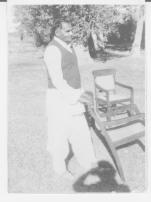
A. P. Gill
Noori Natt’s eyes crinkled as he stroked his flaring moustache. The floor to ceiling bars of his cell only seemed to enhance his legendary dash. He was enjoying the scene without feeling any discomfort at his situation.
On the manicured lawn of the Lahore, Qila Gujjar Singh police station, the little boy squealed with delight as his older brother picked him up and whirled him around while the girl clapped her hands and their young mother sat on a chair, smiling and knitting.
The old Police Stations in the Punjab are built around a hollow square entered through a gate protected by an armed sentry. Officers on duty sit in that block. The management offices face the entrance and the blocks on both sides connecting the entrance and offices are remand custody cells of which the inner wall looking out onto a lawn consists of steel bars. There is no interrogation room — buttock beating on the well-cut lawn surrounded by flower-beds serves that purpose.
Beret set languidly back on his head, constable Hector Lal Din strolled indolently along the verandah running in front of the cell bars. Bloody hawalatis, he thought as he sporadically stroked the bars with his six-foot long stave, while scratching his itchy crotch with the other. As he neared Noori’s cell, he smartened up. Noori, a man with a name on both sides of the India Pakistan border, was not be trifled with and could also be the source of a fat tip.
“Ohé Hectorah!” Noori’s said quietly.
Hector went up to the cell bars. “Jee Noori Jee?” he inquired respectively, ensconcing the renowned bandit’s name in respectful prefix and suffix.
“Who’re these kids?”
“A. P. Gill’s!”
“The magistrate who remanded me?”
Hector nodded.
“What’re they doing here?”
“Safe place for them to play!”
The little boy suddenly started running in the direction of the cell, his brother behind him.
He came up the steps to the verandah and then stopped, staring at Noori.
“Are you a dakoo?”
“Yes, a good one!”
“Daddy says it’s ok to talk to the good ones.”
“Hey, you little brat —” snarled the older boy, then stopped as Noori raised an authoritative hand.
“Don’t — your mother’s just behind you.”
The boy stopped.
The young mum in a shalwar kameez came up.
“Salam aleikum, Begum Sahib,” Noori respectfully greeted her.
“Wa aleikum as salam, Noor Sahib.”
He was taken aback by the woman’s courtesy.
“Do you know who I am, Begum Sahib?”
She nodded. “Yes, another human being with a family waiting for him. But you look well.”
“Begum Sahib, he’s very well looked after,” Hector added.
“I’m due to appear for my first hearing in Gill Sahib’s court tomorrow. I’m locked up on his responsibility,” he added, eyes twinkling.
“You know about my husband. He’s never been accused of an unjust decision, or favouritism. And he doesn’t take rishwat bribes.”
“That’s the worry, Bibi Jee!” he remarked with a twinkle in his eyes.
“Put it in God’s hands. Pray and I’ll pray for you.”
He noticed the cross around her neck and bowed his head. “May your Yesu Masih, our Hazrat Issa, bless us all, and Allah protect your beautiful children.”
Susan Gill walked away with her children and Noori’s mind went back fifteen years, just at the outbreak of the Second World War.
During the monsoon, in a dramatic dawn raid on a jeweller’s haveli mansion to the east of the river Chenab, Noori had decamped with five kilos of gold strapped to the saddle of his milk white steed. A police party led by Superintendent Nicky Nicholson and Sub Inspector Sant Singh Caleb Gill were hot on his heels. Pouring rain in a gale-force wind neither deterred them nor their horses, nostrils flared, snorting and foaming with effort and excitement. After half an hour’s unchecked gallop the police were unable to shorten the distance between themselves and Noori’s steed. The waves in the mighty Chenab seemed to reach up and touch the black sky drenching them to the bone. Without checking his steed, Noori plunged straight into the jaws of the mighty Chenab in spate.

Sant Singh Caleb Gill
Superintendent Nicky Nicholson, pulled in the reins of his galloping mount. The horse raised its forelegs and neighed in the classic stance of a checked gallop and so did the rest of the party. An expert, left-handed shot, Nicky drew his revolver and sighted on the back of the receding Noori. Sub-Inspector Gill, riding to his right, pulled the left rein of his stallion and dug his left heel in its side, careening into his superior officer’s mount, and spoiling his aim. The shot went wide and Gill prepared to resume chase. Before he could fully disengage from his last maneouvre, Nicky had seized the reins of his subordinate’s stallion.
Both men glared at each other.
“Let me get him, Sahib!”
“No. I won’t lose my best officer to the bloody Chenab for a dacoit.”
“But you’d shoot him in the back, Sahib? He’s a man among men and deserves as much!”
A millisecond’s face-off, then teeth shone through brown and white-tanned skin. Both officers exchanged nods, they wheeled their horses in an about-turn and dug their heels into their sides. The elite Punjab Police patrol galloped behind them amid the screams of their ancestral war cries.
The news of Sub Inspector Gill saving Noori’s life spread across the length and breadth of the Punjab. Shortly, Gill was tragically killed in the line of duty, but Noori was unable to pay his respects at his funeral. Noori’s arrest warrant, however, was submerged by the blood-letting madness of the 1947 Partition riots between Hindu / Sikhs and Muslims. Noori excelled himself by leading mounted parties to protect Muslim refugees fleeing Indian territory. And on the way in, he redeemed himself by taking Hindu / Sikh refugees into India. But he was unable to pay his respects at Gill’s funeral, and by the time Paartition settled it was too late and Gill’s younger brother was busy entrenching his magisterial reputation to replace his brother’s. It weighed heavily on Noori’s shoulders.
Noori shook his head. Hector had broken his reverie.
“There’s a message for you that was phoned into the office.”
The sudden lack of expression on Noor’s face told Hector how important the innocuous message was.
“All is well at home and elsewhere.”
“Thank you, Hector. You’ll be looked after.”
Hector bowed his head and strolled away.
Noori’s heart soared. At dawn, he would quietly walk out of his unlocked cell door and past the sentry, from where a Chevrolet Impala would take him to a private aircraft at Walton airport outside Lahore. He would be provided with two genuine passports in different names, foreign currency and a weapon. In a few hours he would be in Dubai. Then another thought hit his gut.
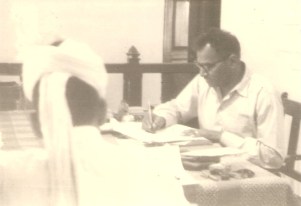
A. P. Gill holding court: the turbaned head is that of the court reader
Arthur Paul (A. P) Gill, section 30 magistrate, Lahore, was sub inspector Sant Singh Caleb Gill’s kid brother. Known in his family as Nikka’a, or kiddo, he had always wanted to be a magistrate and was fast-tracking his way to become a legend. Every morning he got in half an hour early to look over the day’s case files and today was no exception. Little did he realize, sitting on the dais, flipping the pages of Noori’s case file, that this day would be another personal and professional landmark. The fan whirred overhead and the morning was still fresh at that time.
“As Salaam aleikum, sahib bahadur!” a deep voice quietly greeted.
Nikka’a grunted without raising his head.
Footsteps neared the dais. Nikka’a finished the page, looked up and the world stood still. A. P. Gill suddenly felt being stared at, and looked up from The Pakistan Times. His blood ran cold, he silently started reciting the 23rd Psalm but maintained his composure. He looked straight into the eyes of the smiling, handsome face.
“Oi, Noori’a’a, what the hell are you doing here, without handcuffs, or a police escort!” he demanded, then smiled wryly. “You’re early!”
“So are you, Gill Sahib,” Noori replied, adjusting the two-horse chinese boskey silk kurta over his shalwar with one hand. The other hand held a smart leather briefcase. “But if I’m here, it’s not to hurt you, but to offer you a gift.”
“You insolent dog, I could take you apart with my bare hands,” Gill said flatly.
Noori inclined his head. “We who live apart from your society know you’re a hard man, Sahib-ji. Give me five minutes, then take me apart or call your police.”
Gill looked deep into Noori’s dark brown eyes, made a decision, glanced at his watch, and nodded.
Noori stepped forward, and put the briefcase on top of the railing that separated a magistrate’s dais from the public, clicked it open, then spun it around so Gill could see the contents.
Gill scowled at the contents.
“Check the revolver, Sahib-ji, and both passports.”
Gill removed the .38 Smith and Wesson revolver between two passports lying over packets of neatly stacked foreign currency, opened the cylinder, saw the shining brass of the cartridges, closed it, and offered it to Noori butt forward.
“Well?” Gill inquired, eyes glinting.
Noori pressed a lever, let the cartridges roll onto his other palm and put the revolver on the railing.
Gill grunted, and flicked open the passports, one British, the other Turkish. The picture in both documents was Noori’s, but not the names.
“Now please ring Walton Private Airport to confirm that a plane is waiting for Sheikh Azhar Zahoor’s private flight to Dubai.”
Nikka’ah put the phone back on its cradle and looked down at Noor.
“All right. What’s this tamasha all about?”
“Your brother spared my life. In return, I can’t steal your career — and it’s a brilliant one, Sahib jee! Had I said that I could escape at will in court later today, what would you have done?”
“Had you buttocks beaten to shreds!” Nikka’ah said with a grin. “So what are you hoping for?”
“Justice and mitigation.”
Gill nodded. “It will be done. Now fuck back to police custody before I change my mind and shoot you dead on the spot!”
Noori obeyed and Nikka’a kept his word.
Indo-Pakistan LOC Tikka Party
Source: Indo-Pakistan LOC Tikka Party
Indo-Pakistan LOC Tikka Party
Preamble. LOC Kashmir will offer autobiographical short fiction in one of the world’s most dangerous flashpoints, the 740 kilometer Line of Control dividing the Pakistani and Indian parts of Kashmir. Approximately 500,000 Indian and 300,000 Pakistani armed and battle-hardened troops face each other across their gun-sights. Both sides indulge in infiltration and aggressive patrolling. Exchanges of fire occur with regular frequency. This is where and how I spent my late teens, as a young officer in the wake of the 1971 Indo-Pakistan War, before having to enlist in the French Foreign Legion. I wish to see peace in beautiful Kashmir during my lifetime, even though I am not very hopeful.

http://www.google.fr/imgresimgurl=http%3A%2F%2Fabuabdulsamadz.co
 Azam Gill