Blasphemy: The Incident
Azam Gill’s latest novel
The first English novel written by a Punjabi Christian about the Christians of Pakistan.

Little Muthkar Masih’s life is in mortal danger, caught in Pakistan’s lethal combination of class and communal conflict, inequality, intolerance, fundamentalism and jihad overridden by the blasphemy law. This is the epic saga of lovers trapped in the dangerous world of the fallout from the Afghan Jihad in Pakistan. Louisa Skimmer is a lecturer in English literature. An urban, middle class daughter of a distinguished police officer, she studies at Lahore’s most prestigious ladies’ college. Piaro Masih learns trade craft at his father’s feet. He inherits his rural family’s role as a bandit and smuggler in the Punjab’s heartland. Can their love survive in the conflict between Islam and Christianity, caste and social class, East and West, theocracy and secularism? Testing their limits, considering the condition of women in Pakistani society and the excesses of orthodoxy and fundamentalism, events race to a tragic and blasphemous conclusion. The only witness is a child who must be protected.
Available at 880 bookshops including –
France: http://www.amazon.fr/Blasphemy-The-Incident-Azam-Gill/dp/3659704547
USA: http://www.amazon.com/s/ref=nb_sb_noss?url=search-alias%3Daps&field-keywords=azam+gill+blasphemy
UK: http://www.amazon.com/Blasphemy-Incident-Azam-Gill/dp/3659704547/ref=sr_1_1?s=books&ie=UTF8&qid=1448057701&sr=1-1&keywords=blasphemy+azam+gill
India: http://www.amazon.in/s/ref=nb_sb_noss/278-2970901-4840127?url=search-alias%3Dstripbooks&field-keywords=azam+gill+blasphemy
Canada: http://www.amazon.ca/Blasphemy-Gill-Azam/dp/3659704547/ref=sr_1_1?s=books&ie=UTF8&qid=1448039915&sr=1-1&keywords=blasphemy+azam+gill
Tea and Halwa ‘till the Next Round!
Preamble. LOC Kashmir will offer autobiographical short fiction in one of the world’s most dangerous flashpoints, the 740 kilometer Line of Control dividing the Pakistani and Indian parts of Kashmir. Approximately 500,000 Indian and 300,000 Pakistani armed and battle-hardened troops face each other across their gun-sights. Both sides indulge in infiltration and aggressive patrolling. Exchanges of fire occur with regular frequency. This is where and how I spent my late teens, as a young officer in the wake of the 1971 Indo-Pakistan War, before having to enlist in the French Foreign Legion. I wish to see peace in beautiful Kashmir during my lifetime, even though I am not very hopeful.

http://www.google.fr/imgres?imgurl=http%3A%2F%2Fabuabdulsamadz.com%2Fw
Tea and Halwa ‘till the Next Round!
It was late and only two officers remained at the folding metal mess table. They were humming to the faint sounds of the regimental song Badlu Ram ka jisam zameen ka neecha hai, aur hamko uska ration milta hai, drifting in from the men’s bunkers. The field mess of the Assam Rifles battalion deployed on the Kashmir Line of Control (LOC) facing the Pakistan army was a large underground bunker about eight hundred meters behind the front line.
Major Manjit Singh Chander, holder of the second highest gallantry award, the Maha Vir Chakra, yawned. His Company Officer, Second Lieutenant Albert Bajwa, fresh out of the Indian Military Academy, snorted. “Sick of this shitty meat, sir,” he retorted. “But there’s nothing to be done except survive on scrawny local goats.”
“Don’t ever say that, young man. There’s always something to be done.”
Albert nodded. That attitude had earned his Company Commander a Maha Vir Chakra.
“So what should we do sir? Go on patrol and nick a couple of chickens from a farm?”
Major Manjit Singh stood up and snapped his fingers. “You got it! Fresh meat. There’s plenty around without raiding farms!”
“Oh yes, sir! There’s game but with our 7.62mm SLR assault rifles there won’t be anything left of a partridge!”
“Ohé k’hughoo k’hordhé — hobby horse — I’ve got a shotgun!”
Albert’s eyes glinted.
“So tomorrow, 06H00, after stand-to, in front of my bunker.”
“Shouldn’t we inform the Pakistanis, sir?”
“No problem — they can tell the difference between the sound of a shotgun and an assault rifle!”
“What if we drift into their area?”
“Why the hell should we?”
Both Indian and Pakistani army la’angree cooks served the same breakfast of hot, sweet, milky tea, deep-fried puris and semolina halwa or chick-peas. By the end of the morning stand-to on the LOC, jeeps snarling on high revs rushed breakfast containers to the platoon headquarters where a jawan from each rifle section brought them through the crawl trenches to the bunkers.
That morning the Pakistani puris had been especially delicious, with halwa to match.
Due to the layout of the terrain, two-striper naik Ilam Din, Punjab Regiment, Pakistan Army and his two jawans, Karam Ali and Ghuncha Khan were in a bunker well forward of the line of deployment. It allowed the platoon to cover most of the dead ground in front although the rest of it sloped into Indian territory. After a clear field of fire of fifty metres their combat vision had to contend with man-high reeds on sandy soil. Which meant hard to see and hear. So they had to be alert at all times. It was thus.
“Ohé chughad, you’re writing poetry again?” Naik Ilam Din asked with a playful slap behind Ghuncha Khan’s head.
“No Ustad Jee”, he replied, using the respectful ‘teacher sir’ form of address used for a two-striper. “I’m writing to my uncle. Look!” He ducked a second slap.
Naik Ilam Din couldn’t read.
“So what’re you saying to him?”
Ghuncha Khan grinned wickedly.
“That I’m in the best rifle section of the Punjab Regiment and commanded by its best naik —”
“Ustad-jee!” Karam Ali’s urgent whisper from behind the MG-1A3 7.62 machine gun arrested Naik Ilam Din’s raised hand.
Ilam Din turned his head and Ghuncha Khan put his writing pad down, picked his G-3 7.6mm assault rifle and sighted along the barrel, index finger outside the trigger guard, thumb over the safety catch. Ilam Din cranked the handle of the field telephone and spoke in a rapid whisper.
The partridge were sprightly that morning and Major Manjit Singh a perfectionist. He wanted them from where he could get a decent shot. But they decided to move tantalizingly in short hops — birds do have their little ways. 2/Lt Albert Bajwa walked a little to his left, his 9mm Sterling sub machine gun slung casually over his right shoulder. The worlds of both officers had shrunk to the sight of hopping partridges.
They ignored the gentle rustle in the reeds but stopped dead in their tracks at the harsh command of “Rukk – hath uppar – ta’ali bajao” — halt, hands up, clap your hands. The last to ensure against a clutched grenade, pin out, ready to be thrown.
Both officers stood deathly still, then slowly turned left.
Naik Ilam Din and Ghuncha Khan had sprung up from the reeds, their G-3 rifles rock steady, bayonets fixed, fingers on the triggers, first pull-off, eyes professionally focused.
Albert’s glance went to his superior, ready to unsling his Sterling and blaze away. A casual gesture from Major Manjit Singh stayed his resolve.
“We are officers! We were just hunting.”
“I can see that Sahib! And welcome to Pakistan!” Ilam Din added cheekily.
“Is this how you treat an officer?”
A Junior Warrant Officer suddenly loomed into everybody’s vision, though out of his men’s line of fire.
“No, like this, Sahib!” he declared with a parade-ground smart salute.
Both Indian officers replied in the same manner.
“Naib Subedar Ashiq Bajwa, Punjab Regiment, Pakistan Army!” he said, moustache and voice bristling.
“Major Manjit Singh and 2/Lt Albert Bajwa, Assam Rifles!”
The hard planes of Ashiq Bajwa’s features cracked open into a smile, teeth shining whitely. A low, rumble rose from the bottom of his belly, became a chuckle and exploded as laughter. His men were expressionless, eyes on the intruders, fingers steady. The Indian officers grinned.
“What’s funny, Sahib?” Albert asked. Regardless of rank, Indian and Pakistani officers and troops alike address a warrant officer as Sahib.
“Two Bajwa Jatts, on opposite sides, respecting our contracts. But what’s funnier is —” and he paused for a loud giggle — “that young officers of the Indian army are as foolhardy as our own — good news for the next war!”
This time they all broke into laughter even though Ghuncha and Ilam Din’s gun barrels remained rock steady.
“I reported to our Adjutant Sahib. He says to turn you back!”
“Good decision. Thank you,” Manjit Singh said.
“But I’m not going to. I have a condition.”
Both Indians were suddenly back on their guard.
“You come with me, have our tea and halwa and then go.”
“Otherwise?”
“My men will cut you down.” His eyes were pitiless.
The Indian officers exchanged looks and nodded.
“Well then, halwa and tea win, Sahib! You and your adjutant are gracious.”
The smiles were back.
“God in His majesty, Sahib. Come. Time for tea and halwa. Then go back and prepare for the next round.”
WHAT THE US CAN DO ABOUT PERSECUTION OF CHRISTIANS
As such, from the downgraded semantics employed by professional diplomats and their staff, it is possible to gauge the real extent and intensity of persecution suffered by Christian minorities outside of Western democracies and some Latin American countries. The oppression of Christian minorities barely flits on the periphery of media interest.
Mainly, there is a general belief that all minority Christians are rice bowl converts — the residue of 19th century western colonialism. For the United States to use its power and influence for good on the behalf of an oppressed Christian minority at the risk of compromising its political agenda is not an option. Letting this minority survive as best as it can, is. Just as with the non-Christian Kurds in Iraq during the end days of Saddam Hussein. Thus, the thought that these residual remnants of colonialism are merely the consequence of an economic impulse flagellates western guilt for its redemption, with the hope that mercantile policies can be better pursued from this moral high ground.
Somewhere down the line, this argument has further suffered by being force-fed into the Iraqi and Syrian situations. After all, before the US went into Iraq, and the Arab Spring blossomed for the strategic benefit of militant Islamic fundamentalists, eventually leading to the Syrian civil war, Christians in Iraq and Syria were said to be happy with their lot. As happy as they could be by murky suffrance. Their survival depended on a policy reminiscent of a “don’t see don’t tell” approach: conversions to Christianity were illegal, and to the best of my knowledge, even a capital offence. At the same time, the Syrian Orthodox church colluded with the state to persecute Christian evangelists of other denominations. The US State Department, meanwhile, blithely pursued its diplomacy as the ranks of persecuting-country immigrants in the American Dream swelled, and in proportion to their prosperity, were able to dictate where and when — if at all — Christmas Trees would be lit.
The foreign policy of the United States also appears to have inspired its immigration policy of generously opening its doors to immigrants from countries where Christians undergo direct discrimination. While these immigrants are enabled to hold stock options in the American Dream, their Christian fellow citizens in their homelands only hold shares in a Living Nightmare — of fear and insecurity during their lucky periods when their homes and churches aren’t torched. Such a policy can safely be criticized as being absurdly disproportionate.
The underlying positive discrimination in the United States’ immigration policy leaves Christian minorities to languish in their predicament, since there is not a single country that has passed positive discrimination laws for the protection and uplift of a depressed Christian minority. Their expatriate dual citizens in the United States, however, may prosper under these laws if they care to.
Except in some individual cases, the United States has no policy to accommodate Christian minority applicants to the United States as refugees from persecution. Yet, in furtherance of its policy during the Cold War, escapees from Communist countries received a treatment almost on par with that accorded to economic immigrants from countries where Christian minorities are actively persecuted.
It is regrettable that this policy shows no signs of being revised in order to redress the unfavorable situation of Christian minorities.
The implicit policy of ignoring the plight of Christian minorities and seeking to assuage western guilt for colonialism has reached an impasse. In any case, carrying this burden is an exercise in the absurd. United Fruit’s dubious approach to Latin America and Hearst’s ‘Hully Gee it’s War!’ notwithstanding, the US never was a colonial power, even though it received the ‘white man’s burden’ from Kipling. This policy begs to be revised — nay, excised. As Alexis de Tocqueville said in Democracy in America (1835), “The greatness of America lies not in being more enlightened than any other nation, but rather in her ability to repair her faults … If America ceases to be good, America will cease to be great.”
Recognizing the suffering of Christian minorities without taking active measures to redress it has been a mistake. It can be repaired by extending a policy of positive discrimination or most favored status to Christian immigrants from countries in which they are a minority.
Also see The New York Times Magazine at http://www.nytimes.com/2015/07/26/magazine/is-this-the-end-of-christianity-in-the-middle-east.html?action=click&contentCollection=magazine®ion=rank&module=package&version=highlights&contentPlacement=2&pgtype=sectionfront&_r=0
Sexually Repressed Military Police: LOC 1973
Preamble. LOC Kashmir will offer autobiographical short fiction in one of the world’s most dangerous flashpoints, the 740 kilometer Line of Control dividing the Pakistani and Indian parts of Kashmir. Approximately 500,000 Indian and 300,000 Pakistani armed and battle-hardened troops face each other across their gun-sights. Both sides indulge in infiltration and aggressive patrolling. Exchanges of fire occur with regular frequency. This is where and how I spent my late teens, as a young officer in the wake of the 1971 Indo-Pakistan War, before having to enlist in the French Foreign Legion. I wish to see peace in beautiful Kashmir during my lifetime, even though I am not very hopeful.
http://www.google.fr/imgres?imgurl=http%3A%2F%2Fabuabdulsamadz.com%2Fwp-
Leaving over two hundred thousand rupees of the battalion’s monthly payroll in the care of my three-striper havildar and two privates, I strode light-heartedly down the bazaar in Gujrat, Pakistan’s 18th largest city with a population the size of Houston packed into Pasadena, 173km southeast of Islamabad, between the rivers Jhelum and Chenab. Gujrat was one of the transit points for getting to the Line of Control between Pakistani and Indian troops deployed in Kashmir. It took an hour’s drive on a pot-holed dirt road, visibility obscured by khaki dust kicked up by a vehicle’s passage.
That day, and at that time in Gujrat, I wasn’t thinking of the dust cloud. I had had something better to think of.
The paper bag filled with just-bought Old Spice after shave and deodorant would please Dolly nicely, I thought. Not old Eden Roc from Mirpur, that backwater 97 kilometers north-west of Gujrat, known as Little England from where much of its population, displaced by the Mangla Dam (9th largest in the world), had migrated to Britain so that the poor Brits could lay off their boiled-to-hell three-veg and overcooked meat for the pleasures of sizzling Balti gosht and heavenly table nan, leaving nothing behind in Mirpur for a young warrior to slake his desires.
I only went to Mirpur because I had to. That’s where the State Bank of Pakistan and the Pakistan Army, in their uncontested wisdom, had decided that my battalion should receive the monthly payroll. So I had been ordered to go there in an open jeep with an escort of a three-striper havildar and two privates to draw out the battalion’s payroll in cash. Pakistan Army troops liked their salary up front, handed out by their officers in command. Besides which, they didn’t have bank accounts either. Not many Pakistanis did, in those days, without a recommendation from some sort of a self-inflated VIP!
The armed escort was not to protect against bandits – I alone could have handled that, though looking at me one might be skeptical of that disability. Those battle-tested warriors accompanied me to ensure against the Indians ambushing a pay party on the back tracks. On occasions — typically to pay off a high-level informant — the intelligence services of both countries decided that they needed their enemy’s ‘real’ rather than the usual counterfeit currency with which they financed their clandestine operations. Natural law being unjust to the weak, it was usually a keen young Lieutenant who had the honor of either leading an ambush party or being the victim of one.
Life.
But in Gujrat, as on the metalled roads cutting through fields devoid of cover or broken ground, there was no risk of ambush. So I could leave the jeep and nip into the bazaar, which is what I did.
I breathed deeply and enviously — being assailed from either flank by the sensory explosion of centuries old spices from tantalizing pyramids of palaas and biryaanees in paraat dishes and a variety of hard-coal grilled meat – tikkas, tikkies, and those indecently enticing seekh kebabs! The gestures of moustached kareegar chefsand their assistant shagirds danced in my peripheral vision — glowing coals releasing primeval impulses. Gritting my teeth, I rained silent curses on my gastronomically illiterate Batallion Commanding Officer who’s competence stopped at the mess entrance but authority continued unabated. Having whipped our unit into shape, he was convinced that it was in the best interests of his officers to eat blander than the British: chillies, spices and ghee were considered more lethal than the Indian army! My mommy was upset for me.
And then another scene loomed in my vision, jerking me back to the harsh reality of border duty. At the chownk crossing, my three-striper havildar was standing to shun outside the jeep getting a rocket from a Military Police (MP) Major. The two jawans guarded the monthly pay in the jeep, eyes stroking the Major, waiting for orders to cut him down if necessary. I inserted myself in the Major’s vision, came to shun, gave him my smartest salute, and introduced myself in English.
He turned his full glare on me.
“Who the hell are you? Where’s your rank? I’ll arrest you for impersonation!”
“Sir, I took my pips off to go to the bazaar. Can’t buy Old Spice in Chamb sector! And Dolly likes it!”
“Don’t be cheeky and irrelevant! You took your pips off to visit a bloody brothel! And left your battalion’s payroll unattended in the jeep. ****ing negligence!”
“Sir, we’ve been taught that walking around in a bazaar displaying rank cheapens it! We’re also trained to trust our men. And they’re worth it!”
We stared at each other, neither of us backing down.
The Major drove off with his two MP stooges, promising retribution.
The sexually repressed MP Officer was from Corps Headquarters, Kharian, and sent a report about the incident to my anti-chillies-masala-ghee Commanding Officer (CO). Returning to the unit, I had immediately reported the incident to him. He fired a short verbal rocket up my what’s-it, then a long interrogatory one that left me twitching. However, in reply to the MP’s charge, he wrote that having full confidence in my integrity he was certain I had not sneaked off to a brothel to slake my lust.
Had the MP Major kept his nose out of my sex life, the CO might have put me on adverse report, or at least demanded a written explanation.
The major and my CO, whose sterling leadership qualities fizzled out in the officer’s mess, both got their comeuppance.
It was rumored later that the major had been caught in flagrante delicto with a lady of pleasure while his wife was having labor pains. Imagine. And eventually, the CO of unchallenged professional integrity, was weaned off his gastronomical perversions by a busty mistress who made superb — but absolutely superb — lamb korma and potato parathas.
LOC Kashmir – General Shuhrat the Slayer
Preamble. LOC Kashmir will offer autobiographical short fiction in one of the world’s most dangerous flashpoints, the 740 kilometer Line of Control dividing the Pakistani and Indian parts of Kashmir. Approximately 500,000 Indian and 300,000 Pakistani armed and battle-hardened troops face each other across their gun-sights. Both sides indulge in infiltration and aggressive patrolling. Exchanges of fire occur with regular frequency. This is where and how I spent my late teens, as a young officer in the wake of the 1971 Indo-Pakistan War, before having to enlist in the French Foreign Legion. I wish to see peace in beautiful Kashmir during my lifetime, even though I am not very hopeful.

http://www.google.fr/imgres?imgurl=http%3A%2F%2Fabuabdulsamadz.com%2Fwp- …
General Shuhrat the Slayer
Just as I emerged from the tomb into the sunlight, the one-star general commanding our Brigade was standing in my path like a two-handled mug, swagger stick dandily clutched in his right hand. Passing by in his jeep he had not failed to notice soldiers going in and coming out of the Sufi Saint’s tomb. He now wanted to give the officer responsible a dusting.
I gave him my smartest salute with the PMA Haider One flick, something I used to be known for.
He was of medium height, wheat-complexioned with a stocky body under a rocky face. One of his ancestors must have been an Uzbek, I thought behind my expressionless stare as I silently christened him Shuhrat the Slayer.
He looked me up and down.
“Follow me!”
We were now under the shade of a sukh-chaen peace and happiness tree to the side of the entrance. A little brook gurgled in the background. The setting was an appropriate balance to the rocket that would be fired up my behind.
“You’re on a route march, not a tourist trip. Your men are illiterate Muslims who need to be discouraged from saint-worship type practices. Yet, you, a Christian officer, are encouraging it. More, you’re leading it. Explain.”
Shuhrat the Slayer’s voice was tempered steel, eyes carved from marble.
“Sir, we Christians love Mian Mohammed for his t’ha dé masjid t’ha dé mandir. And if I participate in a ritual with my troops, it will strengthen my leadership and raise their morale. The old Brit officers used to do things like this.”
“Hmm, “ the Slayer grunted. “Your route march was supposed to be four hours, finishing time 12 hundred hours. Finishing time now is 1130 hours. Double up to the finish line, Lieutenant!”
“Sir!”
I came to the salute.
Shuhrat the Slayer replied, turned around, whacked his thigh with his swagger stick and hopped into his open topped jeep. At a nod, the driver gunned it, sprayed grit and they disappeared in a cloud of dust looking, no doubt, for other prey.
Mian Muhammad Bakhsh, the Sufi author of Saif-ul-Maluk is buried near Mirpur, in the northwestern foothills of Kashmir in Pakistan. His tomb is near enough to the Line of Control to give civilians a shiver, yet far enough from this front line to allow the Pakistan army to retrieve about a third of a rifle company’s strength from the trenches for continuous training.
Accordingly, back in 1973/74, I was taking my troops on an endurance route march, a welcome break from the sight of gun-toting Indian warriors on the other side of the LOC. While enjoying the view of the countryside, thoughts of Dolly intersected visions of mouth-watering makhadi halwa semolina desert and cardamom laced tea waiting at the finish.
Eyes fighting sweat-drops, glands exuding feline odor, we rounded a bend of the tree-lined back road straight into dazzling sunlight that overwhelmed my vision. It was reflected off the marble walls of a domed structure. A shrine, I could tell and couldn’t keep my eyes off it. I might have ended up with a crick in my neck except for Subedar (Warrant Officer) Mohammed Khan, from Sargodha. Luxurious moustache twitching, he said: “Saab, that’s Mian Muhammed Baksh’s mazaar “.
He had an expectant look on his face, mirroring my own. The Sufi’s reprise of Baba Bulleh Shah’s original “t’ha dé masjid t’ha dé mandir” started buzzing in the tiny muscle between my ears:
Smash down a mosque
Smash down a temple
But break not the heart of man
For God resides in there: https://www.youtube.com/watch?v=rYMw4BbSCSg
Like other Punjabi Christians, I too read this segment of Sufi enlightenment as inspired by 1 Corinthians 6:19 in the Holy Bible. My heart and step quickened and I went in with my men on a quick rota system.
Which is what Shuhrat the Slayer had seen.
Although he had the tact to fire his rocket out of the hearing of my men, in English and without a single insulting discharge, I still felt a slight tingling where I shouldn’t have.
As my one-mum’s good little Christian boy, I confessed all to the Lieutenant Colonel commanding my Battallion, an admirable officer in the finest traditions of the British Indian army. He gave me a long, keen look and chuckled. Then and later, we were both surprised to learn that the General had never officially or unofficially mentioned the incident. Appearances aside, Shuhrat the Slayer ended his day as an officer and gentleman.
From all accounts, this species of officer is still alive and flourishing!
BBC Asian Network allergic to Asian Christians
Discrimination and persecution make a hearty meal of silence and invisibility.


https://tangleofwires.files.wordpress.com/2010/07/asian_network.jpg;http://stanselmchurchsouthall.com/wp-content/uploads/2013/01/br-D-ceremony1.jpg. Right – a typical Asian Church in Souhtall, London!
BBC Asian Network delightfully intersperses the United Kingdom’s Asian Diaspora issues with music, news, interviews and phone-ins. When relevant, the DJs often collectively address Hindus, Muslims and Sikhs, but I have yet to hear them including the quarter million or so Asian Christians or Zoroastrian subjects flitting on the Kingdom’s landscape. And so, wherever they might be, oriental Christians remain invisible to the Western World waiting to be brutally killed before catalyzing dead-end political semantics.
Discrimination and persecution make a hearty meal of silence and invisibility.

http://www.ashgate.com/images/9780754662617.jpg
Accordingly, Invisible Diaspora, edited by Knut Jacobsen and S. J. Raj and published by Ashgate (2007), draws together studies of South Asian Christians in Europe and North America.
“The Christians concerned are doubly invisible: firstly, because the majority of Christians in Europe and North America are either white (of European background) or black (of African and African-Caribbean background); secondly, as most South Asians are Hindu, Muslim or Sikh, many people – whatever their own ethnicity – are unaware of the presence of Christians from Indian, Pakistani, Bangladeshi and Sri Lankan backgrounds in countries such as Britain…. local and central Government grants are available for non-Christians for building community centres but not for South Asian Christian communities”. http://www.shapworkingparty.org.uk/journals/articles_0708/nesbitt.pdf
Perhaps that is why The Hindu, one of India’s major dailies, ran this headline on June 29, 2010:
“Indian Christians feel unwelcome in U.K. churches”.http://www.thehindu.com/news/indian-christians-feel-unwelcome-in-uk-churches/article491996.ece


https://lh6.googleusercontent.com/-8yaakBFRur4/AAAAAAAAAAI/AAAAAAAAAME/KsXPMFO6nfo/photo.jpg; http://www.gracebaptistpartnership.org.uk/wp-content/gallery/southall-thanksgiving-service-january-2013/p1010415.jpg
Be that as it may, the BBC Asian Network seems to be tight on space for Asian Christians.
Yet, South Asia itself is home to nearly forty million Christians, exceeding the total population of explosive Afghanistan by ten million. And back in South Asia, they are pretty visible.
In 1960, the lyrics of Mukesh’s hit theme song for Bollywood’s original Chhalya addressed all communities: Chhalya mérà naam, Chhalya mérà naam, Hindu Muslim Sikh Isai sab ko méra sala’am— Chhalya is my name, Chhalya is my name, To Hindus, Muslims Sikhs and Christians I give my sala’ams— https://www.youtube.com/watch?v=CjkifP5G19o (BBC Asian Network’s DJs need to listen to this song!).
Hardly surprising, considering that the movie was inspired by Fyodor Dostoyevsky’s White Nights and focused on the anguish of family estrangement as a consequence of the 1947 Partition of India and Pakistan: https://www.youtube.com/watch?v=CjkifP5G19o
All the same, up until recent times, Lollywood and Bollywood’s recognition of India’s over thirty million Christians wasn’t worth writing home about. Just as Sikhs were depicted as recklessly courageous buffoons with doubtful IQs, Christians were gold-hearted Anglo-Indian secretaries in skirts, had off-beat morals and spoke Pidgin Hindi— the residue of colonialism who bore the brunt. Even after shedding most of the stereotyping, pidgin Hindi lingered on until the nineties. Christian characters consistently said ‘Hum God ko bolta (we speak (to) God’ while speaking Hindi, reminiscent of Hollywood’s depiction of Native Americans grunting Injun brave-um kill-um white man ugh!
One only has to walk past a church on a Sunday mid-morning to hear charged voices crying Rabb, Khudawand, Allah and Prabhu (Punjabi, Urdu and Hindi for God) while one of the most popular hymns in North India and Pakistan is Jai Jai Yesu— musically, a classic Hindu bhajan with Christian lyrics: https://www.youtube.com/watch?v=fkbsa2jRqF8, sung by the Cornerstone Asian Church choir to desi instrumentation.
This century has ushered in a refreshing change that may be noted in hugely popular movies like 7 Khoon Maaf (2011) and John Day (2013), in which the main protagonists are Christians who can actually— wonder of wonders— speak Hindi!
These changes in India might outpace Lollywood on the issue but being stuck in the Strait of Jabal Tariq leave the Brits blissfully unaware of the existence of a quarter-million Asian Christian subjects languishing for recognition by the BBC.
Attacks on Christians in India and Pakistan affirm the visibility of South Asia’s exposed Christians. That should not be the price for South Asian Christian recognition in the United Kingdom on Malika Elizabeth’s watch.
Teddyism in South Asia!
O’ Teddy, my cruel and heartless lover, she sang!


Well before Britain started growing and exporting chilies to India and Pakistan, it cried victory over Teddyism, the youth sub-culture of the 1950s, enthusiastically lapped up by Pakistanis. Its remnants, buried deep in Britain, still flourish in Pakistan.
In the early sixties, boys strutted with their feet in pointies, legs in narrow bottomed, tight trousers, chests in tight shirts and Brylcreamed duck-tail hairstyles — after all, Teddyism and Preslyism overlapped in time. The smell of Old Spice and King’s Men after shave made the girls hide their smiles.
https://encrypted-tbn3.gstatic.com/images?q=tbn:ANd9GcRm2Cjril-ksAZSWRmDX-bFcpQ_OD-Rr19vcDxi8WnHE_PKfL7nLg; https://encrypted-tbn1.gstatic.com/images?q=tbn:ANd9GcQkG8-QPHP2hy4QWetdlPQ7Qj9Dzx4JltDl6JdWJDfUQecC0yhV
Dolly liked it, though she hid her smile as best as she could.
After all, actually being caught smiling was considered ‘forward’ or too ‘modern’ for a Pakistani girl.
Yet, although South Asian women never directly adopted Western styles of clothing, girls themselves were not immune to the influence of this style on their traditional couture.

http://glamstruck.com/wp-content/uploads/2012/09/Sharmila-Tagore.jpg
The indirect influence was clearly visible in the Ladies’ Teddy Suit of form-fitting pajama bottoms under mini-kameezes or kurtas inspired by Mary Quant’s mini and micro skirts while diligent back-combing was de rigeur.
We are, of course, referring to the hello jee western-educated urban middle classes.

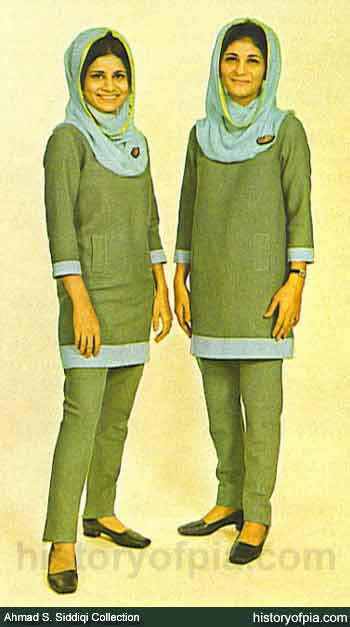
This look was exemplified by the Pakistan International Airlines flight attendants’ new uniform designed by Monsieur Pierre Cardin in 1966, respectfully called Pir Khair Deen by many.
Anyway, the dopatta long scarf over a teddy suit was draped in different styles reflecting the wearer’s degree of emancipation. Some girls discarded it entirely, shocking people out of their business. But that wasn’t the only outrage about the teddy fashion.
Since their birth, the parental generation had been used to seeing white and brown Englishmen both wearing shape-hiding shorts and trousers that flapped around the legs. They were suddenly confronted with this shape-showing fashion, and in fact were most worried about the possible consequences on their growing children’s feet stuffed into narrow pointed shoes.
But all to no avail.
Teddyism took hold, spurred by Nazir Begum’s song Teddy Balam, hai zalam in the 1963 film Chooriyan, the first Pakistani Adults Only film. Tufail Farooqi’s lilting composition and Nasira’s gyrations gave the lie to Kipling’s “East is East and West is West and ne’er the twain shall meet.” East and West met with a box office bang in this song:
https://www.youtube.com/watch?v=ameii-4gUNI
:

http://i.ytimg.com/vi/c-HfNZEb5IY/hqdefault.jpg
Mein rang rangeely teddy
Mérà piyar vee har dum ready.
I’m a multi-colored teddy
I pant for my love is ready
To top it all, the melody was interspersed with English words like welcome, fashion, position, aeroplane, my darling kiss my hand to make Pakistanis dream and view themselves differently.
The sharp, short sound of ‘teddy’ had a welcome impact on the Pakistani ear, the word slipped into colloquial language, and is still thriving.
In 1961, Pakistan had adopted the international decimal system, with 100 paisas to a rupee. As the one paisa coins were very small in diameter they were promptly dubbed teddy paisa. The name has stuck.
Someone of short stature, even in a shalwar kameez was called Teddy. The word even unnaturally united academia and the military. One of the Punjab Regiment’s best drama artists was Lance Corporal Salim a.k.a.Teddy, and one of the best known professors of English Literature at Forman Christian College, Lahore was also Salim a.k.a. Teddy. One was in khaki, the other one zigzagged across the leafy campus in a dark, tight-fitting teddy suit. Neither was aware of each other’s existence, except perhaps to one of Professor Teddy’s former students who just happened to be the Lance Corporal’s Company Commander!
Through both Salim Teddies the army and academe united in an ironic recognition of this little understood British movement.
In the 1950s a section of British youth decided to revive the fashion of King Edward VII’s era from 1901 to 1910 with an influence measured until 1917.
“Originally known as Cosh Boys, the name Teddy Boy was coined when a 1953 Daily Express newspaper headline shortened Edwardian to Teddy.”
The first youth group in England to call themselves teenagers, they helped to create a youth market. They also distinguished themselves in the 1958 Notting Hill race riots in London by beating up helpless West Indian immigrants before they discovered their manly pride in paki-bashing.
Just as the word Jugni originates from Queen Victoria’s Jubilee it was appropriate for Teddyism to be institutionalized within this Punjabi musical form:
Ik din Teddy gayi darbar
A’ap andar té burka ba’ar
Ohnoon pawé Data’a di ma’ar
Ohé pir méréya Jugni kehndi aé
Té na’am Ali da,
Ali da
Na’am Ali da layndi aé
Teddy went to Saint Data’s shrine
She found herself inside
With her burka covering outside
May she be struck by Saint Data
O’ my saint so Jugni says
As she takes the name of
The name of
Takes the name of Hazrat Ali
But at the end of the day, believe me, Dolly in a teddy suit was worth a million teddy paisas!
Come, Let Us Reconcile …
http://t2.gstatic.com/images?q=tbn:ANd9GcTLQhOPS5HoQFfLCHp_JK6FcJI4PRGghfeS5aofZZyfVx-Vyz59KKyY68-o
Lurking beneath cozy semantics, relations between the West and the Islamic world remain trapped in the past.
Three factors scream their guts out for a seat in related paradigms.
The 13th century Siege of Baghdad by the Mongols under Halaku Khan marks the end of the Islamic Golden Age, and not the Western Industrial Revolution’s need for raw materials and markets that led to colonization. Yet, no bitterness is directed at Mongols or Mongolia, perhaps because their underdeveloped state is unconsciously taken to be nature’s punishment!
Secondly, Islam expanded into Eastern and Western Christendom well before European powers occupied Islamic lands.
Thirdly, while the Islamic world and the former Christendom beat their chests about their superior colonial governance, neither is untarnished by the dark stain of institutionalized discrimination and slave-trading.
They claim the moral high ground and undermine each other in callisthenic one-upmanship!
Halaku Khan the Mongol ground the Abbasids and their fine civilization into dust, danced gleefully around burning libraries and spitefully had salt ploughed into Iraq’s fertile land.

http://www.museumofthecity.org/wp-content/uploads/2013/07/history_timeline_photo_09_1.jpg
Consequently, the Ottoman and Persian empires were unable to spawn an Age of Enlightenment and its golden goose, the Industrial Revolution.
Yet, simmering resentment at the West’s success is close to boiling point.
Preaching from pulpits can stoke, cool or redirect resentment.
Preachers need to be taken on board to tell their congregations why the West took a lead and guide their flocks in the same direction.
The past neither needs to be buried, nor resurrected, but studied as a compass for a common, interlinked and interdependent future.
Over a thousand years of blood-drenched Franco-German rivalry was neutralized after World War II by creating a structure of economic interdependence. Admittedly, both nations had the same level of economic, scientific and social development. That seems to be the one way out of this impasse of alarming Western-Muslim rivalry, further complicated by the many warring worlds the Islamic world.

The much maligned and politically incorrect Clash of Civilizations was the work of Professor Huntington, a staunch American Democrat and life-long liberal. Now George Friedman of Stratfor seems to have excelled himself in a forthright and pointed analysis entitled A War Between Two Worlds, despite a title rich in multi-directional meaning.
Although Friedman is right in saying that much of the Muslim antipathy comes from having been bypassed by the industrial revolution, it is regrettable that he has circumvented the effect of the 13th century Mongol invasion.
Yet, his scholarly article remains a time-worthy read: http://www.stratfor.com/weekly/war-between-two-worlds#axzz3Oyy3waWV.
However, at the end of the day, time-honored models for studying geo-strategic challenges were never expected to be infinite and need to be re-assessed.
Newer models relevant to the imperatives imposed by the raw intelligence material are a compelling need.
The Charlie Hebdo Attack: aftermath?

http://ichef.bbci.co.uk/live-experience/cps/912/mcs/media/images/80171000/jpg/_80171382_80171381.jpg
Tuesday, January 6th , 2015, in remembrance of the Magi who followed a star to visit the new-born Christ child, epiphany was being celebrated in France with the usual tradition of eating an almond and butter stuffed gallette. Whoever bites on the hidden ornamental figure is pronounced king and wears the paper crown. Very few remember the blood drenching of the day following Epiphany. When the Magi failed to report the location of the Christ child to King Herod, he had every new-born baby massacred.
In a macabre display of blood-letting on the day after Epiphany, two French citizens by birth decided to avenge the insult to the Prophet of Islam (PBUH) who had been satirized in cartoons by the French left-wing weekly Charlie Hebdo in 2006.
The magazine had rerun the Danish Juland Post’s cartoons and added a few of its own. Islam having a strong aniconic tradition, a graphic representation of any of the prophets mentioned in the Holy Qura’an is taken as a deadly insult. That includes Hazrat Issa, (Jesus Christ), Hazrat Musa(Moses) Hazrat Daud (David) and of course Prophet Muhammed (PBUH).
The preceding decades have seen strong criticism of movies such as The Last Passion of Christ, King David, The Ten Commandments and others, banned in most Muslim countries. Although there was no lampooning of the prophets, yet their graphic representation was enough to incense the Islamic world. Muslims do not, by and large, feel that a simile might lead to a metaphor and thus become a pardonable offense. Nor do they appreciate the didactic value of image-based teaching.
Not where their holy prophets are concerned.
Eight years after Charlie Hebdo exercised its Voltairian right to use satire in order to draw public attention to situations in need of remedy, the French born brothers Kouachi burst into the offices of Charlie Hebdo, coolly shot dead the editor, ten of his staff, two police officers, and calmly walked out declaring that they had avenged their prophet.
That may be, but the act has received condemnation from Muslim clerics across the spectrum of the Islamic world.
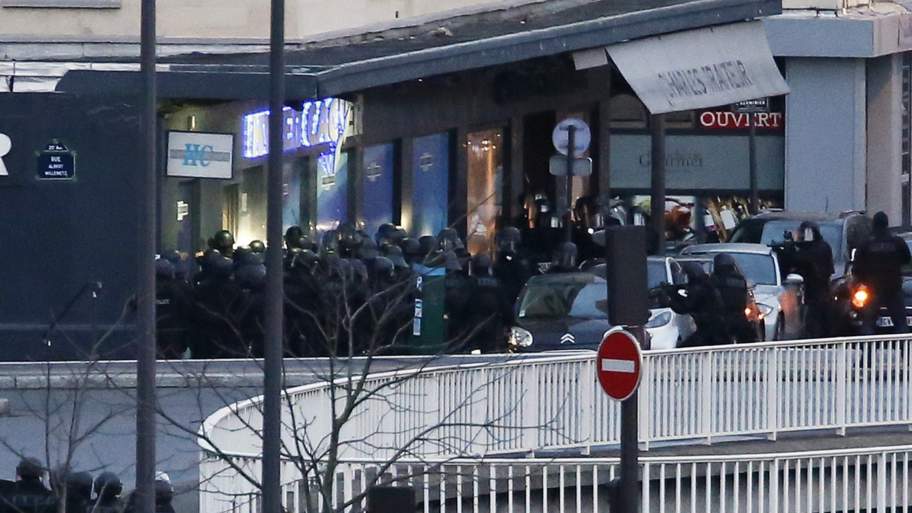
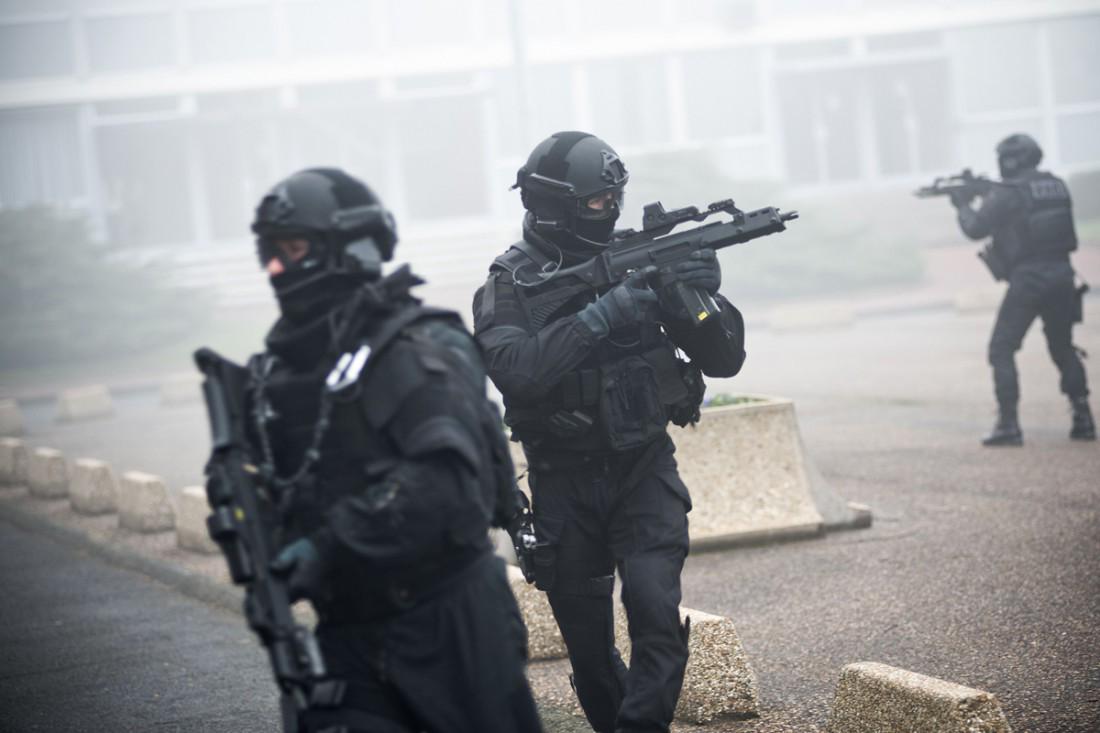
The perpetrators were cornered in business premises and shot dead by France’s elite GIGN counter-terrorism troops. Their associate had taken hostages in a Kosher supermarket, killed four, and also been shot dead.
The final body count between January 7 and 9 was twenty including the three offenders, with twenty-one injured.
https://pbs.twimg.com/media/B65RIiNCAAATLpY.jpg:large
Paris was terrified and France was outraged.
Some mosques were defaced, but in general there has so far been no repressive backlash on France’s five million Muslims unrelated to this misguided act.
Which, its savagery apart, it is.
Somewhere down the line, the perpetrators gave the perceived interests of the Muslim Umma a higher priority than the land of their birth. They elected themselves judge, jury and hangpersons on the behalf of Muslims who, however incensed they might be on the issue, do not believe it justifies cold blooded murder in the name of their prophet.
The Kouachi brothers had obviously rejected their affiliation with their welfare nation state. That association is one of the foundations of the vaunted French public education system, which failed the Kouachi brothers and the French nation when and where most needed. The Kouachi brothers too, failed their system and deliberately betrayed the land of their birth.
Something is rotten somewhere, in and far beyond the state of Denmark.
Attacking Charlie Hebdo for its cartoons eight years after the commission means that the act hopes to generate a backlash on Muslims, widen communal gulfs and destabilize France. And that is strategy beyond the reach of the Kouachi brothers.
Someone somewhere is pulling global strings following an agenda with strategic objectives. A million marchers in Paris led by forty-eight world leaders bursting with high-calorie semantics that make good press will not impress them.

 Azam Gill