Lady Di’s Death Revealed Unchanged Passions: Part 4— Tony, Champagne Charlie, Elton John, hugs & tears

ttp://www.google.fr/imgres?imgurl=http%3A%2F%2Ffc05.deviantart.net%2Ffs70%2Fi%2F2014%2F144%2Fb%2Ff%2Fgroup_hug_by_tiitra_tear_heart-d7jitlh.jpg&imgrefurl=http%3A%2F%2Ftiitra-tear-heart.deviantart.com%2Fart%2FGroup-Hug-

Mr Blair was able to successfully walk the space between word and act due to the clear signals emanating from the people’s expression of grief at Lady Diana’s untimely demise. The funeral was practically stage-managed by the government, and the hillocks of flowers in front of Buckingham palace combined with the hints dropped in Mr Blair’s speeches pressured the Queen into coming from Balmoral to Buckingham for the funeral. She was not even allowed to passively disapprove of Lady Diana’s manner of living and dying. There were open tears and passionate speeches during the funeral ceremonies, uniting the high and mighty with the lowly and humble. Complete strangers just hugged and wept, and Lady Diana’s brother, also known as “champagne Charlie” made an impassioned speech the contents of which clearly criticised the royal family.


http://www.curatedobject.us/.a/6a00e54f9f8f8c883401630359614b970d-pi;  https://writegill.com/wp-content/uploads/2014/11/badfb-elton_john_365905.jpg; http://blogs.law.harvard.edu/houghton/files/2012/06/ms-thr-858_000001.jpg; http://ghostneuquino.files.wordpress.com/2010/11/att00026.jpg

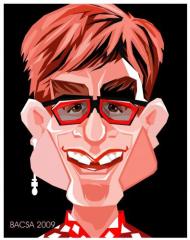
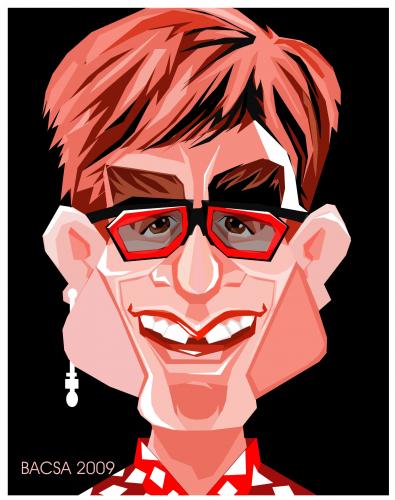
Elton John composed and sang Lady Diana’s eulogy, Candle in the Wind, (putting Marilyn Monroe at par with a Royal) the translation of which was carried on the front page of the prestigious French daily, Le Monde, while not a whisper of reserve escaped from the Royal household to question the appropriateness of Elton John’s sexual preference. There was disappointment from the public about the Royal Family’s dry-eyed stiff upper lip reaction to the tragedy, and the courtiers gave no press statements on the subject. When the public espied Camilla Parker Bowles, she was liberally assaulted with bread-rolls. All these were signs that the Britain of that day was no longer the Britain of preceding years.

http://www.victorianweb.org/images/medals.gif;

However, before Victoria became Queen-Empress of the British Empire, the British might not have been described as touchy-feely, but they certainly were not Victorian in the sense of the term we now use. Victorianism is not a fundamental cultural or genetic trait of the Anglo-Saxon peoples. The words bawdy and raunchy had never lost their relevance since the Shakespeare. The Elizabethan age was the times of Shakespeare and Marlowe, when what is sexual innuendo today was explicitly expressed on the stage, and moreover, appreciated. We may go further back to the times of the legendary Robin Hood and his Merry Men, when, despite the religious fervour inspired by the Crusades, merriment was a sought after virtue. The British were a rambunctious, hard-drinking lot of tavern brawlers who became successful pirates before being legitimised as corsairs. The tradition of merriment continued to be appreciated through low-brow soap operas and street artists, and has now been democratised in an increasingly heterogeneous society in television sit-coms such as Benny Hill, Fawlty Towers, Yes Prime Minister, The New Statesman, East Enders, Coronation Street and Goodness Gracious Me.

Lady Di’s Death Revealed Unchanged Passions: Part 3— Fear for Britain

Part 3— Fear for Britain.

http://www.google.fr/imgres?imgurl=http%3A%2F%2Fimage.guardian.co.uk

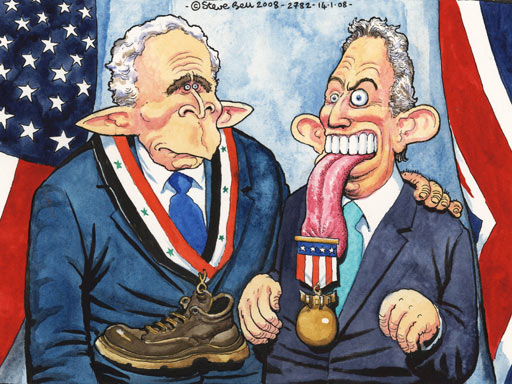
The death of functional conservatism within the British Tories led Dame Thatcher to give her blessings to Mr Blair, and shortly thereafter, Mr Blair made every effort to ensure that Dame Thatcher would not regret her decision. He shored up the special relationship with Washington, much to the United States’ advantage, as time has shown. Abandoning the traditional socialist approach, he merged the Self-Regulatory Organizations into the Security and Investments Board, lending it a structure similar to the United States Security and Exchanges Commission, and setting it up as a counter-weight to the Bank of England.

With the economic interdependence of the United States and Britain ensured, Dame Thatcher declared that “there was no fear for Britain under Blair”.

Taking a cue from the Chinese Prime Minister Deng Xiaoping, Mr Blair felt encouraged to launch his “four modernizations”, promising a flexible economy, a modern welfare state, constitutional reform and a role for Britain in the world. It was a tacit admission that Britain’s economy was rigid, its welfare state outdated, its unwritten constitution an anachronism, and that its grip on Uncle Sam’s coat tails was slipping.

http://static.guim.co.uk/sys-images/Guardian/Pix/pictures/2009/1/14/1231896919311/14.01.09-Steve-Bell-award-001.jpg

Mr Blair then put act to speech, and Britain certainly changed. There was less unemployment, and seen as a whole, the British economy was doing well, with corporations thriving. Britain took firm steps to shift from an industrial to a service economy, and the housing market was booming. The effect on the middle and upper classes has been positive, but on the lower middle class and the poor, devastating. There was no job security, and the closing down, or relocation of traditional industries left people dependent on temporary employment agencies. For many job seekers, service industry translated as outsourcing with further job losses.

The results of the modern welfare state are overcrowded hospitals, poor schooling, and overworked police faced with a choice of chasing armed juvenile delinquents or hardened, home-grown terrorists. Constitutional reform stopped short of actually producing a written constitution compatible with the charters of European Union member states, and had to content itself with devolution of legislative power to Wales and Scotland. Since the bombing campaign of Serbia in 1999, the daily telephone call between the U.S. president and the British Prime Minister was ritualised, if that may be considered a foreign policy achievement.

Lady Di’s Death Revealed Unchanged Passions: Part 2— Multi-cultural Britain

Part 2— Multi-cultural Britain

 http://blog.kevinmaxwell.co.uk/wp-content/uploads/2013/05/Olympic-multiculturalism-2.jpg

The attitude of the stiff upper lip came under unconscious revision during the hey-days of Lady Diana Spencer’s rule over the hearts, expectations and imaginations of the British public. The reaction to her tragic and untimely death in 1997 by the same public caused this change to be openly acknowledged by sociologists and the media.

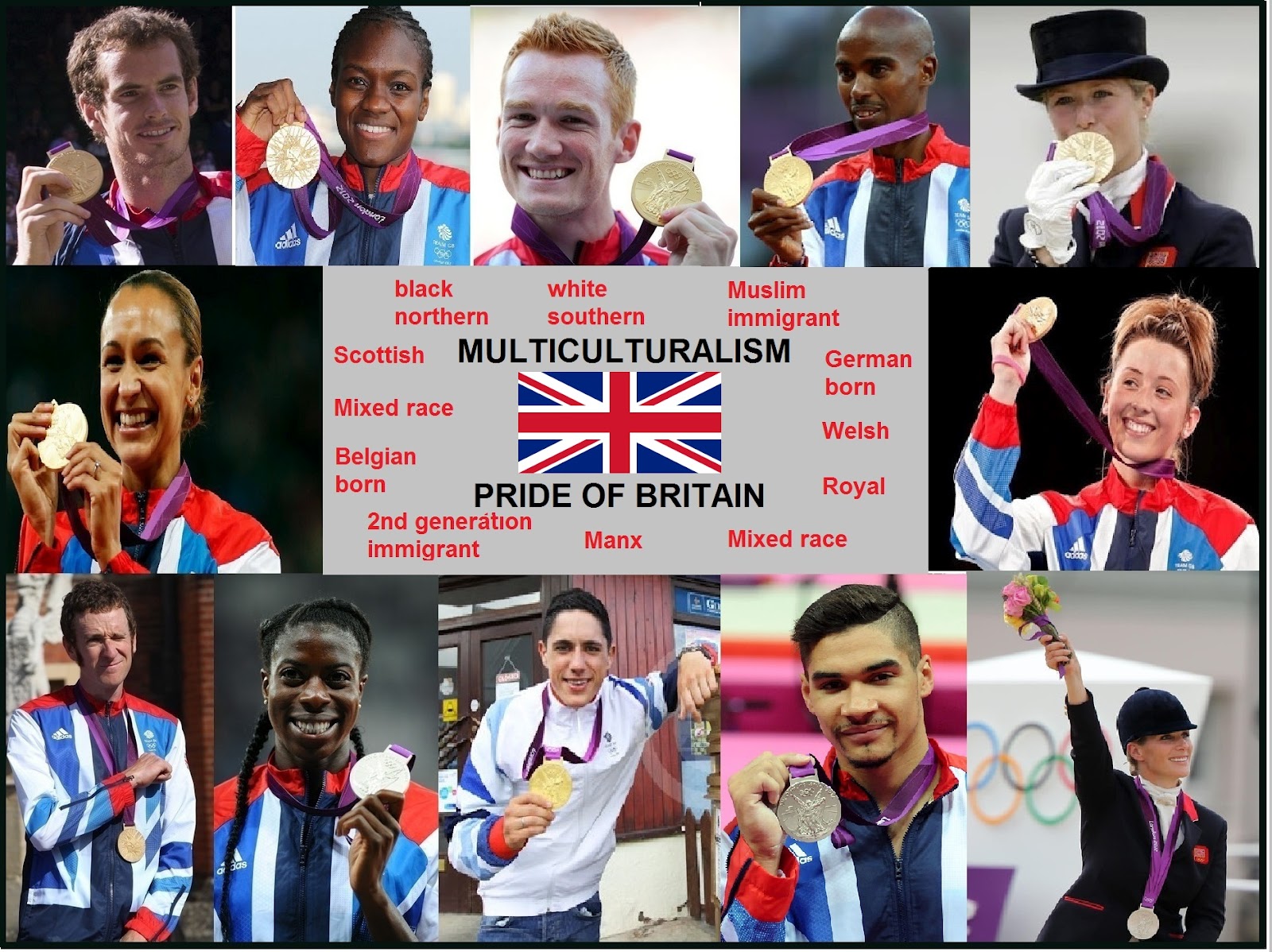
Shortly before her death, Tony Blair, the Prime Minister of Britain, had led his Labour Party to a resounding victory and been nominated Prime Minister. Mr Blair’s campaign team had recognised the change in the British public, and revamped the labour Party as New Labour to respond efficiently to the expectations of a changed, socially mobile, heterogeneous and ethnically diverse Britain in which fish and chips as the national dish had been, in effect, replaced by Chicken Tikka Masala, a side effect of post-war immigration from South Asia.

The “quavering intuitions of the heart” were based on feeling and touching, and the British were said to have evolved into a touchy-feely people, a term that is now a standard way of describing this trait as opposed to the stiff upper lip.

Therefore no study of this change, and the degree to it which has endured, can succeed without taking into account the way the British public expressed their grief at Diana’s death, and what Tony Blair promised them.

Lady Di’s Death Revealed Unchanged Passions: Part 1— Myth and Reality — the Stiff Upper Lip

The reaction to the death of Diana, Princess of Wales … was meant to mark a profound shift in the history of British sentiment as it moved from the stiffness of upper lips to the quavering intuitions of the heart.” Hywel Williams.

Part 1— Myth and Reality — the Stiff Upper Lip

http://lowres.cartoonstock.com/sport-british-british_stereotype-stiff_upper_lip-grumble-grumbler-pbtn121_low.jpg

Reserved, stiffening the upper lip, being strait-laced and sexually repressed, with tongue-in-cheek, understated humour is how the British stereotype is still described. It is a commonly held belief that as a child, Queen Victoria was encouraged to keep her chin up and maintain a stiff upper lip by a prickly sprig of holly placed under her collar.

Faced with misfortune or adversity, the upper lip tends to quaver, and stiffening it is an external sign of inner resolve. Emotion perceived by an audience deemed inferior democratises the relationship between superior and inferior, an undesirable change for the continuity of aristocracy. The class society of Britain relied on distance and exclusivity for its perpetuation. Entrants from the middle or lower middle classes into the colonial services maintained this trait in their relations with native peoples they considered their inferiors just as in the hierarchy of the aristocracy in Britain these colonial officers, by birth, were near the lower rung of the social ladder. As Queen Victoria grew up, and eventually became Queen-Empress of the British Empire, maintaining a stiff upper lip in the face of adversity assumed the proportions of a national virtue common to all classes in Britain. It enlarged its scope from facing adversity with dignity to suppressing emotion, and at all costs, avoiding its tactile expression.

http://d1mpb3f4gq7nrb.cloudfront.net/img/toons/cartoon3210.png

The heart might quaver, but the upper lip would not betray it. Intuition, something that the science of the second half of the nineteenth century was incapable of explaining, was not taken into consideration. It was only after the twentieth century was well into its way that writers such as E.M. Forster were able to deal with this subject by comparing the intuitive and emotive approach of the Italians with the tight-corseted attitude characteristic of British females.

Lady Di’s tragic death laid Killjoy Kromwell’s legacy to rest


http://2.bp.blogspot.com/txuQAmfzpf4/UkYB5ALKEXI/AAAAAAAANS8/JMuwpyJ_SJI/s1600/Lady+Diana+www.fashionmaza.com+(3).jpghttp://media-cache-ec0.pinimg.com/736x/d5/f2/09/d5f2099259f1f6f12676c1ad7e3569aa.jpg

The Princess of Hearts’ untimely death paid put to Killjoy Kromwell’s sexually repressed revival during the Victorian and Edwardian eras which continued to taint this nation of witty, fun living, garrulous warriors redeemed by John Cleese’s pointed satire.


http://hoocher.com/Oliver_Cromwell/Oliver_Cromwell_Two.jpghttp://3.bp.blogspot.com/mzJWPtj2HuY/Tmx8v2Pl4sI/AAAAAAAABIg/bTUIJBozYYk/s1600/civil2.jpg

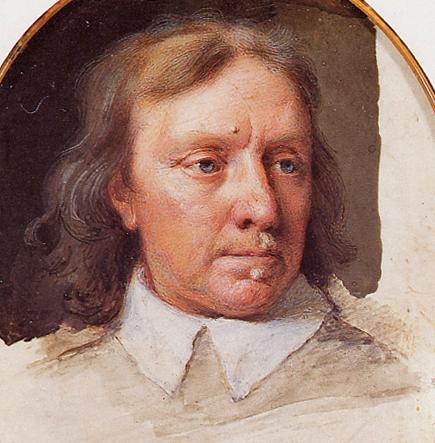
Kromwell, the long-haired leader of a gang of self-righteous skinheads who ruled Britain from 1653 to 1658, sucked the life force out of British veins.

https://sherhaps.files.wordpress.com/2011/05/friar-tuck_1947116.jpg

Friar Tuck was before that time: “This is grain, which any fool can eat, but for which the Lord intended a more divine means of consumption. Let us give praise to our maker and glory to his bounty by learning about… BEER!” — Prince of Thieves.

http://bloggingshakespeare.com/wp-content/uploads/2012/01/falstaff.jpg

Falstaff came later: “I’ll be no longer guilty of this sin; this sanguine coward, this bed-presser, this horseback-breaker, this huge hill of flesh,—” King Henry IV, Part 1.

Friar Tuck and Falstaff are icons of raunchy merriment. As for the rest of their compatriots, they wish each other merriment even at the solemn occasion of Christ’s birthday.

The upbeat friendliness in a British public house today is not a post-colonial development either. The Anglo-Saxons established ale-houses in village homes in the 5th Century, and in 965 there were so many of them that King Edgar had to limit them to one per village by royal decree.

http://www.jamesmaherphotography.com/images/0000/0861/McSorleys_old_ale_house_east_village.jpg

 Kromwell rode the tide of a joyless people power, helped by Charles I’s ineptitude for which he gallantly lost his head even though there wasn’t much in it to lose.

https://piratedocuments.com/Images/People/behead-king-charles300w-.jpg

So Killjoy Kromwell became Lord Protector and to ensure pure souls leading a good — as opposed to the good — life he closed down theatres, had boys whipped for playing football on Sundays, imprisoned people for swearing and turned Sunday into a farce. One day in every month became a compulsory fast day.

This political correctness became known as Puritanism and sensual pleasure evidence of sinning.

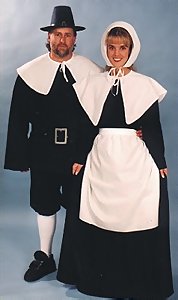
A feminist at heart, Kromwell ensured that women remained safe from men’s impure lust. As such, his skinheads scrubbed makeup off the faces of those women of low intelligence who thought it made them more attractive. Colorful dresses were forbidden, long black dresses, white aprons and hair hidden under a white head-dress were preferred. Their menfolk too, were in Black.

http://www.costumesofnashua.com/CNWebSite105/Active905/Pictures/PicPilgrim/piligrim18070.jpg

Christmas celebrations were banned — no decorative holly and the smell of a goose could get the household into serious trouble.

And goodness gracious me — there was no question of leading by example: Kromwell had long hair, drank, ate well and entertained lavishly.

The year he died, Charles II was asked to become King, and did the Brits then let their hair down and party! It lasted until buxom Queen Victoria of the tight round cheeks resurrected Kromwellian fundamentals which held the Brits in the colonies in good stead. But even then, we’re only talking of the governing class.

http://i.dailymail.co.uk/i/pix/2011/03/26/article-1370210-0B513ADC000005DC-521_468x501.jpg

When the working classes weren’t getting scurvy, fighting venereal disease, singing ditties, pirating other people’s ships, looting their national treasures or in the stocks for drunkenness, they were throwing around winks and having a laugh. So this Victorian business wasn’t really true of most Brits — just the governing class.

http://www.chethams.org.uk/treasures/image_hogarth_beer_larger.jpg

The British even ate well, though badly. Still do — well and badly, that is. In fact better, actually, thanks to decried immigration and health concerns. Although the whiff of a curry in the colonies sent them running out into the afternoon sun with mad dogs, they lapped up their fiery vindaloos in restaurants started by immigrants they preferred in their place.

http://i.dailymail.co.uk/i/pix/2014/03/21/article-2585820-1C7398DF00000578-188_634x620.jpg

All this richness went unnoticed until Lady Diana’s fatal accident, when journalists and sociologists brought the ‘new touchy feely Britain’ into public focus. This Britain was actually as old as Britain itself but overshadowed by two stuffy periods. Lady Di released this perception trapped unchallenged in Kromwellian and Victorian stuffiness, since that’s what suited everybody, John Cleese notwithstanding. They even chose a Jimmy and a Tony for Prime Minister whose Christian names were un-Christian nicknames carried by at least half a dozen wide boys in Soho over five generations whose conversations are peppered with ‘rollies’ and ‘mercs’, mate!

Naah! The British hug, kiss muah muah, speak Estuary, use first names, dress down and their national dish is Chicken Tikkar Masalar.

The Gently Placed Hot Potato on Washington’s Derriere: radical policy shift?


Stratfor writes that the UAE Cabinet has classed 83 organizations as terrorist. The United States’ Council on American Islamic Relations (CAIR) and the Muslim American Society (MAS) are included in this effort to contain the Muslim Brotherhood’s growing influence that threatens the status quo in the Gulf States and Saudi Arabia.

They fear the politically correct semantics of the Brotherhood more than the drawn guns of the Al Qaeda affiliates. These semantics legitimize the Brotherhood in Western circles, allow it freedom of movement and ensure expanding affiliate support.

The UAE Cabinet’s announcement, while implicitly criticizing the United States for tolerating the CAIR and the MAS, also seeks to empower the lobby waiting to crack down on these two organizations. One may wonder if the same lobby might have requested the UAE to act on their behalf galvanized by Islamic scholar Adnan Oktar’s warning in his November 11 A9TV interview.

He predicted that ISIS and the Muslim Brotherhood will eventually merge since the Brotherhood is “at the root” of ISIS.

And if Adnan Oktar himself was also encouraged by the same lobby, this would indicate a radical shift in American policy.

In the process, the UAE Cabinet has gently placed a hot potato on the US Administration’s derriere. It will now have to wiggle between conciliating its affluent Muslim voters and its allies.

Azam Gill

Read the Stratfor report… “<a href=”http://www.stratfor.com/geopolitical-diary/uae-and-saudi-war-muslim-brotherhood-could-be-trouble-us”>The UAE and Saudi War on the Muslim Brotherhood Could Be Trouble for the U.S.</a> is republished with permission of Stratfor.”

The UAE and Saudi War on the Muslim Brotherhood Could Be Trouble for the U.S.

Monday, November 17, 2014 – 18:58 Text Size

The UAE Cabinet approved a list of 83 designated terrorist organizations on Saturday, including al Qaeda and the Islamic State. Much more significant, though, was the inclusion of many Muslim organizations based in the West that are believed to be allied with the Muslim Brotherhood movement. Prominent among them are two American Muslim groups: the Council on American Islamic Relations and the Muslim American Society.

The decision to put two mainstream U.S. Muslim groups on its list of terrorist organizations is part of an initiative, together with the Saudis, to undermine the Islamist movement known as the Muslim Brotherhood. The move is unlikely to succeed, but it could cause problems between the U.S. government and the American Muslim community.

Ever since the Muslim Brotherhood’s rise in the aftermath of the 2011 Arab Spring, the United Arab Emirates and Saudi Arabia have felt deeply threatened by the Islamist movement. Both countries supported the July 2013 coup that toppled the Brotherhood-led government of Mohammed Morsi in Egypt. They continue to use their financial might to prop up the government of former military chief President Abdel Fattah al-Sisi. In addition, they are trying to make sure that the Brotherhood in the region is generally weakened, or even decimated.

What is a Geopolitical Diary?George Friedman Explains.

From their perspective, the Islamism of the Muslim Brotherhood is a far greater threat to the monarchies than even the jihadism of al Qaeda and the Islamic State. Given the armed insurrectionist approach of the jihadists, the Saudis and Emiratis can crack down on them using coercive means more easily.

But for them, the Brotherhood is a much more insidious threat. Not only does it oppose violence as a means of achieving its political goals, but it also seeks democracy. Therefore, the Brotherhood is not just difficult to counter; it promotes a political system that is a threat to the monarchical systems of Saudi Arabia and the United Arab Emirates.

What is worse for the Gulf Arabs is that the Brotherhood is seen as a legitimate political force in the West. Earlier this year, the Saudis and Emiratis pressured the British government to crack down on British Muslim groups that were part of the global Brotherhood network. London launched an inquiry into the movement within its borders, resulting in an unpublished report that cleared the Brotherhood of links to terrorism.

Frustrated, the Gulf Arabs are pursuing a different tack. By declaring the Council on American Islamic Relations (CAIR) and the Muslim American Society (MAS) as terrorist organizations, they are trying to exploit a fault line within the United States. There is a sizable lobby within the U.S. government that is interested in cracking down on those and other Muslim groups. The Emiratis and Saudis hope the lobby will use the United Arab Emirates’ announcement to push in this direction.

While CAIR has for years operated as a nonprofit advocacy entity, in 2007 U.S. authorities named it an unindicted co-conspirator along with about 250 other groups and individuals in a case against the Holy Land Foundation charity. The charity was convicted of supporting Hamas, a designated terrorist organization in the United States, though no formal charges have been brought against CAIR. As a result, it will not take much for groups within the United States that are hostile to CAIR to use the UAE decision against the group.

The goal of the Emiratis and Saudis is to get U.S. authorities focused on CAIR and MAS so that they can use that to press Washington to take action against the Muslim Brotherhood. They are unlikely to get their wish given the lack of evidence that the Brotherhood is engaged in terrorism and given the U.S. focus on fighting jihadists — an effort that requires the Americans to work with moderate forces.

On the domestic front, however, CAIR and MAS could face legal issues. Large numbers of American Muslims support the groups, especially CAIR. Putting them under closer scrutiny could upset American Muslims — exactly the outcome that the Islamic State and al Qaeda want.

Read more: The UAE and Saudi War on the Muslim Brotherhood Could Be Trouble for the U.S. | Stratfor
Follow us: @stratfor on Twitter | Stratfor on Facebook

Pakistan’s Muslim Clergy condemns mob killings of Christians: Pakistan’s blasphemy laws explained.

Asma Jehangir, champion of human rights in Pakistan and an Officer of France’s Order of the Légion d’Honneur, has hailed the long-awaited participation of the Muslim clergy in condemning the misuse of Pakistan’s Blasphemy laws. Since the 1980s, minority communities, mainly Christians, have been suffering under the misappropriation of this law. Passed under Zi-ul-Haq’s dictatorship, these laws boil up simmering passions within people which only the clergy can redirect. Only a hearts and minds campaign will alleviate this suffering, and the Muslim clergy have the power and competence to institute this change.

Condemnation of Christian couple’s killing by religious parties good omen: Asma.

Dawn, November 21, 2014

http://i.dawn.com/primary/2014/11/546f2486c548a.jpg?r=1558677647

LAHORE: Condemnations by Pakistan’s top clerics and religious parties against the misuse of blasphemy laws could help reverse a rising tide of mob killings, according to Asma Jahangir, Pakistan’s leading rights activists.

A Christian couple accused of desecrating the Holy Quran were beaten to death this month, by a mob of 1,500 and their bodies thrown in a furnace in a spate of lynchings in Pakistan.

A day later, a policeman hacked a man to death with an axe, who had been accused of blasphemy while he was in custody.

Read more: … http://www.dawn.com/news/1145980/condemnation-of-christian-couples-killing-by-religious-parties-good-omen-asma

What are Pakistan’s blasphemy laws?

BBC 6 November 2014

http://news.bbcimg.co.uk/media/images/78815000/jpg/_78815184_024624360-1.jpg

Pakistan’s blasphemy laws carry a potential death sentence for anyone who insults Islam. Critics say they have been used to persecute minority faiths and unfairly target minorities.

Read more: … http://www.bbc.com/news/world-south-asia-12621225

Four Huge Immigration Problems Obama Likely Won’t Fix Tonight

Foreign Policy, November 20, 201

BY JUSTINE DRENNAN, ELIAS GROLL , SIOBHÁN O’GRADY

President Barack Obama goes before the nation on Thursday night to lay out the executive orders he’s issuing to bypass Congress and massively overhaul the nation’s immigration laws. Through a combination of reforms, Obama’s plan is expected to keep up to 5 million undocumented immigrants with long-standing ties to the United States from being deported.

Republican lawmakers are apoplectic about the initiatives, which they say should be made through legislation rather than by White House fiat. “If he acts by executive diktat, President Obama will not be acting as a president, he will be acting as a monarch,” Sen. Ted Cruz, the Texas Republican, wrote in Politico. Administration officials say the president had no choice but to act because such legislation has been stalled in Congress for years.

Under Obama’s reforms, some 4 million undocumented immigrants who have lived in the United States for more than five years will be granted work permits and exempted from deportation. The president is also expected to raise the age limit on a program that allows children who came to the United States illegally as children to stay in the country.

Read More: … Four Huge Immigration Problems Obama Likely Won’t Fix Tonight

Beaujolais Nouveau

Sixty three years ago, France inverted the quality criterion of vintage wine by allowing Beujolais to be sold fresh and un-matured before  December 15th of the harvest year. The humble drink, released from its rustic confines near Lyons, unexpectedly found itself elevated to an international institution. Cash flow increased and small wine growers became millionaires.

http://www.letetard.com/wp-content/uploads/2014/10/Beaujolais_nouveau.jpg

This year the third Thursday of November falls on the 21st, when Beaujolais Nouveau may be opened with its ritual fanfare and riotous parties. Affluent Japanese in swimming pools, British and American students in grunge, Brazilian and Indonesian millionaires in their mansions and oil-rich Arabs on their yachts will be raising glasses and pontificating on the residual flavor of this year’s Beaujolais Nouveau.

http://i.telegraph.co.uk/multimedia/archive/02741/wineparty_2741745b.jpg

While some will be nibbling at elegant finger food, others will content themselves with crisps and peanuts. Some will be sick, others invigorated. Some drunken promises will be kept, others broken.

http://www.doyoueven.com/wp-content/uploads/2014/09/couple-flirting-while-drinking-wine.jpg

Such has become the power of this wine extracted from the simple Gamay grape. It used to be savored with pieds et paquets — trotters and stuffed tripe — at the market fairs north of Lyon in the Beaujolais region. In 1951, the wine produced in ten villages was allowed to be sold before December 15th under the label Beaujolais Nouveau. Later, 30 other villages were extended this privilege under the label Beaujolais-Village Nouveau.

http://www.winecountrytravel.com/France/images/beaujolais2.jpg

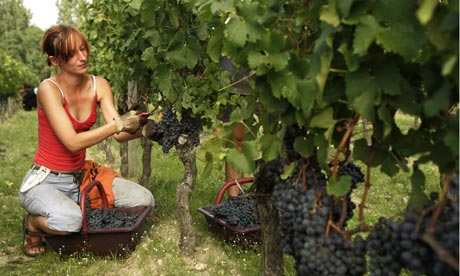
No other wine in the world can be sold under any of these labels. And in France, no wine other than primeur can be sold before December 15th of the harvest year. Considering the annual consumption of Beaujolais Nouveau, one may rightly wonder where such a large quantity is harvested and by whom!

But harvested it is, by hand,

http://static.guim.co.uk/sys-images/Guardian/Pix/pictures/2010/2/17/1266439813211/Harvester-Picking-Grapes-001.jpg

and consumed it is, with gusto.

https://encrypted-tbn0.gstatic.com/images?q=tbn:ANd9GcR2eoJBzAiwrgJt–qDMOHf4_JGFQ22y_W6oqEOOWjncWWKPwwPRw

Actually, this vin primeur trend now includes fifty-five other French Protected Designations of Origin that may be savored starting from late November. They have less tannin and thus more fruity residual flavor that allows connoisseurs to wax eloquent and expose their cultured selves. They also allow plain and simple folk the pleasure of enjoying a chilled, naturally fruity wine with their favourite home-made canapés.

http://t3.gstatic.com/images?q=tbn:ANd9GcTi3V22-IoTMsYdvcr9U3B8Idhkn3Xf7IwYInJLKw9XOFS7f1MpuziOKdwWvw

My favourite primeurs are Côtes du Rhone, Ardêche and Gaillac.


http://t1.gstatic.com/images?q=tbn:ANd9GcSFPwVEX0nsMO3IPGCA-G7WXeaUPue8pW6-726Qmw01GxLblUgwY92DPQcvwAhttp://maison1.advcdn.net/images/medias/000/010/000010868/600.jpghttp://www.danstontarn.fr/wp-content/uploads/2013/10/gaillac-primeur-2013.jpg

Do try these primeurs with a mild chicken korma accompanied by fluffy white basmati rice — oh yes, and don’t forget the handful of crudités on the side!

A votre santé et bon appétit mes amis!

India: The First Soft Power

The Durga Vahini women’s movement limited to two districts of India is part of that nation’s latest three-hundred year old Hindu revival. The Canadian filmmaker Nisha Pahuja’s quest to make a documentary on this movement finally ended in success. Writing for the BBC, she raises questions but expresses no alarm at this movement, based on pride and history — The World Before Her https://www.youtube.com/watch?v=umjDyRaikqQ  and http://www.bbc.com/news/world-asia-india-29798148).

The more one studies India’s history, the more it eludes one’s grasp, retreating constantly into the mists of time in a tantalizing dance. This mother lode of all that is Indo-European can stake its claim on the basis of holding the archives. Other components of and claimants to Indo-European roots only have oral history on their side, but India has the Vedas – sacred documents dated from between 1800BC to 3000BC, or even earlier.

https://encrypted-tbn3.gstatic.com/images?q=tbn:ANd9GcSxAz1NLs_qBa5A921-5AlCVrcODqjmgT8J7DNBg0mx5l0c4xGz

The total time span allotted to Indian history is so wide that were a subject called The Rise and Fall of Indian Civilization be introduced in academia, it would fall flat on its face. Indian civilization demands the plural, despite its continuing integral core. It expanded and receded several times, the components cohabiting comfortably with each other’s characteristics.

http://ptdeepali.files.wordpress.com/2012/12/lothal.jpg?w=640

 One of the most remarkable features of this civilization is its influence which stretched from Macedonia to the limits of East Asia without any evidence of hard power projection. India can bask in its status as a pioneer of Soft Power.

That finesse did not stop other civilizations from penetrating India’s refined screen to raid, loot and settle as minority rulers over much of its territory.


http://www.indohistory.com/images/medieval/mahmud_ghaznavi_conquests.jpghttp://static.guim.co.uk/sys-images/Guardian/Pix/pictures/2012/11/5/1352139688017/British-Empire-Throughout-008.jpg

The last ones to do so failed to integrate, were unable to settle and had to leave sixty seven years ago, leaving behind a free press and the cherished structure of parliamentary democracy.

The sheer force and prestige of Nehru’s personality dragged India through its period of socialism, but since its heyday there has been a turnaround. The most positive result of that is the continuing economic growth and progressing health and literacy rates despite the population increase since 1947.

Famine, rife under the Mughals and the British, has disappeared.

India is coming back into its own.

On the flip side, some Indians, basking in their new-found independence, seem to be taking the occasion to show that they are not softies. That they aren’t is an opinion buoyed by the reputation of the Indian Army for efficiency, not to speak of its millennia-old battle record. Militant groups and movements appear to be challenging world-wide extremist obediences in a race for each to prove that they’re the toughest on the block.

The Durga Vahini just might end up being one such movement, the female equivalent of the Bajrang Dal and part of the Vishva Hindu Parishad. The stated purpose is to involve more women in a Hindu revival through physical, mental and knowledge development in order to involve them in social services.

Considering India’s population of 1.252 billion, there are only about 8000 women involved in Durga Vahini. The movement is more local than national and, in general, most Indian Hindus have no hang-ups about settling scores with remnants of erstwhile minority rulers. Shouldn’t have any, in principle. Not after the last Hindu revival.

In the 18th century, the Marathas, by becoming the pre-eminent power in India effectively eclipsed the effete Mughals of that time, engendering a Hindu revitalization that continues to grow in most desirably impressive directions.

https://encrypted-tbn0.gstatic.com/images?q=tbn:ANd9GcQYG HElO7ENOkptBPbArAgYSCXv85vsuTaeZ7VjOWiApEmFFNRzw

It is confidently hoped that this balance will be maintained in a world where perceptions and soft power have superseded the old hard power, as obsolete as a nuclear weapon!

The world’s soft power pioneer is no doubt aware of this.

Many others are!

http://qz.com/271585/from-the-buddha-to-bollywood-to-bpos-a-brief-history-of-indias-soft-power/